


Not every warehouse pallet has the same underside structure. Some have low fork openings, unusual support blocks, reinforced bases, or nonstandard entry directions. These differences can prevent an AGV forklift from picking up a load even when the vehicle has sufficient rated capacity.
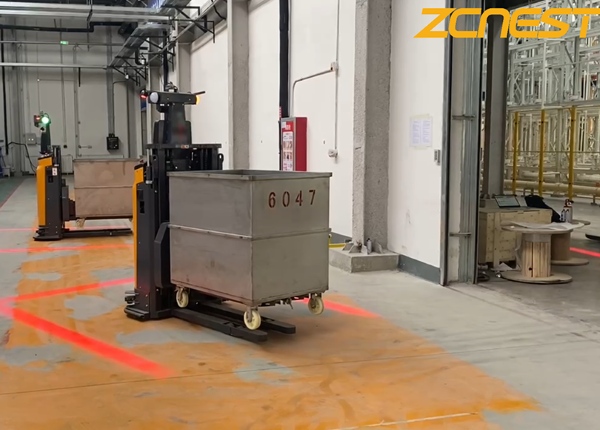
Many AGV forklift projects begin with a nominal pallet size and weight. However, the underside of the pallet is equally important. Fork entry clearance determines whether the vehicle can approach, insert its forks, lift the load, and withdraw without contacting the pallet structure.
When a warehouse uses several pallet suppliers or packaging formats, the actual bottom geometry may vary significantly. This can create an unexpected compatibility problem during commissioning if the project has only been designed around a standard pallet drawing.
A pallet's overall length and width do not describe its fork-entry characteristics. The project team should inspect the underside and record the geometry that affects fork access.
Important measurements include:
Height of the fork-entry opening.
Width and spacing of the openings.
Position and dimensions of bottom support blocks.
Thickness of the pallet deck and lower structure.
Available fork insertion depth.
Permitted entry directions.
Any damaged, reinforced, or protruding sections.
Measure representative pallets from each supplier and product category. Do not assume that pallets with the same nominal footprint have identical underside construction.
Fork thickness, width, spacing, and insertion depth must be compatible with the pallet. If the forks are too thick for the opening, they may contact the lower deck or support blocks. If the fork spacing is unsuitable, the load may not be supported in the intended way.
Engineering review should include:
Minimum vertical clearance required for fork insertion.
Fork width and spacing adjustment range.
Maximum insertion depth and pallet support position.
Ground clearance and fork approach height.
Compatibility with the AGV's lifting mechanism.
The supplier should verify the complete geometry rather than confirming compatibility based only on pallet footprint and rated load weight.
Even when the forks fit the pallet opening, pickup may fail if the pallet is not presented in a repeatable position. Pallets placed manually on the floor or at a transfer station may have small variations in alignment.
Determine how the AGV identifies the pallet position and corrects its approach. Depending on the application, the project may use mechanical guides, positioning references, or an appropriate vehicle positioning system.
Also check whether pallet overhang, damaged bottom boards, or uneven support surfaces affect the pickup operation. The design should be validated using pallets in the condition in which they will actually be used.
Successful fork insertion does not automatically mean that the load is safely supported. The pallet's support blocks and lower structure must be able to carry the load through lifting, travel, and placement.
Review the pallet's rated capacity, load distribution, condition, and center of gravity. Where a pallet is weakened or damaged, the warehouse should define whether it can enter the automated process or must be transferred using another approved method.
For high-bay applications, pallet support and fork engagement are particularly important because the vehicle may handle loads at elevated storage positions. The actual pallet and load combination should be included in engineering validation.
If standard forks cannot accommodate the warehouse's pallet range, the supplier may need to evaluate a customized fork arrangement or another mechanical handling interface.
Possible design considerations include:
Different fork thickness or width.
Adjustable fork spacing.
Specialized fork profiles.
Custom support structures at transfer stations.
Separate handling configurations for different pallet types.
Any modification must be checked against vehicle capacity, load center, structural strength, lifting performance, and safety requirements. A custom fork should not be treated as a simple dimensional adjustment without engineering validation.
Key Procurement Checkpoint
Send the AGV supplier underside photographs, dimensioned drawings, and physical samples of every pallet type. Request pickup and drop-off tests using the actual loaded pallets before confirming the vehicle configuration.
A warehouse with multiple pallet types should maintain a compatibility list for automated handling. Each pallet type should be tested against the proposed fork arrangement and operating conditions.
Include the following checks:
Approach and fork insertion.
Full lifting and load support.
Travel with the representative load.
Placement at the intended station or rack interface.
Fork withdrawal without contacting the pallet.
Repeatability across different pallet samples.
Record the tested pallet dimensions, load weight, and accepted configuration. If a new pallet type is introduced later, it should be evaluated before being released into the automated warehouse process.
Pallet bottom clearance is a critical selection factor for AGV forklifts. Fork entry geometry, pallet support structure, positioning tolerance, and loaded stability all influence handling reliability. Evaluating real pallet samples before procurement can prevent costly configuration changes after installation.
Provide your pallet drawings, bottom clearance, load weight, and warehouse handling requirements. ZCNest can evaluate fork configurations and customized AGV forklift solutions.












 Chinese
 English





