


Large machine components are not always suitable for standard pallet handling. Their irregular shapes, uneven weight distribution, and nonstandard support points can make automated transport difficult. Selecting an AGV forklift for these loads requires a detailed assessment of the component and its handling fixture.
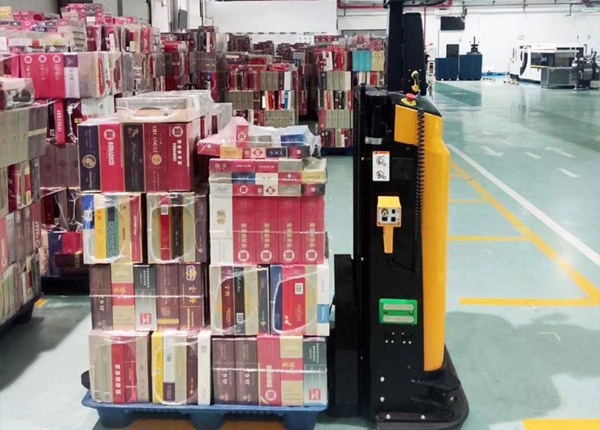
Industrial warehouses may store machine housings, cast components, fabricated assemblies, large tooling parts, and other oversized items. Some loads are placed on custom bases, while others require dedicated support frames before they can be transported.
Traditional forklift operators can make visual adjustments during pickup. An AGV forklift needs a repeatable mechanical interface and a verified movement path. For irregular loads, the engineering work should begin with the component's geometry and center of gravity rather than a standard pallet specification.
Maximum weight alone is not enough to determine whether an AGV can safely handle an oversized component. The load may be much wider or longer than its support base, and its center of gravity may not be located at the geometric center.
Prepare a load specification that includes:
Overall length, width, and height.
Total weight and weight distribution.
Center-of-gravity position, where known.
Permitted support and lifting points.
Surface areas that must not be contacted.
Required transport orientation.
Any removable or movable components.
For unusual components, use engineering drawings or a three-dimensional model where available. Photographs alone may not provide enough information to determine the correct support arrangement.
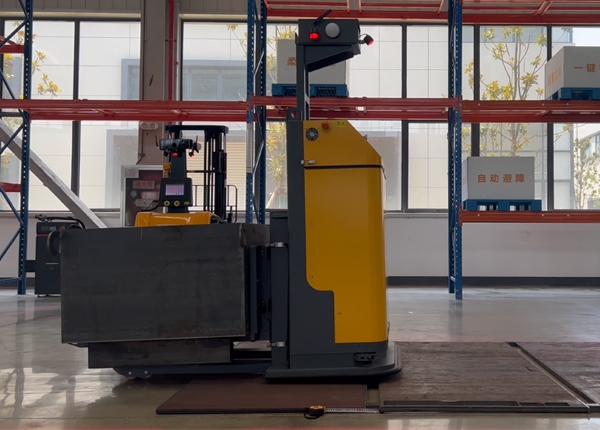
An irregular component may need a custom support fixture to create a repeatable interface with the AGV forklift. The fixture can provide defined fork-entry points and help maintain the required orientation during transport.
Depending on the component, the design may include:
Custom steel support frames.
Positioning blocks or locating features.
Dedicated fork pockets.
Protective contact surfaces.
Mechanical restraints where required.
The fixture must be designed for the actual load, including its center of gravity and support reactions. Its own weight and dimensions must also be included in the AGV capacity calculation.
Forklift rated capacity is generally specified under defined load-center conditions. When a component is oversized or its center of gravity is offset, the effective load center may differ from the standard configuration.
The supplier should evaluate the complete combination of vehicle, attachment, fixture, and payload. Confirm the permitted load center, lifting height, load moment, and operating conditions.
Do not assume that a vehicle rated for a particular weight can automatically handle a component of the same weight with a longer or more uneven load distribution. The final configuration requires engineering confirmation.
Irregular machine parts can occupy more space than a standard pallet. Their widest points may extend beyond the vehicle body or support fixture, affecting turning clearance and aisle access.
Route evaluation should consider:
Maximum overall load width and length.
Turning radius with the actual payload.
Clearance around racks, columns, and doors.
Available space at pickup and drop-off points.
Floor joints, slopes, and other surface transitions.
Visibility and detection of the load's outer profile.
For narrow-aisle warehouses, the loaded vehicle envelope must be evaluated carefully. A route that is suitable for an unloaded AGV may not be suitable when the vehicle carries a large component.
Custom components often have specific support locations. The AGV must approach the load in the correct direction and align its forks or fixture with the intended engagement points.
Define how the load is presented at the pickup location. Mechanical locating features can reduce positioning variation and make repeated handling more predictable.
At the destination, confirm the support surface is suitable and that the AGV can withdraw without contacting the component or surrounding equipment. If the component must be placed at a precise orientation, this requirement should be included in the station design and acceptance criteria.
Some machine components have machined surfaces, exposed connection points, or other areas that must not be damaged during transport. The support fixture should protect these areas and prevent unwanted contact.
Consider whether the load requires protective pads, defined restraint points, a restricted travel speed, or a specific transport orientation. These requirements should be documented and validated with the customer's engineering team.
For particularly unusual loads, a full-scale prototype fixture or representative handling test may be necessary before final vehicle configuration.
Key Procurement Checkpoint
Provide the supplier with component drawings, total weight, center-of-gravity information, support-point details, and the complete transport route. Request an engineering review and physical test using the proposed fixture and representative payload.
Acceptance testing should use the actual component or a representative load with equivalent dimensions and weight distribution.
Verify:
Correct fork or fixture engagement.
Stable lifting and travel under approved conditions.
Clearance along the complete route.
Accurate placement at the destination.
No unacceptable contact with protected surfaces.
Repeatable handling across multiple test cycles.
The accepted load configuration should be documented. If the component dimensions, fixture, or weight distribution changes, the handling configuration may need to be reviewed again.
AGV forklift automation for oversized machine parts requires application-specific engineering. Load geometry, center of gravity, custom fixtures, vehicle capacity, and route clearance must be evaluated together. A properly designed handling interface makes it possible to automate transport even when components do not fit standard pallet dimensions.
Send us your component drawings, load weight, center-of-gravity details, and warehouse layout. ZCNest can evaluate customized AGV forklift configurations and handling fixtures.












 Chinese
 English





