
 Chinese
 English

Before importing an automated guided vehicle (AGV) system into the United States, warehouse operators must answer a pivotal question. Many overseas equipment suppliers thoroughly understand robotics, software dispatching, and navigation mechanics, but possess a very limited grasp of US workplace liability laws, OSHA compliance expectations, and Western industrial safety cultures.
The core question for operations teams is not: “Can this vehicle safely transport a pallet?” It is: “Can this vehicle operate safely within a strict US legal and regulatory environment?”
In American logistics environments, safety compliance is aggressively scrutinized. Post-incident investigations by regulatory bodies are rigorous, documentation trails carry immense weight, and worker safety training standards are legally mandated. An undocumented safety program can void insurance coverage or trigger substantial compliance penalties.
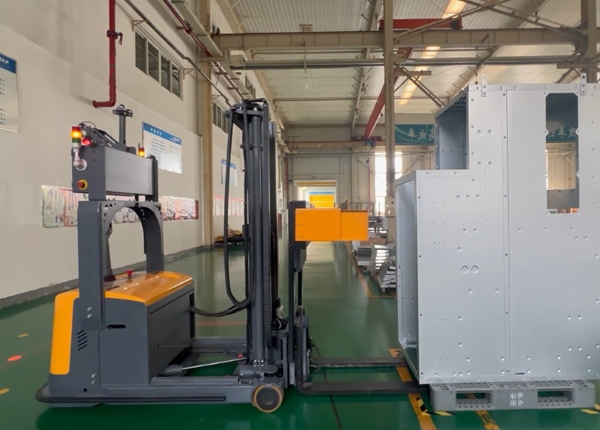
1. Safety Scanner Zoning: Calculating Minimum Stopping Distance
Laser safety scanners form the primary protective shield of an autonomous industrial vehicle. These sensors must be precisely programmed to trigger multi-tiered protective fields. Crucially, safe distance thresholds are never fixed values; they must adapt to specific local warehouse conditions.
Green / Alert Zone (Detects distant objects, flashes situational lighting)
↓
Yellow / Slowdown Zone (Registers closer obstacles, drops vehicle velocity)
↓
Red / E-Stop Zone (Breaks safety PLC circuits, engages mechanical brakes instantly)
These field boundaries are dynamically computed based on maximum vehicle velocities, maximum payload masses, localized floor traction coefficients, hardware reaction times, and safety PLC loop response latency. Missing an onsite calibration window can cause hazardous slide pasts or constant nuisance stops that kill facility throughput.
2. Mandatory US Audible and Visual Safety Indicators
US industrial environments rely on clear, immediate, and redundant sensory warnings to protect personnel operating near heavy automation. In high-velocity fulfillment hubs or loud, noisy distribution centers, warning equipment must remain highly visible and unmistakable.
| Indicator Type | Standard Deployment Metric | Operational Objective |
|---|---|---|
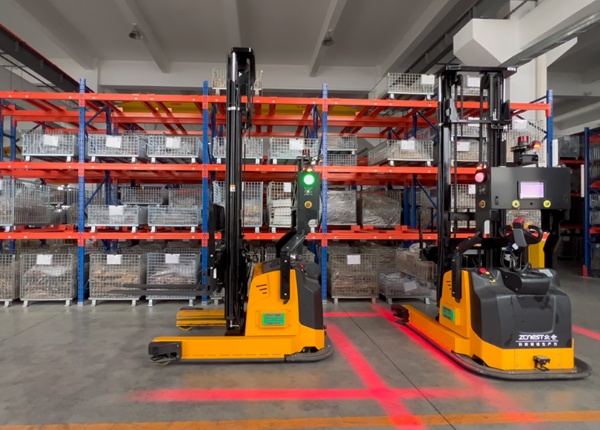
| Blue Spot / Safety Lights | Projected 10–15 feet ahead of or behind a moving vehicle onto the warehouse floor surfaces. | Gives blind-corner notice to workers and manual forklift drivers well before an AGV enters an intersection. |
| Audible Motion Alarms | Decibel-adjustable buzzers, speech alerts, or distinctive tone sequences active during travel. | Provides continuous presence awareness in loud zones, specifically changing tones when a vehicle reverses. |
| High-Visibility Status Beacons | 360-degree flashing or strobe LED towers mounted to the highest point of the vehicle chassis. | Indicates real-time operating states (e.g., normal travel, slow-downs, active system faults, or battery charging). |
📋 Importer Sourcing Check: Always confirm with your equipment supplier that the human-machine interface (HMI) screen, error message lists, and on-board diagnostic warnings provide full English or multilingual localization so your facility technicians can safely clear faults.
3. The Requirement for Formal Safety Risk Assessments
A high-end, mature AGV manufacturer does not just provide physical equipment; they deliver a comprehensive engineering documentation package. Corporate insurers and liability underwriters increasingly demand a formal, site-specific safety risk assessment prior to policy activation.
Key Elements of a Valid Risk Assessment Package:
Hazard Identification Logs: Documented analysis of all potential human-machine contact scenarios across complex workflows.
Stopping Distance Validations: Empirical engineering tables proving that the vehicle's safety scanners match its physical braking capabilities under maximum load.
Zoned Traffic Infrastructure Plans: Clear blueprints delineating AGV-only pathways, shared lanes, pedestrian crosswalk boundaries, and tight blind-spot intersection strategies.
⚠️ The Human Element Challenge: The primary safety risk during initial deployment windows is rarely a hardware failure. It is human unpredictability. Workers often intentionally test safety sensors, walk directly into active paths, misjudge stopping margins, or assume the robot will always avoid them.
4. Cultivating a Predictable Workplace Safety Culture
Long-term automation success relies on building predictable human behaviors around your robotic fleet. A robust workplace training program must be rigorously documented to establish an active safety culture and ensure OSHA readiness.
Initial employee safety training frameworks should cover basic vehicle navigation characteristics, clear rules against stepping inside active safety zones, proper use of physical emergency-stop (E-stop) buttons, and absolute prohibitions against manual load tampering or unauthorized machine riding. Documented training records and repeat evaluations are vital tools for shielding your business from liability gaps.
Audit Your Compliance and Safety Strategy
Ensuring compliance inside a US industrial facility requires blending robust safety hardware with disciplined operational processes. Share your unique facility profile with our compliance specialists to design a customized deployment plan:
Outline your facility compliance parameters: