


A warehouse rarely uses only one type of pallet or load carrier. Plastic pallets, wooden pallets, metal wire mesh bins and corrugated plastic crates may all exist in the same facility. This creates an important question when evaluating a Chinese AMR forklift: can one autonomous forklift safely handle different load materials without sacrificing stability, detection accuracy or operating speed?
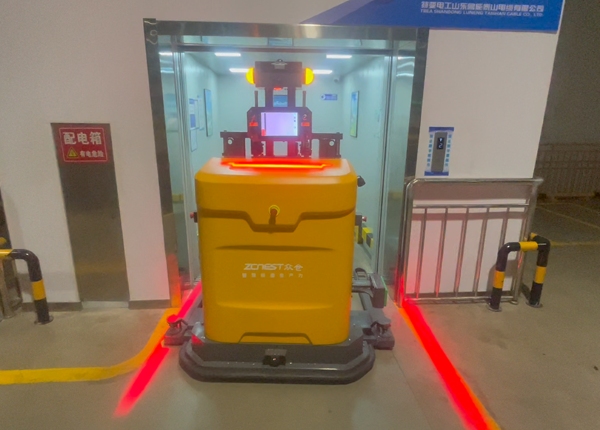
The short answer is that pallet material alone does not determine compatibility. A better engineering approach is to evaluate the complete load-handling profile, including pallet geometry, fork-entry dimensions, load weight, center of gravity, surface characteristics, load stability and the sensors used by the AMR forklift.
When a supplier says that an autonomous forklift can handle wooden, plastic and metal pallets, that statement is useful but incomplete. The robot does not actually “understand” the material in the same way a human operator does. It interacts with the physical geometry and behavior of the load.
Important factors include pallet length and width, fork openings, fork-entry height, pallet bottom structure, total load weight, load center, surface friction, load overhang and the rigidity of the transported goods.
For this reason, an AMR forklift that performs well with one plastic pallet does not automatically have identical performance with every plastic pallet used in the warehouse.
Yes, a properly configured AMR forklift can be designed to handle plastic pallets, but the supplier should validate the actual pallet and load rather than relying only on a general compatibility statement.
Some plastic pallets have relatively smooth surfaces and different bottom structures from traditional wooden pallets. The key issue is not simply whether the pallet is “slippery.” The robot must achieve sufficient fork engagement while keeping the load stable during lifting, acceleration, braking and turning.
For heavy loads, the supplier should evaluate the complete operating profile. A load that is stable while the robot is traveling in a straight line may behave differently during a sharp turn or rapid deceleration.
In a serious acceptance test, I would not ask only whether the AMR forklift can lift the plastic pallet. I would test the actual pallet at the maximum intended load, including pickup, lifting, straight-line travel, turning, stopping and placement.
Black plastic is a good example of why sensor selection matters. Different sensing technologies can behave differently when detecting dark, reflective, transparent or irregular surfaces.
An AMR forklift may use technologies such as LiDAR, 3D LiDAR, cameras, depth sensors or photoelectric sensors. Their performance should therefore be evaluated based on the actual sensing system rather than assuming that every “optical sensor” behaves the same way.
A black corrugated plastic crate should be tested under realistic warehouse conditions. This includes the actual lighting environment, rack structure, floor surface, travel speed and background behind the crate.
This is particularly important when the crate is stored in a dark rack location or positioned against a visually complex background. A supplier demonstration using a brightly colored test object in an open showroom does not prove that the system will perform identically in the warehouse.
My recommendation is simple: send the supplier photographs and physical samples of unusual load carriers before finalizing the AMR configuration. If the black crate is operationally important, include it in the factory acceptance test.
Metal wire mesh bins create a different engineering challenge. They may be heavy, rigid and relatively open in structure, while the load inside the bin can also shift its center of gravity.
For a standard fork-based AMR forklift, load stability does not normally depend on simply increasing “grip pressure.” Instead, stability is primarily achieved through correct fork engagement, load positioning, weight limits and controlled vehicle movement.
The control system can coordinate parameters such as acceleration, deceleration, travel speed, lifting speed and turning behavior. However, the correct values should be established through engineering validation rather than selected arbitrarily.
The supplier should also verify the load center. A metal bin carrying dense components may have a very different center of gravity from an empty bin or a bin filled with lightweight parts.
This is one reason why the phrase “2-ton capacity” should never be treated as the complete answer. Rated capacity is only one part of the load-handling calculation. Lift height, load center, fork engagement and operating conditions also matter.
Potentially, yes, depending on the AMR forklift's software architecture and which parameters the manufacturer exposes to authorized users.
A warehouse may want different movement profiles for different load types. A fragile wooden pallet, for example, may require a more conservative approach speed and fork-entry behavior than a robust metal container.
Depending on the system, configurable parameters may include:
Approach speed
Fork-entry speed
Lifting speed
Lowering speed
Acceleration
Deceleration
Turning speed
Maximum load weight
Load-specific operating rules
However, not every parameter should be available to every warehouse employee. Safety-critical and navigation parameters should normally be protected by role-based permissions.
| Load Type | Potential Challenge | What Should Be Validated? |
|---|---|---|
| Plastic Pallet | Smooth surface and different bottom structure | Fork engagement, load stability and braking behavior |
| Wooden Euro Pallet | Variable condition, damaged boards and fragile structures | Fork-entry accuracy and controlled movement |
| Metal Wire Mesh Bin | High weight and potentially variable center of gravity | Load center, capacity and travel stability |
| Black Plastic Crate | Sensor detection may vary with surface and environment | Actual sensor performance under warehouse conditions |
One of the biggest mistakes during automation procurement is telling the supplier only that the warehouse uses “standard pallets.” That description is usually not specific enough for engineering.
For each important pallet or load carrier, provide as much of the following information as possible:
Pallet or container dimensions
Empty pallet or container weight
Maximum loaded weight
Fork-entry dimensions
Load center
Load height
Load overhang
Photos from all relevant sides
Bottom structure of the pallet
Typical and maximum load conditions
Special handling requirements
If possible, provide engineering drawings and physical samples. For unusual loads, a physical test is much more valuable than a sales presentation.
The best approach is to turn pallet compatibility into a measurable acceptance requirement.
For each important load type, test the complete sequence:
Approach the load
Align with the fork-entry position
Insert the forks
Lift the load
Travel with the load
Accelerate and decelerate
Turn with the load
Place the load into the target position
Withdraw the forks
Repeat the cycle under representative operating conditions
For black plastic containers or other unusual materials, include the actual container in sensor and navigation tests. For heavy metal bins, test the maximum planned load and the expected load center. For fragile wooden pallets, test pallets representing the actual condition found in the warehouse rather than using a new pallet that is unlikely to reflect daily operations.
Instead of asking, “Can your AMR forklift handle different pallets?”, I would ask a much more specific question:
“Can you demonstrate our actual plastic pallet, wooden Euro pallet, black plastic crate and metal wire mesh bin under the intended load weights and operating conditions, and provide the handling parameters and acceptance criteria for each load type?”
That question changes the conversation from a generic product claim to an engineering discussion.
It also exposes an important difference between an AMR supplier that sells standard equipment and a supplier that understands warehouse automation projects. A serious supplier should be able to discuss load geometry, center of gravity, fork engagement, sensor performance, motion profiles and acceptance testing rather than simply saying that the forklift “supports all pallets.”
The material of the pallet is only the starting point. Reliable autonomous handling depends on the interaction between the load, the forks, the sensors, the navigation system and the motion-control strategy.
For overseas buyers importing Chinese AMR forklifts, the safest approach is therefore to define compatibility using actual load profiles instead of material names. Plastic, wood and metal are not sufficient specifications by themselves.
If your warehouse uses several non-standard pallets or containers, make those load carriers part of the technical specification, factory testing and site acceptance testing. This gives both sides a clear definition of what the autonomous forklift is expected to handle—and prevents a common problem in automation projects: discovering after installation that a “compatible” load was never actually tested.
FREE ENGINEERING SUPPORT Stop Gambling on Generic Platforms. Get an AGV/AMR Tailored to Your Warehouse.Buying automated guided vehicles involves complex safety standards (CE/ANSI), navigation setups (Laser SLAM), and ERP system integration. Don't risk your factory safety with middle-men. ✓ 100% Direct Factory: Customized payload up to 5 Tons. ✓ Free CAD Simulation: Send us your layout, and our engineers will simulate the optimal AGV routes. ✓ Global Support: Overseas installation guidance & local maintenance partners. |





 Chinese
 English