

One of the biggest concerns when introducing autonomous forklifts into an existing warehouse is not the robot itself. It is the people who already operate the warehouse.
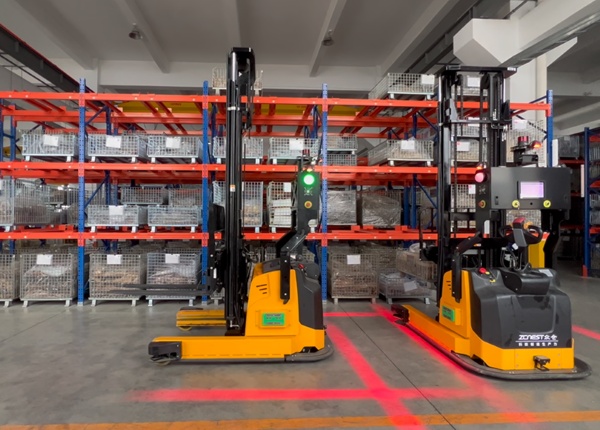
A company may already have experienced forklift operators and material handlers who understand the facility, pallet flow, storage locations, loading areas, and daily operating problems. When Chinese AGVs are introduced, the goal should not necessarily be to replace all of that experience. In many projects, the more practical approach is to retrain existing employees so they can supervise, monitor, and support the automated fleet.
The job changes from physically driving a forklift to managing an automated material-handling process.
In many warehouses, existing material handlers already possess knowledge that is difficult to replace with software. They know how pallets are positioned, which aisles become congested, where damaged pallets appear, which staging areas are frequently occupied, and what happens during peak shipping periods.
Those employees can potentially transition into new roles such as:
AGV Operator.
AGV Fleet Supervisor.
Warehouse Automation Supervisor.
AGV Support Technician.
Fleet Control Room Operator.
The required training depends heavily on the employee's new responsibilities. A person who only monitors fleet status does not need the same training as a technician who changes navigation parameters or performs mechanical troubleshooting.
The most important training change is understanding that an autonomous forklift does not behave like a human-driven forklift.
A manual forklift operator makes continuous decisions based on visual observation, communication with other workers, and personal judgment. An AGV follows programmed traffic rules, navigation logic, safety zones, sensor inputs, and task instructions.
Before the automated fleet enters production, former forklift operators should understand concepts such as:
AGV operating and restricted zones.
Pedestrian crossing rules.
AGV right-of-way behavior.
Safe interaction between AGVs and manual forklifts.
Emergency-stop procedures.
Safe approach distances.
AGV sensor and detection zones.
Blocked-route procedures.
Manual recovery procedures.
Battery and charging safety.
Fault and alarm handling.
Safe pallet placement and pickup.
The objective is not to turn every employee into a robotics engineer. The objective is to ensure that employees understand how to work safely around autonomous vehicles and know when they should intervene and when they should not.
There is no universal training time because fleet software differs significantly between manufacturers. More importantly, the required training level depends on the employee's role.
A useful training structure is to divide employees into three levels.
| Training Level | Typical Responsibilities |
|---|---|
| Operator | Monitor AGV status, view tasks, acknowledge alarms, pause or resume approved operations. |
| Supervisor | Manage task priorities, investigate alarms, adjust approved delivery sequences, and coordinate daily fleet operations. |
| Technician | Perform deeper troubleshooting, diagnostics, maintenance, and approved system configuration. |
An operator may become comfortable with basic dashboard functions relatively quickly, while a technician responsible for troubleshooting and configuration requires substantially more training and hands-on practice.
For this reason, it is better to specify training outcomes rather than simply asking a Chinese supplier for “two days of training.”
The real question should be: What can our employees independently perform after the training is complete?
This depends on the software's permission model, but authorized warehouse supervisors should ideally be able to manage routine task sequencing without contacting the supplier every time a shipping priority changes.
For example, a supervisor may need to move an urgent outbound pallet ahead of several routine replenishment tasks.
Depending on the system, authorized users may be able to:
Change task priority.
Pause a task.
Resume a task.
Cancel a task.
Release a task.
Reorder approved tasks.
Assign or restrict vehicles.
Modify approved delivery sequences.
However, not every parameter should be available to every operator. Core navigation parameters, safety settings, fleet-control logic, and other sensitive configuration items should normally be protected through role-based permissions and controlled procedures.
This is why buyers should evaluate the software's user-permission system as part of the purchasing process.
A useful training program should combine classroom instruction, software practice, and hands-on warehouse scenarios.
For basic AGV operators, training can cover:
AGV system overview.
Basic safety principles.
Fleet dashboard navigation.
Vehicle status monitoring.
Task status monitoring.
Alarm acknowledgment.
Emergency-stop procedures.
Basic recovery procedures.
Charging procedures.
Escalation procedures.
Supervisors should receive additional training in:
Task queue management.
Priority management.
Traffic monitoring.
Temporary route restrictions.
Performance dashboard analysis.
Fault history analysis.
Battery monitoring.
Daily fleet optimization.
Technicians may require a deeper program covering diagnostics, sensors, communication systems, navigation mapping, mechanical components, battery systems, and controlled software configuration.
Many international AGV projects require training to be delivered remotely before the equipment arrives or during the commissioning process. Whether a particular Chinese manufacturer provides formal remote training or certification depends on the supplier.
Buyers should ask whether the supplier can provide:
Live online training sessions.
English-language training materials.
Recorded training videos.
Operator training manuals.
Supervisor training.
Maintenance training.
Remote troubleshooting sessions.
Operator or technician assessments.
Training certificates, where offered.
Refresher training after deployment.
For an overseas warehouse, English-language documentation is particularly important. A translated user interface alone does not guarantee that local employees can safely operate and troubleshoot the system.
Ideally, some training should begin before physical deployment.
Employees can learn the basic fleet interface, terminology, alarm categories, task concepts, and safety principles before the equipment reaches the warehouse. This reduces the amount of classroom training required during commissioning.
Once the AGVs are installed, the training should move into hands-on scenarios using the customer's actual warehouse layout.
For example, employees should practice what to do when:
An AGV stops in an aisle.
A manual pallet jack blocks a route.
An AGV reports a navigation fault.
A charging station becomes unavailable.
A pallet is incorrectly positioned.
A task needs to be reprioritized.
A warehouse area must temporarily be closed.
A vehicle requires manual recovery.
Training on these real scenarios is usually more valuable than spending the entire session clicking through software menus.
A training attendance sheet is not the same thing as competency.
For critical warehouse automation projects, it is useful to define practical competency requirements. An employee should be able to demonstrate the required tasks independently before being authorized to supervise the fleet.
For example, an operator may need to demonstrate that they can correctly identify an AGV alarm, determine whether the situation requires intervention, safely stop or isolate the affected operation, and escalate the issue according to the site procedure.
A supervisor may additionally need to demonstrate task reprioritization, traffic monitoring, performance analysis, and controlled recovery procedures.
Training requirements should be written into the commercial and technical agreement rather than left as an informal promise.
For an overseas AGV project, consider defining:
Number of employees to be trained.
Number of training sessions.
Training language.
Operator training scope.
Supervisor training scope.
Maintenance training scope.
Training materials.
Remote training availability.
On-site commissioning training.
Training assessment requirements.
Certification, if provided.
Refresher training requirements.
Post-deployment technical support.
This is particularly important when the warehouse expects to operate the AGV fleet for many years. Employees will change, supervisors will be promoted, and new operators will eventually join the team.
One of the biggest mistakes in AGV deployment is treating operator training as a short software demonstration.
The purpose of AGV training is not to teach an employee where to click. It is to change the employee's role from physically controlling a forklift to supervising an automated material-handling process.
Your existing warehouse staff already understand the physical operation of the facility. That knowledge can become a major advantage after automation if employees are given the right tools and responsibilities.
The most effective training programs therefore combine three areas: warehouse knowledge, AGV safety, and software operation.
For overseas buyers importing AGVs from China, there is another important consideration: local employees should not become permanently dependent on the supplier for routine operational decisions.
A good AGV deployment should leave the warehouse with a trained local team that can monitor the fleet, manage normal task changes, identify common faults, and safely escalate problems without waiting for a remote engineer in another time zone.
Before purchasing, ask the supplier one practical question: “After commissioning is complete, what can my own warehouse staff independently operate and troubleshoot without calling your support team?”
The answer will tell you much more about the long-term usability of the AGV system than the number of training hours included in the quotation.
FREE ENGINEERING SUPPORT Stop Gambling on Generic Platforms. Get an AGV/AMR Tailored to Your Warehouse.Buying automated guided vehicles involves complex safety standards (CE/ANSI), navigation setups (Laser SLAM), and ERP system integration. Don't risk your factory safety with middle-men. ✓ 100% Direct Factory: Customized payload up to 5 Tons. ✓ Free CAD Simulation: Send us your layout, and our engineers will simulate the optimal AGV routes. ✓ Global Support: Overseas installation guidance & local maintenance partners. |





 Chinese
 English