


A warehouse with one or two autonomous forklifts is relatively easy to manage. The engineering challenge becomes very different when five, ten, or fifty vehicles share the same aisles, intersections, staging areas, and charging zones.
One of the questions we frequently recommend asking a Chinese AGV supplier is not simply whether its fleet management software supports traffic control, but whether the warehouse engineering team can actually configure and modify complex traffic rules.
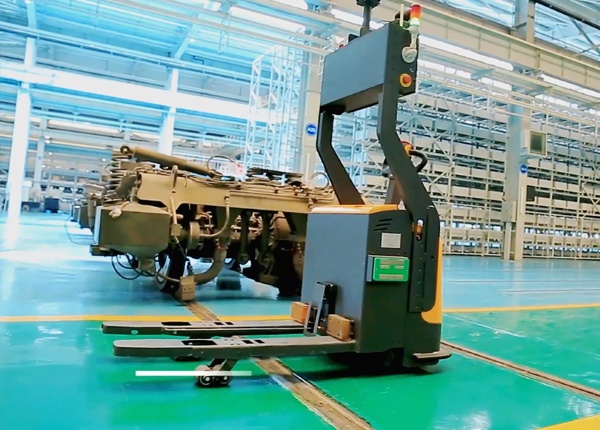
A practical AGV traffic management system should allow engineers to define right-of-way rules, control vehicle priorities, create restricted areas, manage temporary obstacles, and prevent multiple vehicles from creating a deadlock at the same intersection.
Yes, qualified AGV fleet management systems can be designed to manage complex intersections, but the important question is how much control the customer has over the traffic rules.
A typical warehouse may have several AGVs approaching the same junction from different directions. The system must determine which vehicle can enter the conflict area while preventing another vehicle from entering a path that could cause a collision or deadlock.
In a properly engineered system, the intersection is treated as a controlled traffic resource rather than simply an area on the digital map. The dispatch system can reserve the required route segment, allow the vehicle to pass, and release the resource after the vehicle clears the conflict area.
This approach becomes particularly important in high-density warehouses where several autonomous forklifts operate around receiving docks, rack aisles, staging areas, and outbound lanes.
For a serious warehouse automation project, customizable right-of-way rules are much more useful than a completely fixed traffic algorithm.
For example, a warehouse may decide that the main east-west aisle always has priority over vehicles entering from secondary aisles. Another facility may want outbound pallet movements to receive higher priority during the final two hours of a shipping shift.
Depending on the software architecture, traffic rules may be implemented through route priorities, intersection priorities, vehicle priorities, task priorities, restricted zones, or traffic-control nodes.
The important procurement question is therefore not simply “Does your software support right-of-way?” Ask the supplier to demonstrate exactly how a customer engineer creates, changes, tests, and removes a right-of-way rule.
Can the customer change intersection priorities?
Can different AGV types have different priorities?
Can urgent tasks temporarily override normal traffic rules?
Can restricted routes be configured without rebuilding the entire map?
Can traffic rules be tested before being released to production?
This is one of the most important tests for a multi-AGV system.
Imagine five autonomous forklifts arriving at the same hub from five different directions. If every vehicle simply follows the shortest available route, the system may create a situation in which several vehicles occupy mutually conflicting paths.
A more sophisticated traffic management strategy uses concepts such as path reservation, conflict detection, priority management, waiting zones, and deadlock prevention.
Before allowing an AGV to enter a critical intersection, the fleet manager can evaluate whether the required path segments are available. If another vehicle has already reserved a conflicting segment, the approaching AGV waits at a defined safe position rather than entering the intersection.
The objective is not simply to make every vehicle move immediately. In a busy warehouse, controlled waiting is often more efficient than allowing vehicles to enter an intersection and then blocking each other.
This is an important distinction when evaluating Chinese AGV software. A supplier should be able to demonstrate what happens when five or more vehicles simultaneously request access to the same traffic resource.
Temporary speed zones are extremely useful in warehouses where pedestrian activity changes throughout the day.
For example, an AGV may normally travel at its configured operating speed in a storage aisle but slow down when passing a breakroom, employee entrance, pedestrian crossing, or frequently used staging area.
Depending on the fleet management system, engineers may configure fixed speed zones, restricted areas, temporary no-go areas, or time-based traffic rules.
A useful system should also allow the engineering team to change these zones without manually rebuilding the entire navigation map.
For example, during a warehouse break period, a temporary rule could reduce the permitted vehicle speed around a pedestrian-heavy area. After the period ends, the normal traffic configuration can be restored.
However, speed-zone configuration should not be treated as a replacement for physical safety measures. Traffic software, onboard safety sensors, facility markings, pedestrian controls, and risk assessment should work together.
This is a normal warehouse event and should be tested before commissioning the fleet.
Suppose an employee leaves a manual pallet jack in the middle of an AGV intersection. The autonomous forklift approaches the area but cannot safely continue.
A properly designed system should not simply continue issuing movement commands. The vehicle should detect the obstruction using its safety sensors and stop or slow according to the configured safety behavior.
The fleet manager can then determine whether the obstruction is temporary or whether the route should be considered unavailable for a longer period.
A practical sequence may look like this:
AGV approaches the blocked intersection.
Safety sensors detect the obstacle.
The AGV reduces speed or stops according to its safety configuration.
The dispatch system maintains or releases the relevant route reservation according to system logic.
If the blockage persists, the system can generate an alarm or event notification.
Other AGVs can be rerouted if an alternative route is available.
Once the intersection becomes available, the affected task can resume according to the dispatch strategy.
The exact behavior depends on the supplier's traffic architecture, safety configuration, and fleet management software. This is why it should be validated during FAT and SAT rather than assumed from a software brochure.
A software demonstration should reproduce your actual warehouse traffic problems instead of showing only a simple two-vehicle route.
For a serious evaluation, ask the supplier to demonstrate at least the following scenarios:
Five AGVs arriving at one intersection simultaneously.
Two AGVs requesting conflicting routes.
A high-priority outbound task entering a congested area.
A manual pallet jack blocking an intersection.
A pedestrian-heavy area requiring a temporary speed reduction.
A temporarily closed aisle requiring route replanning.
An AGV stopping unexpectedly inside a shared traffic zone.
Several vehicles competing for the same staging area.
More importantly, ask the supplier to let your own engineering team operate the traffic configuration interface. Watching a Chinese engineer configure the system remotely does not prove that your local team can maintain it six months after installation.
The exact level of customer access varies between suppliers. Before signing the contract, define which traffic parameters can be changed by your warehouse engineering team and which changes require supplier support.
| Traffic Function | Recommended Customer Access |
|---|---|
| Speed Zones | Customer configurable |
| Restricted Areas | Customer configurable |
| Intersection Priority | Preferably customer configurable |
| Vehicle Priority | Customer configurable |
| Temporary Route Closure | Customer configurable |
| Core Dispatch Algorithm | Usually supplier controlled |
| Safety Parameters | Controlled under approved safety procedures |
When evaluating Chinese AGV software, buyers often ask whether the supplier has an advanced dispatch algorithm. That is useful, but it is not enough.
A warehouse operates according to its own physical constraints. A traffic rule that works perfectly in one distribution center may be inefficient in another because of different aisle widths, rack layouts, staging locations, pedestrian traffic, peak shipping schedules, and manual forklift activity.
For this reason, configurability can be just as important as algorithm sophistication.
From an engineering perspective, we would rather have a system that allows the customer's trained team to understand and adjust traffic rules than a black-box system that claims to optimize everything automatically but requires the original supplier to change every traffic parameter.
For international buyers importing AGVs from China, this should become part of the procurement specification. Do not only request a software brochure. Include multi-vehicle intersection testing, deadlock scenarios, temporary obstacles, speed zones, traffic priorities, route closures, and operator access requirements in the FAT and SAT documents.
The best question to ask a supplier is simple: “Show me how my own engineer would change the traffic rule after the system has been running for six months.”
That demonstration tells you far more about the practical value of the AGV software than a list of software features.
FREE ENGINEERING SUPPORT Stop Gambling on Generic Platforms. Get an AGV/AMR Tailored to Your Warehouse.Buying automated guided vehicles involves complex safety standards (CE/ANSI), navigation setups (Laser SLAM), and ERP system integration. Don't risk your factory safety with middle-men. ✓ 100% Direct Factory: Customized payload up to 5 Tons. ✓ Free CAD Simulation: Send us your layout, and our engineers will simulate the optimal AGV routes. ✓ Global Support: Overseas installation guidance & local maintenance partners. |











 Chinese
 English




