


When companies import autonomous forklifts or AGV systems from China, most purchasing discussions focus on equipment price, delivery time, and technical specifications. However, one question is often overlooked until after installation:
What spare parts and maintenance consumables should I prepare before my Chinese AGV fleet starts operating?
A warehouse automation system may contain dozens of mechanical, electrical, and electronic components. Not every component needs to be stored locally, but certain low-cost parts can create significant downtime if they fail unexpectedly.
The purpose of spare parts planning is not to purchase everything in advance. A professional strategy is to identify the components with high failure impact, long international shipping time, or simple replacement procedures, and keep an appropriate inventory level.
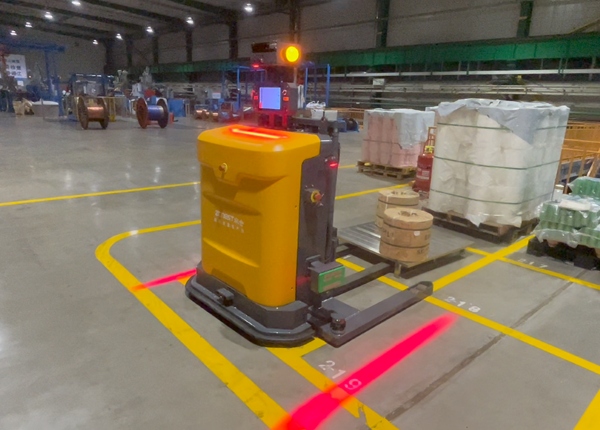
For local forklift fleets, maintenance teams can usually obtain replacement parts quickly from nearby suppliers. However, imported AGV systems have a different operational model.
A small component failure, such as a damaged proximity sensor or worn drive wheel, may stop an entire automated workflow if no replacement part is available locally.
The real cost is not only the price of the component. The larger cost comes from:
Warehouse operation interruption
Delayed pallet movement
Manual labor replacement costs
Emergency shipping expenses
Production or distribution delays
Therefore, spare parts planning should be considered part of the AGV implementation project, not an afterthought.
Drive wheels are one of the most important wear components on autonomous forklifts. Unlike electronic parts that may fail occasionally, wheels experience continuous mechanical stress during daily operation.
The replacement frequency depends on several factors:
Daily operating hours
Number of shifts
Average payload weight
Warehouse floor condition
Turning frequency
Dust and contamination levels
For a small AGV fleet, many companies choose to keep at least one complete spare drive wheel assembly available. For larger fleets operating multiple shifts, a percentage-based inventory approach is usually more practical.
For example, a warehouse operating 20 autonomous forklifts continuously may consider maintaining several replacement wheel assemblies to avoid long downtime caused by normal wear.
An experienced automation supplier should provide recommended replacement intervals based on operating conditions rather than only providing a general spare parts list.
Many buyers worry that Chinese AGV components require special replacement parts that can only be purchased from the original manufacturer.
For mature industrial equipment, many consumable components should follow standardized specifications.
Hydraulic filter selection should be based on technical parameters such as:
Filter dimensions
Filtration accuracy
Pressure rating
Connection type
Operating temperature range
A professional Chinese AGV manufacturer should provide complete component specifications so customers can understand replacement options in their local market.
From a long-term maintenance perspective, standardized consumables reduce dependency on international shipping and improve equipment availability.
For reach AGVs, stacker AGVs, and high-lift autonomous forklifts, mast lubrication is an important maintenance activity.
The correct lubricant depends on:
Lifting frequency
Load weight
Operating temperature
Dust conditions
Manufacturer recommendations
Many industrial applications use lithium-based grease or extreme-pressure industrial grease for mechanical moving parts. However, maintenance teams should always follow the supplier's recommended specification.
Mixing different grease types without confirmation can reduce lubrication performance and may create unexpected maintenance problems.
When importing AGVs from China, customers should request:
Lubrication schedule
Recommended grease specification
Maintenance frequency
Application points
Yes, proximity sensors and safety-related sensors are usually good candidates for local inventory.
These components are often:
Relatively low cost
Easy to store
Fast to replace
Critical for equipment operation
Common recommended spare sensor categories include:
Proximity sensors
Photoelectric sensors
Safety switches
Reflectors
Emergency stop components
A warehouse may have hundreds of automation cycles every day. A small sensor failure should not require waiting weeks for international transportation.
| Component | Importance | Recommended Strategy |
|---|---|---|
| Drive wheels | High | Keep emergency replacement stock |
| Safety sensors | High | Recommended local inventory |
| Hydraulic seals and filters | Medium | Prepare based on usage hours |
| Controller boards | Low frequency / High impact | Keep limited backup stock |
| Battery components | High value | Plan replacement strategy |
Instead of simply asking:
"Can you provide spare parts?"
A better purchasing approach is to request a complete maintenance package including:
Recommended spare parts list
Replacement cycle information
Estimated service life
Part numbers
Technical drawings when available
Emergency delivery process
Remote troubleshooting support
For large projects, many companies also negotiate a starter spare parts package included with the first shipment.
One common mistake is focusing only on equipment purchase price while ignoring operational readiness.
A warehouse that spends hundreds of thousands of dollars on automation should not allow a low-cost sensor or wheel replacement to create unnecessary downtime.
Another mistake is purchasing too many expensive components while ignoring simple consumables.
The best spare parts strategy is not about storing everything. It is about storing the parts that have the highest impact on operational continuity.
Based on practical experience with warehouse automation projects, the companies that achieve the best long-term results are usually not those that only negotiate the lowest equipment price.
They are the companies that prepare the complete operating system around the robots:
Maintenance procedures
Operator training
Spare parts inventory
Remote technical support
Performance monitoring
An AGV is not just a machine delivered from China. It becomes part of a long-term logistics operation.
My view is that a mature AGV supplier should help customers build a maintenance strategy before shipment, not wait until a failure happens. The difference between a successful automation project and a frustrating one is often not the robot itself, but whether the customer has planned how to keep that robot running every day.
FREE ENGINEERING SUPPORT Stop Gambling on Generic Platforms. Get an AGV/AMR Tailored to Your Warehouse.Buying automated guided vehicles involves complex safety standards (CE/ANSI), navigation setups (Laser SLAM), and ERP system integration. Don't risk your factory safety with middle-men. ✓ 100% Direct Factory: Customized payload up to 5 Tons. ✓ Free CAD Simulation: Send us your layout, and our engineers will simulate the optimal AGV routes. ✓ Global Support: Overseas installation guidance & local maintenance partners. |





 Chinese
 English