


When companies consider importing autonomous forklifts from China, warehouse floor conditions are often one of the most overlooked technical factors.
Many warehouses were originally designed for manual forklift operations. Small floor differences, expansion joints, metal transition plates, dock areas and uneven concrete surfaces may not create problems for human drivers, but they can influence the performance of autonomous forklifts.
The real question is not whether an AGV can drive over a small floor variation. The more important question is:
How does the autonomous forklift detect, absorb and compensate for real-world warehouse floor conditions while maintaining navigation accuracy and safety?
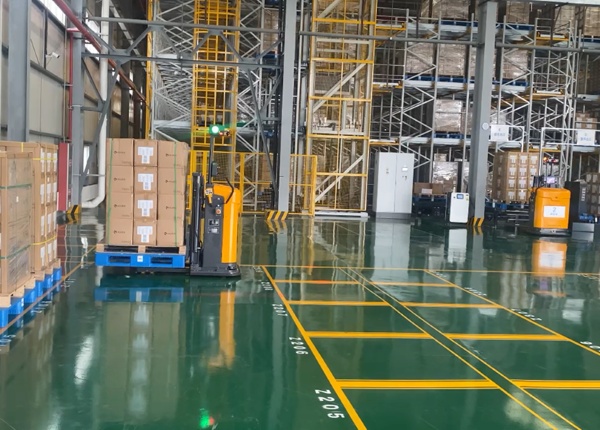
An autonomous forklift relies on multiple systems working together:
Navigation sensors
Laser or visual mapping system
Drive wheels
Suspension structure
Vehicle control algorithms
Safety sensors
A sudden floor height change can affect more than physical movement. It may influence wheel contact, vehicle vibration, sensor stability and load handling performance.
For high-lift applications, the impact can become more significant because small chassis movements may translate into larger positioning errors when handling pallets at elevated rack levels.
A 15mm transition plate does not automatically mean an AGV project will fail. However, the actual impact depends on several factors:
Vehicle wheel diameter
Wheel material
Vehicle payload
Driving speed
Approach angle
Floor plate design
A slow-moving warehouse AGV carrying stable loads may handle a small transition more easily than a high-speed autonomous forklift operating near maximum capacity.
Professional suppliers normally evaluate these conditions during site surveys. They consider not only the height difference but also whether the transition edge is sharp, rounded, fixed securely and located in a critical travel path.
A metal plate with a smooth ramp profile is very different from a sharp-edged obstacle of the same height.
The navigation system is one of the most important components of an autonomous forklift. Excessive vibration can influence sensor performance and long-term equipment reliability.
Chinese industrial AGV manufacturers typically address vibration through a combination of mechanical and software methods.
Mechanical solutions may include:
Suspended drive wheels
Shock absorption structures
Flexible mounting systems
Vibration-resistant sensor installation
Software compensation may include:
Sensor filtering algorithms
Localization correction
Real-time position adjustment
Motion control optimization
The purpose is not to eliminate every vibration. The goal is to ensure that normal warehouse floor conditions do not create unacceptable positioning errors.
Yes, many industrial AGVs are designed to operate across normal warehouse floor joints. However, the joint condition matters.
A typical industrial floor joint evaluation includes:
Gap width
Height difference between surfaces
Edge condition
Vehicle travel direction
Load condition
A narrow and smooth expansion joint is usually less challenging than a damaged joint with broken edges.
During project planning, customers should identify:
Expansion joints
Dock transitions
Cold storage entrances
Ramp connections
Areas repaired with different materials
These locations should be included in the AGV simulation and testing process.
There is no single floor flatness number that applies to every autonomous forklift project.
Requirements depend on:
Vehicle type
Travel speed
Lift height
Rack height
Load accuracy requirements
For example:
A low-level pallet transport AMR may tolerate more variation.
A high-bay reach AGV requiring accurate pallet placement at 10 meters may require stricter floor control.
A VNA autonomous forklift operating in narrow aisles may require both floor flatness and rack alignment accuracy.
The higher the lifting height and positioning requirement, the more important floor quality becomes.
| Floor Issue | Potential AGV Impact |
|---|---|
| Metal transition plates | Vibration and wheel impact |
| Uneven expansion joints | Navigation stability and mechanical stress |
| Floor settlement | Positioning accuracy problems |
| Damaged concrete edges | Wheel wear and safety concerns |
A common mistake is only sending warehouse dimensions and rack drawings.
For a professional AGV evaluation, customers should also provide:
Warehouse floor drawings
Photos of unusual floor areas
Locations of expansion joints
Metal plates and ramps
Floor repair areas
Maximum vehicle speed requirements
Maximum payload information
If possible, a supplier should perform a virtual or physical site assessment before final equipment selection.
From practical warehouse automation projects, one important lesson is that AGV performance depends on the relationship between the robot and the environment.
Many companies spend significant time comparing robot specifications but underestimate the importance of warehouse conditions.
The best automation projects do not start by asking:
"Which AGV has the highest speed?"
They start by asking:
"Is my warehouse environment ready for reliable autonomous operation?"
A mature AGV supplier should not simply promise that the robot can handle any floor. A professional supplier should help customers identify risks, define acceptable floor conditions and verify performance before full deployment.
In my experience, successful AGV projects are rarely determined by the robot alone. They are determined by the engineering preparation before the robot arrives. Proper floor evaluation, realistic testing and clear acceptance criteria usually create a much higher return on automation investment.
FREE ENGINEERING SUPPORT Stop Gambling on Generic Platforms. Get an AGV/AMR Tailored to Your Warehouse.Buying automated guided vehicles involves complex safety standards (CE/ANSI), navigation setups (Laser SLAM), and ERP system integration. Don't risk your factory safety with middle-men. ✓ 100% Direct Factory: Customized payload up to 5 Tons. ✓ Free CAD Simulation: Send us your layout, and our engineers will simulate the optimal AGV routes. ✓ Global Support: Overseas installation guidance & local maintenance partners. |





 Chinese
 English