


When companies evaluate warehouse automation, the discussion usually focuses on labor savings, throughput improvement and operational efficiency.
However, another important benefit is often underestimated:
Can autonomous forklifts reduce product damage and improve warehouse quality performance?
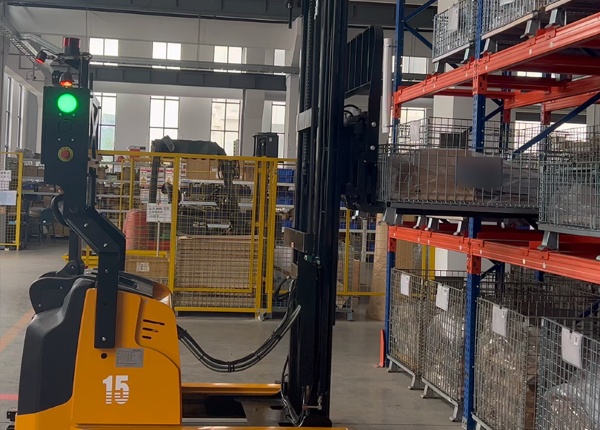
In many warehouses, product damage is not caused by equipment failure. It is caused by inconsistent human operation:
Incorrect fork positioning
Sudden acceleration or braking
Improper pallet handling
Collision with racks
Incorrect storage placement
A properly designed AGV system can reduce these variations by creating a controlled and repeatable material handling process.
Traditional forklift operations depend heavily on operator experience and attention.
Even experienced drivers may face challenges during:
Peak warehouse periods
Night shifts
High-volume receiving operations
Narrow aisle movement
Fast pallet transfers
Common damage scenarios include:
Forks entering pallets incorrectly
Pallets becoming unstable during transport
Products hitting racks during turning
Loads being placed incorrectly
The challenge is that human-related damage is difficult to measure and prevent consistently.
The actual improvement depends on the warehouse environment, product type and existing damage rate.
AGVs can reduce damage costs through several mechanisms:
Repeatable driving behavior:Every movement follows programmed acceleration, braking and speed limits.
Precise positioning:The vehicle follows predefined routes and stopping positions.
Controlled pallet handling:Lifting and lowering actions follow programmed parameters.
Safety monitoring:Sensors continuously monitor surrounding conditions.
For warehouses with frequent forklift-related damage, reducing even a small percentage of product loss can create significant financial benefits.
Yes, controlled acceleration and braking are important advantages of autonomous forklifts.
Unlike manual driving, where acceleration depends on operator habits, AGV movement parameters are controlled by software.
The system can manage:
Starting acceleration
Travel speed
Turning speed
Stopping distance
Load handling speed
This is especially valuable for:
Food and beverage products
Electronic components
Glass products
Medical supplies
Unstable pallet loads
The goal is not simply moving faster. The goal is moving consistently.
Fork positioning and pallet stability are critical factors in automated material handling.
Depending on the AGV model, manufacturers may use:
Tilt angle monitoring
Lift position sensors
Load detection systems
Fork position feedback
These systems help ensure that:
The forks are correctly positioned
The pallet is lifted safely
The load remains within operating limits
The vehicle does not continue unsafe operations
For high-value goods, accurate pallet handling can directly reduce damage risks.
Modern AGV systems can record and manage detailed operational information.
Depending on system configuration, software may track:
Pallet pickup location
Drop-off location
Vehicle movement history
Task completion records
Error events
This creates better traceability compared with traditional manual operations.
If a product is damaged or misplaced, managers can review operational records and identify where the problem occurred.
| Damage Type | How AGV Helps |
|---|---|
| Rack collision | Precise navigation and safety sensors |
| Pallet impact | Controlled acceleration and braking |
| Incorrect placement | Software-controlled positioning |
| Load instability | Controlled lifting parameters |
A practical calculation should include:
Current annual product damage cost
Forklift collision expenses
Rack repair costs
Customer claims
Lost inventory value
Insurance impact
The potential benefit from AGVs is not only reducing direct damage costs. It also improves:
Inventory accuracy
Warehouse safety
Operational consistency
Employee training efficiency
To achieve damage reduction, companies should evaluate:
Navigation accuracy
Safety sensor configuration
Load handling capability
Software tracking functions
Factory testing procedures
After-sales support
An AGV is not automatically safer just because it is autonomous. The system must be correctly selected, configured and integrated into the warehouse process.
From practical warehouse automation projects, one important observation is that companies often calculate AGV value only by labor replacement.
However, the hidden value is often quality improvement.
Human operators naturally have different driving habits, experience levels and decision-making methods. Automation creates a standardized process where every pallet movement follows the same rules.
In my opinion, the strongest reason to adopt autonomous forklifts is not simply that robots can move materials. It is that they transform warehouse operations from experience-dependent work into a measurable and repeatable system.
For companies handling expensive inventory, reducing damage and improving traceability can sometimes deliver more long-term value than labor savings alone.
FREE ENGINEERING SUPPORT Stop Gambling on Generic Platforms. Get an AGV/AMR Tailored to Your Warehouse.Buying automated guided vehicles involves complex safety standards (CE/ANSI), navigation setups (Laser SLAM), and ERP system integration. Don't risk your factory safety with middle-men. ✓ 100% Direct Factory: Customized payload up to 5 Tons. ✓ Free CAD Simulation: Send us your layout, and our engineers will simulate the optimal AGV routes. ✓ Global Support: Overseas installation guidance & local maintenance partners. |





 Chinese
 English