


When companies evaluate warehouse automation, the discussion is no longer limited to labor savings and productivity.
Environmental impact has become an important factor in automation decisions, especially for global companies with sustainability targets.
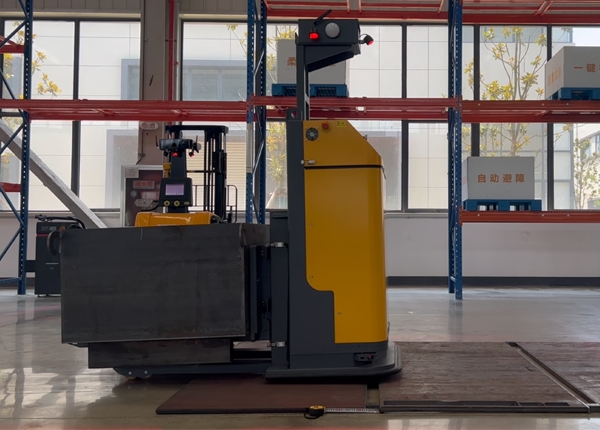
Many warehouse operators are asking:
Can an AGV fleet imported from China help reduce carbon emissions while improving operational efficiency?
The answer depends on several factors:
Energy source
Battery technology
Charging strategy
Warehouse operating hours
Fleet utilization rate
Existing forklift type
Many warehouses still rely on internal combustion forklifts powered by diesel or LPG.
These vehicles create environmental challenges:
Fuel consumption and direct carbon emissions
Exhaust gases inside warehouse environments
Higher ventilation requirements
Noise pollution
Frequent maintenance of combustion engines
For large logistics centers operating multiple shifts, fuel-powered forklifts can represent a significant portion of internal logistics emissions.
Replacing traditional forklifts with electric autonomous vehicles can reduce energy consumption through several mechanisms.
The main improvements include:
Electric drive system:Electric motors convert energy more efficiently compared with combustion engines.
Optimized routing:Fleet software reduces unnecessary travel distance.
Automatic charging management:The system can schedule charging based on operational demand.
Reduced idle operation:AGVs do not consume energy while waiting like traditional vehicles with running engines.
The actual energy savings depend on the existing forklift fleet and warehouse operating conditions.
A warehouse replacing older LPG forklifts with electric AGVs may achieve a much larger environmental improvement compared with a facility already using modern electric forklifts.
Battery lifecycle management is an important consideration for sustainable automation.
Modern industrial AGVs commonly use lithium iron phosphate (LiFePO4) battery technology because of:
Long cycle life
High safety performance
Stable thermal characteristics
Lower maintenance requirements
However, responsible battery management requires more than selecting lithium technology.
Companies should confirm:
Battery supplier qualifications
Battery certification documents
End-of-life recycling process
Local disposal requirements
Transportation regulations
A professional AGV supplier should provide battery specifications and support customers with lifecycle management information.
The concept of a "dark warehouse" refers to highly automated facilities where lighting requirements are significantly reduced because human workers are rarely present.
Chinese AGV fleets can support this type of operation when combined with:
Automatic storage systems
Robot-based material movement
Warehouse management software
Remote monitoring systems
Reducing lighting requirements can create additional energy savings, especially in large warehouses operating 24 hours per day.
However, not every warehouse should immediately become a fully dark operation. Many facilities still require human inspection, maintenance and exception handling areas.
Carbon reduction usually comes from multiple improvements working together.
| Area | Environmental Benefit |
|---|---|
| Electric power | Reduces direct fuel emissions |
| Optimized routes | Reduces unnecessary movement |
| Smart charging | Improves energy utilization |
| Reduced maintenance | Lowers resource consumption |
A professional sustainability evaluation should compare before and after automation data.
Useful measurements include:
Fuel consumption before automation
Electricity consumption after AGV installation
Operating hours per vehicle
Warehouse throughput changes
Battery charging efficiency
Reduction in maintenance activities
Companies can then estimate:
Energy cost reduction
CO2 emission reduction
Operational efficiency improvement
Before selecting an AGV supplier, companies should evaluate:
Battery technology and certification
Charging efficiency
Energy monitoring capability
Supplier recycling support
Vehicle lifespan
Spare parts availability
A sustainable automation system should consider the entire lifecycle, not only the initial purchase.
From practical warehouse automation projects, one important observation is that companies sometimes focus too much on whether a robot itself is "green."
The larger environmental improvement often comes from redesigning the entire material flow.
A well-designed AGV system reduces unnecessary movement, eliminates inefficient waiting, improves warehouse utilization and creates more predictable energy consumption.
In my view, the biggest environmental advantage of AGVs is not simply replacing a diesel forklift with an electric robot.
The real value is creating a smarter warehouse where every movement is planned, measured and optimized.
For companies with long-term sustainability goals, AGV investment should be evaluated not only as an automation project, but also as part of their future low-carbon logistics strategy.
FREE ENGINEERING SUPPORT Stop Gambling on Generic Platforms. Get an AGV/AMR Tailored to Your Warehouse.Buying automated guided vehicles involves complex safety standards (CE/ANSI), navigation setups (Laser SLAM), and ERP system integration. Don't risk your factory safety with middle-men. ✓ 100% Direct Factory: Customized payload up to 5 Tons. ✓ Free CAD Simulation: Send us your layout, and our engineers will simulate the optimal AGV routes. ✓ Global Support: Overseas installation guidance & local maintenance partners. |











 Chinese
 English




