

When a warehouse already has an automatic stretch wrapper, pallet dispenser, labeling machine, conveyor, or other local equipment, a common question is whether a Chinese AGV can communicate directly with that equipment.
In many projects, the answer can be yes, but "direct communication" can mean several different things. The AGV may communicate with a local PLC, warehouse control system, equipment controller, or an intermediate gateway. The physical connection may use Ethernet, Wi-Fi, digital I/O, or another industrial communication interface.
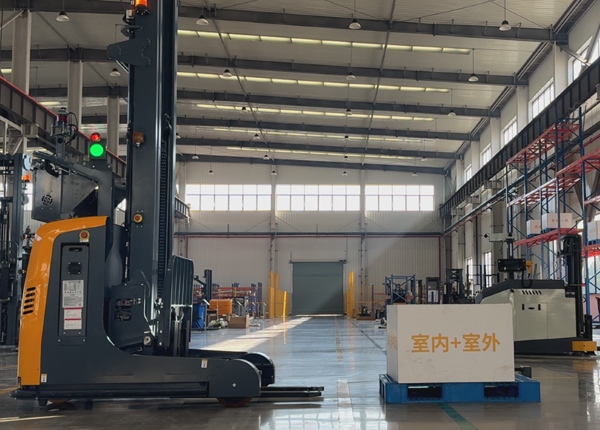
For a U.S. warehouse importing Chinese autonomous forklifts, the important issue is not simply whether the supplier says "PLC integration supported." The buyer should define the handshake sequence, communication protocol, safety architecture, ownership of the interface, and FAT/SAT test requirements before the equipment is shipped.
A Chinese AGV can potentially communicate with a local stretch wrapper, but the exact integration method depends on the controllers installed on both systems.
A typical pallet-wrapping process may look like this:
The AGV receives a wrapping task.
The AGV transports the pallet to the wrapping station.
The AGV positions the pallet in the defined handoff area.
The AGV sends a pallet-arrival or ready signal.
The wrapping machine confirms that it is ready.
The AGV releases the pallet and moves to its waiting position.
The wrapping machine completes the wrapping cycle.
The wrapper sends a cycle-complete signal.
The AGV receives the retrieval task.
The AGV returns to the station and retrieves the wrapped pallet.
This is normally treated as an equipment-to-equipment integration project rather than a simple wireless connection.
The AGV does not necessarily need to communicate directly with the wrapper's internal controller. A PLC, WCS, WMS, or integration gateway can coordinate the process.
There is no universal wireless handshake signal used by Chinese AGVs and stretch wrappers.
The communication architecture can use different technologies depending on the project. For example, the AGV fleet controller may communicate with a local PLC through an Ethernet-based network, while the PLC exchanges discrete signals with the wrapping machine.
Possible integration methods include:
Industrial Ethernet
TCP/IP communication
REST or other supplier-specific APIs
MQTT or message-based interfaces
Modbus TCP
PROFINET
Digital I/O
PLC gateway or middleware
The actual interface should be selected based on the controllers and integration architecture at the warehouse.
For example, a wireless network may provide the communication path between the AGV and fleet-management system, while the stretch wrapper is connected to a PLC using a wired industrial network. In this case, the AGV is participating in the process without having a direct wireless connection to the wrapper.
This distinction is important because a buyer should not ask only for "the wireless signal." The better question is: "What interface does the AGV fleet controller provide for external equipment, and what handshake signals or API messages are required?"
Some Chinese AGV platforms can integrate with PLC-based equipment using protocols such as PROFINET or Modbus TCP, but support is supplier-specific and should be confirmed for the exact fleet-management software and hardware architecture.
The buyer should not assume that a robot supporting Ethernet automatically supports every industrial protocol.
During the RFQ process, ask the supplier to identify:
Supported PLC communication protocols
Supported protocol versions or implementation details
Whether the interface is available directly from the fleet controller
Whether an additional gateway is required
Available API documentation
Data points and message definitions
Read/write permissions
Connection recovery behavior
Communication timeout behavior
Event and alarm handling
For a U.S. warehouse, it is also useful to identify who will develop and maintain the PLC interface. The Chinese AGV supplier may provide the API or protocol documentation while the local integrator or warehouse controls engineer implements the PLC logic.
PROFINET and Modbus can both be used for industrial communication, but the actual data architecture and engineering requirements are different.
A project should therefore define the actual signals instead of specifying only a protocol name.
For a stretch-wrapper station, the interface could include signals such as:
| Signal | Possible Meaning |
|---|---|
| AGV Arrived | Pallet has reached the handoff position |
| AGV Ready | AGV is ready for the next operation |
| Wrapper Ready | Wrapping machine is available |
| Start Wrap | Request or authorization to begin wrapping |
| Wrap Complete | Wrapping cycle has finished |
| Fault | Equipment requires intervention |
| Safe to Enter | Defined condition for vehicle access |
These signals should be defined in an interface control document before commissioning.
Yes, this type of workflow can be implemented when the AGV fleet-management system and the wrapping machine have a properly defined interface.
The key is not the physical act of "waiting." The system needs to know the state of the wrapping station.
A typical state sequence could be:
| Step | System State |
|---|---|
| 1 | AGV receives pallet-to-wrapper task |
| 2 | AGV travels to wrapper station |
| 3 | AGV confirms positioning |
| 4 | Pallet handoff is completed |
| 5 | AGV leaves the equipment zone |
| 6 | Wrapper performs wrapping cycle |
| 7 | Wrapper reports cycle complete |
| 8 | AGV receives retrieval task |
| 9 | AGV returns and retrieves the pallet |
The system should also define what happens if the wrapper reports a fault, the pallet is missing, the cycle takes too long, communication is lost, or the AGV cannot safely access the station.
A robust integration does not simply contain a "start" and "complete" signal. It also needs timeout, fault, recovery, and abnormal-state handling.
This part of the integration requires more caution than ordinary equipment communication.
A safety interlock should not simply be wired into a normal PLC input or ordinary AGV digital input and then described as a safety function. The required architecture depends on the hazards, safety devices, AGV safety system, machine controls, and applicable site requirements.
A typical architecture may involve a safety-rated controller or safety PLC coordinating the relevant safety devices and equipment responses.
Depending on the machine and risk assessment, safety-related devices may include:
Guard door interlocks
Emergency-stop devices
Safety light curtains
Safety laser scanners
Safety mats
Machine safety PLCs
Safety-rated outputs
AGV safety inputs or safety communication interfaces
Drive safety functions such as Safe Torque Off where applicable
The exact wiring should be designed and validated by qualified controls and safety personnel for the specific machine and AGV architecture.
One of the most important concepts in this type of project is the difference between operational communication and safety functions.
A normal PLC message such as "wrapper ready" may coordinate the production sequence. It should not automatically be treated as proof that the area is safe for an AGV to enter.
Similarly, an ordinary Ethernet or Wi-Fi connection between the AGV and a local PLC does not automatically provide a safety-rated communication channel.
The safety architecture should independently address hazards such as:
Personnel entering the AGV operating area
Personnel entering the wrapping machine's hazardous zone
Unexpected machine movement
AGV entering while the wrapper is operating
Unexpected restart after an emergency stop
Loss of communication between equipment
The correct response may involve stopping the AGV, stopping the wrapping machine, preventing restart, or preventing access to the hazardous zone, depending on the specific risk assessment.
The integration project becomes much easier when the buyer provides the AGV supplier with a complete interface specification instead of simply asking whether "PLC communication is supported."
The supplier should receive information such as:
Stretch-wrapper manufacturer and model
Local PLC manufacturer and model
Available communication protocols
Network architecture
Required AGV handoff position
Pallet dimensions and weight
Wrapper cycle time
Required AGV throughput
Handshake sequence
Fault and timeout conditions
Safety-zone layout
Required safety interfaces
WMS/WCS integration requirements
A simple sequence diagram is also extremely useful. It should show which system sends each signal, what response is expected, how long the system waits, and what happens when a signal is missing.
The AGV-to-wrapper interface should be tested before shipment whenever practical. FAT should verify more than the successful completion of one normal cycle.
The test plan can include:
AGV arrival detection
Pallet positioning
Wrapper-ready handshake
Pallet handoff
Wrapper cycle start
Wrapper cycle completion
AGV retrieval task
Communication timeout
Wrapper fault
AGV fault
Lost communication
Unexpected restart
Safety interlock activation
Emergency-stop response
Recovery after the fault is cleared
The buyer should also verify that the AGV does not enter a machine's hazardous area simply because a normal communication signal says that the equipment is ready.
For an imported Chinese AGV project, the equipment interface should be documented before production is completed.
| Item | Requirement |
|---|---|
| Communication Protocol | Specify PROFINET, Modbus TCP, API, I/O, or another approved method |
| Handshake | Define every signal and state transition |
| Timeout | Define the response when expected communication is missing |
| Fault Handling | Define what happens when AGV or wrapper reports a fault |
| Safety Interface | Define safety-related interfaces separately from normal communication |
| FAT | Test the interface before shipment where practical |
| SAT | Validate the complete process at the actual warehouse |
| Documentation | Provide protocol, API, I/O, network and recovery documentation |
For a warehouse importing Chinese autonomous forklifts, the most reliable approach is to treat the stretch wrapper as a defined workstation within the AGV system rather than attempting to create an informal robot-to-machine connection.
The AGV fleet controller can manage the transport task, while the local PLC or equipment controller manages the wrapping cycle. A clearly defined handshake connects the two systems, and the safety architecture independently controls hazardous conditions.
This architecture also makes troubleshooting easier. If a pallet is waiting too long, the engineering team can determine whether the problem is the AGV task, the wrapper cycle, the PLC handshake, the network connection, or a safety interlock.
For a Chinese AGV project, the key procurement requirement should therefore be specific: define the communication protocol, handshake sequence, fault recovery, safety interface, FAT requirements, and SAT acceptance criteria before the equipment is manufactured.
FREE ENGINEERING SUPPORT Stop Gambling on Generic Platforms. Get an AGV/AMR Tailored to Your Warehouse.Buying automated guided vehicles involves complex safety standards (CE/ANSI), navigation setups (Laser SLAM), and ERP system integration. Don't risk your factory safety with middle-men. ✓ 100% Direct Factory: Customized payload up to 5 Tons. ✓ Free CAD Simulation: Send us your layout, and our engineers will simulate the optimal AGV routes. ✓ Global Support: Overseas installation guidance & local maintenance partners. |





 Chinese
 English