


Expanding an autonomous forklift fleet is very different from simply purchasing more robots. A warehouse that operates five Chinese AGVs may behave very differently after the fleet grows to 20, 50, or more vehicles.
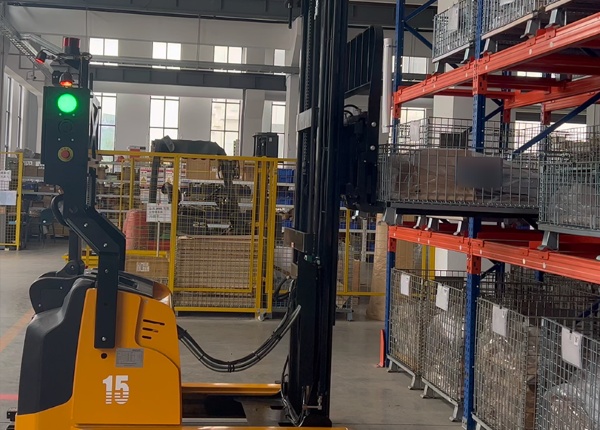
As fleet size increases, the warehouse must manage more task requests, vehicle-to-vehicle interactions, charging demand, wireless traffic, intersections, waiting areas, and dispatch decisions. The central fleet-management or scheduling system also needs enough processing capacity to coordinate the larger workload.
For a U.S. warehouse importing Chinese autonomous forklifts, fleet scaling should therefore be treated as a system-capacity problem rather than simply a vehicle-count problem.
The most effective way to scale an AGV fleet is to identify the actual bottleneck before adding more vehicles.
A warehouse can experience low throughput even when the AGV fleet has unused capacity. For example, the bottleneck may be a narrow aisle, a single elevator, a pallet staging area, a wrapping station, a charging station, a WMS interface, or a high-traffic intersection.
Before expanding the fleet, measure:
AGV utilization
Completed missions per hour
Average travel time
Waiting time at intersections
Queue time at pickup and drop-off stations
Charging and battery waiting time
Average task response time
Traffic-related stops
Mission failure and recovery rates
WMS or external-system response time
If the existing fleet is already spending significant time waiting for a shared resource, adding more AGVs may increase congestion without increasing throughput.
A successful scaling project therefore requires both software capacity and warehouse traffic capacity.
There is no universal maximum number of AGVs that applies to every Chinese dispatch server.
The practical fleet capacity depends on the architecture and workload of the fleet-management system. A server coordinating a relatively simple warehouse with predictable tasks may support a different fleet size from a system managing complex traffic, multiple zones, frequent task updates, elevator interfaces, WMS communication, and dynamic routing.
The supplier should be asked to specify the tested fleet size for the exact software and server configuration being proposed.
Important variables include:
Number of simultaneously connected vehicles
Task creation frequency
Number of concurrent missions
Map and route complexity
Traffic-control calculations
External WMS/WCS communication
Database workload
Alarm and event volume
Real-time monitoring requirements
Server CPU and memory resources
Network architecture
High-availability requirements
For procurement purposes, it is better to specify a tested performance target than to ask for a theoretical maximum.
For example, an RFQ could require the supplier to demonstrate that the proposed architecture can support the planned fleet size while maintaining defined task-response, dispatch, monitoring, and recovery performance.
If the warehouse plans to start with 20 AGVs but expects to reach 40 or 50 vehicles later, the supplier should design the software and server architecture with expansion in mind.
A useful question is:
"How many vehicles has this exact software architecture been validated to support under a workload comparable to our warehouse, and what hardware resources are required at that scale?"
This is more useful than asking whether the software is simply "scalable."
Adding five AGVs can increase wireless traffic, but the number of vehicles alone does not determine whether the warehouse Wi-Fi network will become congested.
The actual wireless workload depends on factors such as:
Message frequency
Packet size
Video or image transmission
Telemetry frequency
Map and software update traffic
Number of access points
Channel configuration
RF interference
Roaming behavior
Network segmentation
Other warehouse devices sharing the same network
A fleet of additional AGVs that mainly exchanges lightweight control and telemetry data may create a very different network load from robots transmitting continuous camera streams or large diagnostic files.
The correct approach is to measure the network rather than assume that five additional robots will automatically create a problem.
AP client capacity
Channel utilization
Signal strength throughout AGV travel routes
Roaming behavior
Packet loss
Latency
Retransmissions
Interference
Network segmentation
Traffic prioritization
Switch uplink capacity
Fleet-server connectivity
If the warehouse uses a dedicated industrial wireless network for AGVs, the IT team should also determine whether the current access-point layout was designed for the planned final fleet size or only the initial deployment.
The network should be tested under representative peak conditions rather than only when the warehouse is empty.
Charging becomes increasingly important as the AGV fleet grows because charging stations become shared resources.
A fleet-management system may consider several variables when deciding which vehicle should charge:
Current battery state of charge
Current task priority
Remaining workload
Estimated time until the next required mission
Charging-station availability
Charging duration
Vehicle location
Battery temperature or charging status where supported
Fleet-wide workload
The exact scheduling algorithm is supplier-specific. Some systems may use simple battery thresholds, while more advanced systems can combine battery state with task priority and charging-station availability.
For example, sending every AGV to charge immediately when the battery falls below a fixed threshold could create a charging queue. A more coordinated strategy can maintain enough vehicles for active warehouse tasks while scheduling lower-priority vehicles for charging.
Adding more AGVs without reviewing charging capacity can create a new bottleneck.
The buyer should evaluate:
Number of chargers
Charging power
Average charging duration
Battery capacity
Operating hours per day
Fleet utilization
Opportunity-charging strategy
Charging-station location
Queueing behavior
Electrical capacity
The objective is not necessarily to provide one charger for every AGV. The correct charger-to-vehicle ratio depends on battery capacity, charging strategy, operating schedule, and actual fleet utilization.
In some deployments, a warehouse can be divided into separate operating zones, but whether each zone can run as an independent software instance depends on the supplier's fleet-management architecture.
There are several possible architectures.
All AGVs are controlled by a central fleet-management system. The warehouse can still be divided into logical zones, but the dispatch system maintains a unified view of vehicle locations, tasks, traffic, and resources.
This architecture can be useful when AGVs frequently move between zones.
Different warehouse zones can potentially use separate software instances, with each instance controlling its own group of vehicles.
This can simplify operational boundaries, but it creates additional management requirements if pallets or vehicles need to move between zones.
A central fleet manager can maintain one overall system while assigning different maps, traffic rules, vehicle groups, priorities, and task permissions to different warehouse zones.
For many larger warehouses, this approach can provide the operational separation of multiple zones without creating completely independent fleet-management systems.
Cross-zone movement is one of the most important questions to resolve before choosing a multi-instance architecture.
If Zone A and Zone B are controlled by completely independent fleet systems, the two systems need a defined handoff mechanism if an AGV or pallet must move between them.
Possible approaches include:
Shared task-management software
WMS/WCS coordination
API-based task transfer
PLC or gateway-based handoff
Defined transfer stations
Manual pallet handoff
Without a clear handoff architecture, separate fleet systems can create duplicate task ownership, vehicle conflicts, or unclear pallet status.
Fleet expansion should be accompanied by traffic analysis.
Adding more vehicles to a fixed warehouse layout can increase waiting time at intersections, narrow aisles, pickup points, staging areas, elevators, and other shared resources.
Useful traffic-management strategies can include:
One-way traffic in selected aisles
Virtual traffic zones
Intersection priorities
Speed zoning
Task prioritization
Dynamic route selection
Dedicated staging areas
Restricted access to congested areas
Charging zones
Peak-hour fleet limits
The objective is not to maximize the number of robots operating simultaneously. The objective is to maximize useful pallet movements per hour while maintaining acceptable travel time, safety, and system reliability.
| Question | Why It Matters |
|---|---|
| How many vehicles has this exact fleet software been validated to coordinate? | Provides evidence of real system capacity |
| What server resources are required at the planned fleet size? | Identifies infrastructure requirements |
| What happens when the fleet reaches capacity? | Shows how the system handles scaling limits |
| Can another server or instance be added? | Determines expansion options |
| How is charging priority calculated? | Helps prevent charging bottlenecks |
| How does the system manage traffic congestion? | Shows whether additional AGVs will improve or reduce throughput |
| Can zones have different traffic rules? | Important for large warehouses |
| Can multiple fleet instances exchange tasks? | Important for multi-zone architecture |
| What APIs are available for fleet integration? | Supports WMS/WCS and multi-system integration |
| Can performance data be exported? | Allows the buyer to monitor scaling performance |
A useful fleet-expansion test should simulate the expected future workload rather than simply connecting additional vehicles to the server.
For example, if the warehouse plans to expand from 15 to 25 AGVs, the buyer can ask the supplier to demonstrate the proposed architecture under a workload representative of the future operating environment.
The test can measure:
Task assignment latency
Vehicle communication stability
Average mission completion time
Traffic waiting time
Charging queue time
Server CPU and memory utilization
Database response
Network utilization
Fault recovery time
WMS/WCS communication performance
This type of capacity test is much more useful than relying on a supplier statement such as "the software supports 100 robots."
The maximum productive fleet size is determined by more than the number of autonomous forklifts that can log into the Chinese dispatch software.
The warehouse also needs enough wireless capacity, server resources, charging capacity, traffic space, staging capacity, WMS/WCS processing capability, and operational bandwidth.
For this reason, the best fleet-expansion plan should define a target operating level before additional robots are ordered. The supplier should provide a scalable architecture, while the warehouse team should identify physical bottlenecks and network requirements.
For a large warehouse, logical zones can also be used to control complexity, but the buyer should determine whether zones will share one central fleet manager or operate as separate software instances. If vehicles or pallets must cross zone boundaries, the handoff mechanism should be designed before deployment.
The key question is therefore not "How many Chinese AGVs can the server handle?" It is "How many AGVs can the complete warehouse system coordinate while maintaining the required throughput, response time, traffic flow, charging availability, and reliability?"
FREE ENGINEERING SUPPORT Stop Gambling on Generic Platforms. Get an AGV/AMR Tailored to Your Warehouse.Buying automated guided vehicles involves complex safety standards (CE/ANSI), navigation setups (Laser SLAM), and ERP system integration. Don't risk your factory safety with middle-men. ✓ 100% Direct Factory: Customized payload up to 5 Tons. ✓ Free CAD Simulation: Send us your layout, and our engineers will simulate the optimal AGV routes. ✓ Global Support: Overseas installation guidance & local maintenance partners. |





 Chinese
 English