


Using an autonomous forklift in a chemical processing plant is very different from deploying the same vehicle in a clean distribution warehouse. Dust can accumulate on sensors, optical surfaces, motors, electrical enclosures, wheels, and mechanical components. If the dust is combustible, the issue becomes even more serious because electrical equipment may need to be suitable for a classified hazardous location.
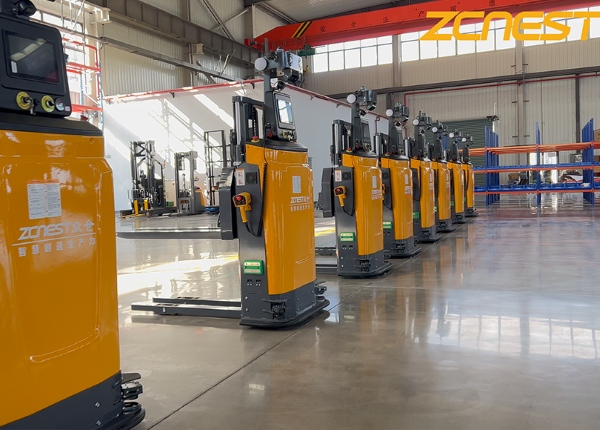
For a U.S. buyer considering an automated forklift from China, the evaluation should therefore cover two separate questions: can the vehicle physically operate reliably in a dusty environment, and is the vehicle actually approved or engineered for the specific hazardous location where it will operate?
They can potentially be configured for dusty industrial environments, but the answer depends heavily on the type and concentration of dust, the vehicle design, the operating area, and whether the dust is combustible.
A normal industrial AGV may tolerate a certain amount of airborne dust without problems, while a high-dust chemical processing area may require additional enclosure protection, sealing, filtration, sensor protection, cleaning procedures, or a specialized hazardous-location design.
The first step is therefore to classify the actual warehouse environment rather than simply asking a supplier whether its AGV is "dustproof."
For U.S. installations, combustible-dust areas can fall under Class II hazardous-location classifications. OSHA describes Class II locations as areas hazardous because of combustible dust, with Division 1 and Division 2 classifications depending on how and when ignitable dust concentrations may occur. :contentReference[oaicite:1]{index=1}
This means a chemical plant should provide the AGV supplier with the site's hazardous-area classification before the vehicle is selected.
It may be possible to source a specially engineered or certified AGV from China, but "dust-explosion-proof" is not a sufficient specification for a U.S. project.
The customer needs to identify the exact hazardous-location classification and the properties of the dust before selecting the vehicle. OSHA requires electrical equipment installed in hazardous locations to be intrinsically safe, approved for the hazardous location, or demonstrated to be safe for that location. The equipment must also be suitable for the specific ignitable or combustible properties involved. :contentReference[oaicite:2]{index=2}
For example, a procurement specification may need to identify:
Class II or another applicable hazardous-location classification
Division or Zone classification
Dust group or material characteristics
Operating temperature requirements
Ambient temperature range
Battery and charging requirements
Motor and drive protection
Electrical enclosure protection
Navigation and safety sensor suitability
Required U.S. approval or certification
A CE certificate or a general IP rating should not be treated as proof that an AGV is approved for a particular U.S. hazardous location. The certification must match the actual vehicle configuration and the intended installation.
OSHA specifically notes that hazardous-location electrical equipment must be appropriate for the class of location and the combustible properties of the specific dust, gas, vapor, or fiber involved. :contentReference[oaicite:3]{index=3}
There is no single IP dust-protection level that applies to all Chinese automated forklifts. The rating must be verified for the exact drive, motor, controller enclosure, and vehicle configuration being purchased.
This distinction is important because an AGV may contain several different electrical and mechanical protection levels. The drive motor may have one enclosure rating, the controller another, and external sensors or connectors another.
A buyer should therefore request the actual IP rating from the supplier instead of accepting a statement such as "the whole vehicle is IP-rated."
The RFQ can request:
Motor enclosure IP rating
Drive-controller enclosure IP rating
Electrical cabinet IP rating
Battery enclosure protection
Sensor enclosure rating
Connector and cable-entry protection
Charging equipment protection
A higher IP dust rating can reduce dust ingress into an enclosure, but it does not automatically make the equipment suitable for a combustible-dust hazardous location. These are different engineering requirements.
For a chemical processing plant, the purchasing team should request the complete equipment certification package rather than evaluating the AGV based on IP numbers alone.
Airborne powder can become a significant maintenance issue for laser-based navigation systems. Even when the laser itself continues to function, powder deposited on the optical window can reduce signal quality or interfere with reliable detection.
The actual effect depends on several factors:
Particle size and shape
Dust concentration
Dust adhesion characteristics
Humidity and temperature
Electrostatic behavior
Sensor mounting position
Air movement around the vehicle
Operating hours
Whether the sensor has a protective window
Fine chemical powder can accumulate on an optical window over time. Some powders may simply form a thin film, while others can adhere strongly and become difficult to remove after repeated exposure.
The critical question for the customer is therefore not "Will the laser work in dust?" but "How does the navigation system perform as contamination increases, and how does the system detect or recover from reduced sensor performance?"
Different navigation systems handle sensor contamination differently. Some systems may generate diagnostic warnings when the sensor reports abnormal data, while others may show reduced localization quality or communication and diagnostic alarms.
The customer should ask the supplier what happens when the optical window becomes partially contaminated.
Does the system generate a diagnostic alarm?
Does localization quality decrease gradually?
Will the AGV automatically slow down?
Will the vehicle stop when navigation confidence becomes insufficient?
Can the fleet system identify which sensor requires cleaning?
Can sensor health information be recorded in system logs?
Can maintenance personnel access diagnostic data remotely?
This information is more useful than simply knowing the sensor's nominal range or resolution because dusty environments create a maintenance problem as well as a navigation problem.
There is no universal cleaning interval such as once per week or once per month. The correct interval should be established from the actual dust loading at the facility.
A practical commissioning approach is to start with a frequent inspection schedule and then adjust it based on actual contamination data.
| Period | Recommended Activity |
|---|---|
| Every shift or daily | Visual inspection of navigation and safety sensor faces |
| Daily | Clean sensors when visible powder or film is present |
| Weekly | Review sensor condition, diagnostic logs, and recurring contamination |
| Monthly | Review maintenance records and determine whether the cleaning interval remains appropriate |
| After abnormal dust events | Inspect and clean sensors before returning the AGV to normal operation |
These intervals are starting points rather than manufacturer specifications. A plant with heavy continuous powder exposure may need inspection several times per shift, while a relatively clean warehouse area may require much less frequent cleaning.
The supplier should specify the approved cleaning method for each sensor. Some optical surfaces may be sensitive to abrasive particles, unsuitable chemicals, aggressive wiping, or improper cleaning materials.
Sensor contamination is only one part of the problem. Dust can also affect cooling surfaces, connectors, electrical cabinets, charging interfaces, wheel assemblies, mast components, hydraulic systems, and mechanical joints.
For high-dust applications, the maintenance team should monitor:
Navigation laser windows
Safety scanner windows
3D camera lenses
Cooling vents and heat-dissipation surfaces
Electrical cabinet seals
Cable glands and connectors
Drive wheels and wheel housings
Mast and lifting components
Charging contacts
Battery enclosure and ventilation components
The maintenance plan should also consider whether the chemical powder is corrosive, conductive, hygroscopic, abrasive, or combustible. These characteristics can create very different risks even when the visible amount of dust appears similar.
What is the exact IP rating of the motor and drive enclosure?
What is the IP rating of the navigation laser?
What is the IP rating of the safety scanner?
What dust concentration was considered during environmental testing?
Can the AGV operate continuously in our specific powder environment?
Is the dust combustible or electrically conductive?
Has the vehicle been designed or certified for a hazardous location?
What exact Class, Division, Zone, Group, and temperature requirements does the certification cover?
Does the certification apply to the complete AGV or only individual components?
How does the navigation system respond to optical-window contamination?
How often does the manufacturer recommend sensor inspection?
What cleaning chemicals and materials are approved?
Can the sensor-health information be monitored remotely?
What additional maintenance is required in high-dust applications?
What documentation and test reports are available for the exact vehicle configuration?
For a normal dusty warehouse, an appropriate enclosure rating and a disciplined cleaning program may be major parts of the environmental protection strategy. A chemical processing plant can require a much more detailed engineering review.
If combustible dust is present, the facility's hazardous-area classification becomes a critical part of AGV selection. OSHA requires electrical equipment in hazardous locations to be appropriately protected or approved for the specific location. :contentReference[oaicite:4]{index=4}
This is why a buyer should never select a Chinese AGV solely because the supplier advertises "IP65," "IP66," or another dust-protection number. The IP rating addresses enclosure protection, while hazardous-location suitability addresses ignition risk, equipment construction, certification, installation, and the properties of the hazardous material.
For a U.S. chemical plant, the safest procurement process is to provide the supplier with the facility's hazardous-area classification, dust characteristics, temperature range, operating conditions, and required certification before the AGV configuration is finalized.
The result should be a documented match between the actual plant environment and the exact AGV configuration being supplied, rather than a general claim that the vehicle is "dustproof" or "explosion-proof."
FREE ENGINEERING SUPPORT Stop Gambling on Generic Platforms. Get an AGV/AMR Tailored to Your Warehouse.Buying automated guided vehicles involves complex safety standards (CE/ANSI), navigation setups (Laser SLAM), and ERP system integration. Don't risk your factory safety with middle-men. ✓ 100% Direct Factory: Customized payload up to 5 Tons. ✓ Free CAD Simulation: Send us your layout, and our engineers will simulate the optimal AGV routes. ✓ Global Support: Overseas installation guidance & local maintenance partners. |





 Chinese
 English