


When importing an autonomous forklift fleet from China, buyers often focus on vehicle specifications, navigation accuracy, battery life, and lifting capacity. However, the fleet management software and warehouse map database can be just as important to long-term operation.
A corrupted database, failed server drive, damaged configuration file, or incorrect software update could affect fleet dispatching, route planning, warehouse maps, task configurations, and historical operating data. The right question is therefore not simply whether the Chinese supplier provides backups, but whether the entire fleet control system can be recovered after a serious failure.
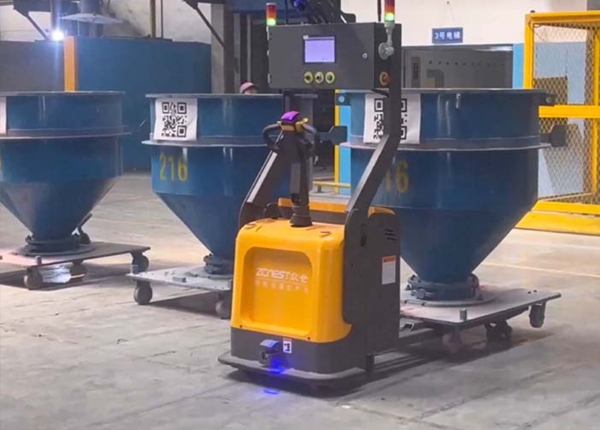
A practical recovery plan should identify which data must be backed up, where the backups are stored, how frequently they are created, and how the system can be restored if the main server becomes unavailable.
For an autonomous forklift fleet, the recovery scope may include several different layers of information:
Fleet management software and server configuration
Warehouse navigation maps
AGV routes and traffic rules
Pickup and drop-off locations
Charging station locations
Restricted zones and safety areas
Vehicle parameters and fleet configuration
Task and dispatching configurations
User accounts and software permissions
Integration settings for WMS, ERP, or other systems
Historical operational data and system logs
These items should not automatically be assumed to exist in one database. Different AGV manufacturers may store maps, configuration files, logs, and vehicle parameters in different locations or formats.
Before purchasing the system, the buyer should therefore request a written description of the backup architecture and recovery procedure.
There is no universal rule that every Chinese AGV fleet management system automatically performs daily database backups. Backup functionality depends on the specific software architecture supplied with the project.
Some systems may support scheduled database backups, while others may rely on manual administrator backups, operating-system-level backup tools, virtual-machine snapshots, or a separate backup server.
This distinction matters because a statement such as "the system supports backup" does not necessarily mean that a current and restorable backup is being created every day.
For a production warehouse, the buyer should ask the supplier to specify:
Whether automatic scheduled backups are supported
How frequently backups can be created
Whether backup frequency can be configured by the customer
Where backup files are stored
Whether backups can be copied to an independent storage system
How long historical backups are retained
Whether backups are encrypted
Whether the backup can be restored to replacement hardware
Whether the supplier has a documented restoration procedure
For a business-critical warehouse, relying only on a backup stored on the same physical server is not a strong disaster-recovery strategy. If the server's storage device fails, the backup may be lost together with the production database.
The recovery process normally starts with replacing or repairing the failed server hardware and then restoring the fleet software environment.
A typical recovery sequence may include:
Replace the failed storage device or prepare a replacement server.
Install the required operating system and fleet management software.
Restore the latest valid software configuration.
Restore the warehouse navigation map and route database.
Restore vehicle configuration and fleet parameters.
Restore WMS or ERP interface settings if applicable.
Reconnect the AGVs to the fleet server.
Verify vehicle communication and localization.
Test routes, charging stations, pickup points, and drop-off points.
Perform controlled operational testing before returning the fleet to normal production.
The important issue is whether the supplier can restore the complete operational environment rather than only restoring a raw database file.
For example, a backup containing the warehouse map may not be sufficient if the system also requires separate configuration files, software versions, vehicle parameters, database credentials, interface settings, or navigation-related files.
This is why an acceptance test for disaster recovery can be valuable. The supplier can demonstrate that a backup can actually be restored to a clean or replacement server instead of simply showing that backup files exist.
This depends heavily on the navigation architecture and the way the fleet system is designed.
An AGV's physical position, localization state, navigation map, task assignment, and fleet-server state are different pieces of information. They should not be treated as one single type of data.
For example, an AGV using Laser SLAM may use onboard sensors and its navigation software to estimate its position relative to a stored map. The fleet server may separately maintain information about vehicle status, tasks, traffic control, and dispatching.
If the central database suddenly fails, the vehicle may still have some local configuration or navigation information. However, that does not necessarily mean that it will retain its complete fleet state, assigned mission, traffic reservation, or exact operational position after a restart.
For safety reasons, a supplier should define the expected behavior after a server failure rather than assuming that the AGV will automatically continue exactly where it stopped.
The recovery procedure should answer questions such as:
What happens to an AGV if communication with the fleet server is lost?
Does the vehicle stop, finish the current movement, or enter a controlled recovery mode?
Which navigation data remains available locally?
Does the vehicle need to re-localize after the fleet server is restored?
Are active transport missions recovered automatically?
How are partially completed tasks handled?
How are traffic reservations reconstructed?
These behaviors should be verified during commissioning or FAT/SAT rather than left as an assumption.
There is no universal recovery time for a corrupted Chinese AGV fleet map. The actual time depends on whether a valid backup exists, the severity of the corruption, the software architecture, server availability, network access, and the complexity of the warehouse configuration.
Restoring a healthy backup may be relatively straightforward. Rebuilding a map from scratch is a very different task and can require additional engineering and on-site validation.
For this reason, an importer should not ask only, "How fast can your engineer fix the problem?" A better procurement question is:
"What is your documented recovery time target for a complete fleet-server failure, and what data must be available before remote recovery can begin?"
The supplier should also clarify the remote-support process. For example, support may require secure remote access to the fleet server, access to backup files, software version information, system logs, and administrator authorization.
If the warehouse operates around the clock, the support agreement should also define support hours, emergency response time, escalation procedures, and whether critical recovery assistance is available outside Chinese business hours.
For a business-critical fleet, maintaining an independent copy of the backup is generally a stronger approach than storing every backup on the production server.
Depending on the company's IT policy, the backup architecture could include a separate backup server, network-attached storage, a protected enterprise backup system, or another approved storage location.
The exact architecture should be agreed with the customer's IT department because warehouse automation systems may be subject to corporate cybersecurity, network segmentation, access-control, and data-retention requirements.
For imported Chinese fleet software, the buyer should also establish who owns the backup files and whether the customer can independently access and export them without requiring the supplier's intervention.
A practical disaster-recovery test can be included in the FAT or SAT process. The goal is not to intentionally damage the production system, but to demonstrate that the supplier's backup and restoration process actually works.
The test can verify:
Creation of a complete system backup
Export of the warehouse navigation map
Backup of fleet configuration
Backup of WMS or ERP interface configuration
Restoration on replacement hardware or an isolated test environment
Reconnection of representative AGVs
Verification of localization
Verification of routes and traffic rules
Verification of pickup and drop-off points
Verification of charging locations
Recovery of user permissions and system settings
Confirmation that the restored system can resume normal fleet operations
The buyer should record the actual recovery time during the test. This creates a much more useful benchmark than relying on a supplier's general statement that "remote support is available."
For an imported autonomous forklift fleet, the following questions should be included in the technical and commercial specification:
Does the fleet management system support automatic scheduled backups?
What data is included in a complete backup?
Can the warehouse navigation map be exported independently?
Can the customer restore the system without the supplier physically visiting the site?
Can backups be stored on customer-controlled infrastructure?
What happens to AGVs when the fleet server becomes unavailable?
Which data remains stored locally on each AGV?
How are active missions recovered after a server restart?
Can the fleet software be restored to replacement server hardware?
What is the supplier's target response time for a critical software failure?
What is the escalation process for an emergency?
Can the customer independently export maps, configurations, and historical data?
What software version and database version are required for restoration?
Is remote technical support included in the warranty or service agreement?
What happens if the original supplier is unavailable in the future?
For a small test fleet, a software recovery problem may be inconvenient. For a large warehouse operating dozens of autonomous forklifts, the same failure can interrupt material movement across an entire facility.
The most important issue is therefore not whether the Chinese fleet software has a backup button. The buyer needs to understand the complete recovery chain: backup creation, independent storage, map recovery, fleet configuration recovery, vehicle reconnection, task recovery, supplier response, and operational validation.
A reliable AGV project should leave the customer with more than operating vehicles. It should also provide a documented and testable way to recover the software environment if the central server, database, or configuration files are damaged.
FREE ENGINEERING SUPPORT Stop Gambling on Generic Platforms. Get an AGV/AMR Tailored to Your Warehouse.Buying automated guided vehicles involves complex safety standards (CE/ANSI), navigation setups (Laser SLAM), and ERP system integration. Don't risk your factory safety with middle-men. ✓ 100% Direct Factory: Customized payload up to 5 Tons. ✓ Free CAD Simulation: Send us your layout, and our engineers will simulate the optimal AGV routes. ✓ Global Support: Overseas installation guidance & local maintenance partners. |





 Chinese
 English