


Before importing an AGV fleet from China, a warehouse operator should complete a detailed feasibility study instead of starting with a vehicle quotation. An AGV may have the required payload and lift height, but that does not automatically mean it can deliver the required throughput in the actual warehouse.
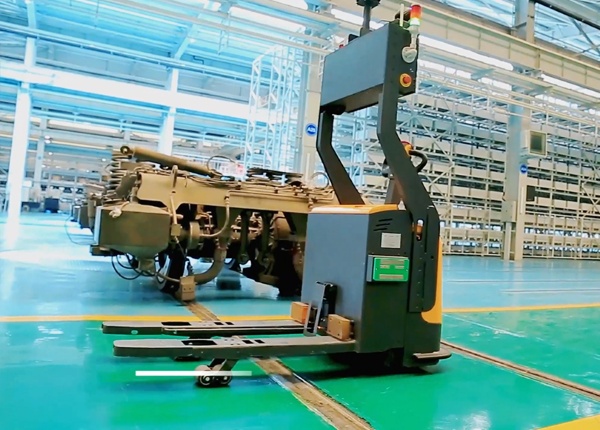
A serious feasibility study should connect four things: the warehouse's current operating data, the physical site conditions, the proposed AGV system, and the expected business return. This allows the buyer to determine whether the project is technically feasible, operationally practical, and financially justified before committing to imported equipment.
A detailed study should examine much more than aisle width and pallet weight. A Chinese automation supplier normally needs enough information to understand how material actually moves through the warehouse.
The study should typically cover:
Daily pallet movements
Peak hourly throughput
Number of shifts
Operating hours per shift
Pickup and drop-off locations
Average and maximum travel distances
Required response times
Number of simultaneous transport requests
Storage rack configuration
Aisle widths
Rack heights
Pallet dimensions and weights
Floor conditions
Charging locations
Pedestrian and forklift traffic
Loading dock and staging-area requirements
WMS or ERP integration requirements
Fire exits and restricted areas
Future warehouse expansion plans
The purpose is to determine whether the proposed AGV fleet can meet the required workload under realistic operating conditions, including peak periods rather than only average daily demand.
A Chinese AGV manufacturer cannot accurately size a fleet from a simple statement such as "we move 500 pallets per day." The supplier needs to understand when those movements occur and how the warehouse generates transport requests.
For example, 500 pallet movements distributed evenly across a 16-hour operating day create a very different workload from 500 movements concentrated into two peak hours.
Useful operational records include:
Pallet movements per hour
Pallet movements by shift
Peak movements during the busiest hour
Pickup-to-drop-off pairs
Average travel distance per movement
Maximum travel distance
Average loading and unloading time
Waiting time at pickup locations
Waiting time at storage locations
Forklift travel time
Queue time at congested areas
Number of manual forklifts currently operating
Battery charging or refueling downtime
Number of pallets waiting for transportation
If the warehouse already uses a WMS, transportation records can be particularly valuable because they may reveal the actual origin and destination distribution of pallet movements.
The buyer should ideally provide several weeks of representative operating data rather than relying only on one unusually busy or unusually quiet day.
A simple spreadsheet can be sufficient if the warehouse does not have a detailed transportation database.
A useful shift log can contain:
| Time | Pickup | Destination | Load | Distance | Manual Time |
|---|---|---|---|---|---|
| 08:10 | Receiving | Rack A | 900 kg | 120 m | 7 min |
| 08:18 | Rack B | Shipping | 750 kg | 180 m | 9 min |
The goal is not to produce a perfect engineering dataset. The purpose is to give the automation supplier enough real operating information to model traffic demand, cycle time, fleet size, and potential bottlenecks.
Many industrial automation companies can develop some form of warehouse simulation, but the level of realism varies significantly between suppliers.
A useful simulation should represent the actual operating constraints of the proposed project rather than simply showing several AGVs moving around a warehouse model.
Depending on the project, the simulation may represent:
Warehouse dimensions
Rack locations
Aisle widths
Pickup and drop-off stations
Staging areas
Charging areas
AGV travel paths
Traffic intersections
Vehicle acceleration and deceleration assumptions
Loading and unloading cycle times
Peak transport demand
Fleet size
Potential congestion points
The buyer should ask what assumptions are included in the simulation. A visually impressive 3D animation is not necessarily a throughput simulation.
A more useful deliverable should provide measurable outputs such as estimated completed transport missions per hour, vehicle utilization, waiting time, congestion areas, charging impact, and fleet capacity under the defined workload.
The simulation should also clearly distinguish between average performance and peak-period performance.
A realistic AGV ROI calculation needs a reliable baseline. Comparing the price of an AGV fleet directly with the hourly wage of a forklift operator is usually too simplistic.
The current manual pallet transport cost should consider the labor and operational resources required to perform the existing process.
A practical calculation can include:
Forklift operator wages
Payroll taxes and benefits
Overtime
Recruitment and training costs
Forklift lease or depreciation
Fuel or electricity
Maintenance
Tires and wear components
Operator waiting time
Travel and congestion losses
Product damage related to manual handling
Equipment downtime
Supervision costs
For example, if a warehouse uses several forklift operators during each shift, the buyer should calculate the actual annual labor cost associated with the pallet movements being considered for automation.
The calculation should then be compared with the complete cost of the proposed AGV solution, including vehicles, chargers, fleet software, integration, installation, commissioning, training, maintenance, spare parts, infrastructure modifications, and ongoing software or service costs where applicable.
One of the most common feasibility-study mistakes is sizing the AGV fleet according to average daily pallet movements.
Suppose a warehouse moves 800 pallets per day. That number alone does not tell the supplier how many AGVs are required.
If demand is evenly distributed, the fleet may have substantial idle capacity. If a large proportion of those movements occur during a short shipping window, the fleet may need significantly more capacity to prevent queues.
The feasibility model should therefore examine:
Average hourly demand
Peak hourly demand
Peak transport request bursts
Travel distance distribution
Loading and unloading cycle time
Traffic congestion
Charging requirements
Vehicle availability
Recovery from temporary congestion
A fleet that works during average conditions but cannot recover from peak demand may not meet the warehouse's actual operational requirements.
A feasibility study can become unreliable if important site conditions are missing or incorrectly represented.
Common problems include:
Incorrect warehouse dimensions
Outdated rack layouts
Incorrect aisle widths
Unrecorded columns or structural obstacles
Unexpected floor height transitions
Floor conditions that are unsuitable for the proposed vehicle configuration
Insufficient clearance around racks
Incorrect pallet dimensions
Unstable or damaged pallets
Unexpected pedestrian traffic
Insufficient staging space
Inadequate charging infrastructure
Blocked emergency routes
Unidentified doors or gates
Changes to the warehouse layout after the simulation data was collected
A CAD drawing alone is also not enough. Engineering drawings may not reflect temporary storage, actual pallet positions, damaged rack components, pedestrian behavior, or operational congestion.
A physical site survey is therefore an important part of a serious AGV feasibility study.
The AGV design must match the actual pallets used in the warehouse. A nominal pallet weight is not enough to determine compatibility.
The study should identify:
Pallet length and width
Overall load dimensions
Maximum load weight
Load center
Fork entry dimensions
Bottom-board configuration
Condition of the pallets
Load overhang
Load stability
Variation between pallet types
If multiple pallet types are used, each important type should be included in the feasibility assessment. A pallet that works well during a demonstration may not represent the most difficult pallet configuration in daily operation.
For high-bay or narrow-aisle warehouses, vehicle selection becomes closely connected to the rack system and building geometry.
The feasibility study should examine the complete combination of:
Vehicle overall dimensions
Required aisle width
Pallet dimensions
Load center
Lift height
Residual capacity at the required lift height
Rack beam geometry
Floor conditions
Pallet positioning tolerance
Rack protection and guidance requirements
Required operating clearances
The narrowest possible aisle should not automatically be treated as the best design. A slightly wider aisle may provide better throughput, easier maintenance access, improved pallet-entry tolerance, or lower operational risk.
Before approving the purchase, the customer should request a documented feasibility package rather than relying on a sales presentation.
A useful package can include:
Recommended AGV models
Required fleet quantity
Warehouse layout
AGV travel routes
Pickup and drop-off locations
Charging strategy
Estimated throughput
Peak-period capacity analysis
Traffic and congestion analysis
3D simulation where appropriate
WMS integration concept
Infrastructure modification requirements
Safety-zone concept
Site preparation requirements
Estimated implementation schedule
Assumptions and limitations
The assumptions are particularly important. If the supplier's throughput calculation assumes a specific loading time, pallet quality, floor condition, traffic pattern, or charging strategy, those assumptions should be documented.
The final decision should not be based on the AGV purchase price alone.
A project is more likely to be viable when the technical solution can meet the required throughput, the warehouse infrastructure can support the vehicles, the integration requirements are understood, and the financial model remains attractive after including implementation and ongoing operating costs.
If critical site information is missing, the correct decision may be to perform additional site measurements or a pilot rather than immediately approve the fleet purchase.
For an imported Chinese AGV project, a deep feasibility study should ultimately answer one practical question:
Can this specific fleet, in this specific warehouse, with these pallets, traffic patterns, infrastructure conditions, and operating hours, consistently deliver the required throughput at an acceptable total cost?
If the answer is supported by real operating data, physical site measurements, simulation assumptions, and a transparent cost model, the buyer has a much stronger basis for moving from supplier quotations to an actual AGV investment decision.
FREE ENGINEERING SUPPORT Stop Gambling on Generic Platforms. Get an AGV/AMR Tailored to Your Warehouse.Buying automated guided vehicles involves complex safety standards (CE/ANSI), navigation setups (Laser SLAM), and ERP system integration. Don't risk your factory safety with middle-men. ✓ 100% Direct Factory: Customized payload up to 5 Tons. ✓ Free CAD Simulation: Send us your layout, and our engineers will simulate the optimal AGV routes. ✓ Global Support: Overseas installation guidance & local maintenance partners. |





 Chinese
 English