


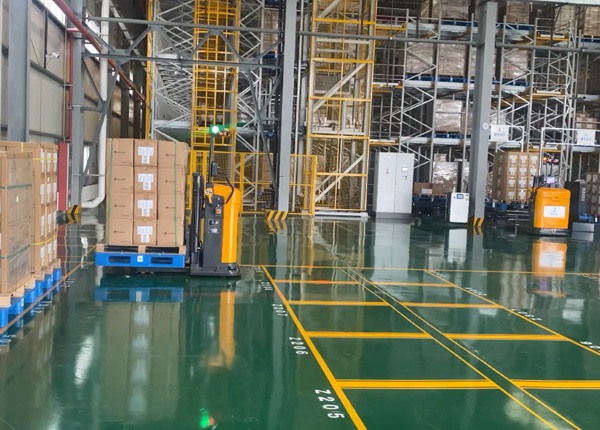
Complex warehouse intersections are one of the areas where the quality of an AGV fleet management system becomes highly visible.
A warehouse may have dozens of vehicles sharing the same aisles, cross aisles, staging areas, elevator approaches, and pedestrian zones.
Simple obstacle avoidance is not enough when several automated forklifts need to use the same intersection at the same time.
When evaluating Chinese AGV software, the key question is not simply whether the system supports automatic routing.
The more important question is whether the fleet management system can control right-of-way, traffic priorities, congestion, deadlocks, temporary restrictions, and abnormal obstacles in a predictable way.
Most warehouse AGV systems use a fleet management system or robot control system to coordinate vehicle traffic. The individual AGV handles local perception and obstacle avoidance, while the fleet-level system can make higher-level decisions about task assignment and route allocation.
At a simple intersection, the software may allow one vehicle to enter while another waits. At a high-volume junction, however, the system may need to consider several variables:
Vehicle priority
Current vehicle position
Destination
Loaded or unloaded status
Task urgency
Current route occupancy
Intersection capacity
Traffic direction
Blocked segments
Pedestrian restrictions
Temporary warehouse traffic rules
A mature system should therefore treat a complex intersection as a controlled traffic resource rather than simply as a point on a navigation map.
In many AGV fleet management systems, traffic rules can be configured at the software level, but the exact level of customization depends on the supplier's RCS or fleet management architecture.
A procurement team should not accept a general statement such as “the system supports traffic control.” Instead, ask the supplier to demonstrate the exact configuration interface and available rule types.
Potential configuration options may include:
Priority by AGV or vehicle group
Priority by task type
Priority by route
Priority by warehouse zone
One-way traffic rules
Restricted entry zones
Intersection reservation
Segment reservation
Vehicle waiting rules
Temporary traffic restrictions
Speed restrictions
Time-based traffic rules
For example, a warehouse may want a loaded pallet-moving AGV heading toward a shipping area to receive higher priority than an empty vehicle returning to a parking position. Another warehouse may prioritize vehicles serving a high-throughput picking or staging zone.
However, priority rules should not be confused with safety functions. A software traffic priority should never override a safety-rated protective function, emergency stop, or required protective field. The traffic management layer controls operational flow, while safety functions must remain independent and appropriately validated.
A four-vehicle deadlock is a useful FAT test because it exposes weaknesses that may not appear during normal one-way traffic.
Consider four automated forklifts approaching a shared intersection from four directions. If every vehicle is waiting for another vehicle to move first, the fleet can enter a circular waiting condition.
A fleet management system may use several strategies to prevent or recover from this situation:
Intersection reservation before entry
Segment reservation
Conflict prediction
Route recalculation
Priority reassignment
Vehicle back-off or release rules
Alternative route selection
Deadlock detection based on vehicle state and waiting time
Operator intervention when automatic recovery is not possible
The exact algorithm is supplier-specific and should not be assumed from the fact that a system uses SLAM navigation. Navigation technology and fleet dispatch logic are separate technical layers.
For a serious warehouse project, the buyer should ask the supplier to demonstrate a controlled four-AGV deadlock during FAT. The test should record which vehicle receives priority, how the other vehicles respond, how long the system takes to recover, and whether the fleet returns to normal traffic automatically.
This distinction is important when evaluating AGV software.
Local obstacle avoidance normally operates at the vehicle level. Sensors detect an obstacle and the AGV slows down, stops, or attempts a local avoidance maneuver according to its configuration.
Fleet traffic management operates at a higher level. It determines which vehicle should use a route, whether a section should be reserved, and how multiple vehicles should coordinate their movements.
If a manual pallet truck suddenly enters an intersection, the AGV's local safety and obstacle detection functions may stop the vehicle. The fleet management system may then need to decide whether the vehicle should continue waiting, request a new route, or report an exception.
A strong system therefore needs both layers. Fleet optimization cannot replace local safety sensing, and local obstacle avoidance cannot replace fleet-level traffic coordination.
Many warehouse AGV systems support configurable speed zones or route restrictions, but the exact implementation varies by vehicle and software platform.
For example, a warehouse may define a pedestrian walkway crossing as a low-speed area. When an AGV enters the configured zone, the fleet or vehicle control system can apply a lower operational speed limit.
Other possible applications include:
Pedestrian crossing areas
Warehouse doors
Loading and unloading zones
High-traffic intersections
Blind corners
Areas near offices
Charging zones
Temporary construction areas
Areas with frequent manual forklift traffic
The important distinction is between a normal operational speed restriction and a safety-rated protective function. A software-defined low-speed zone can be part of traffic management, but it should not be treated as a substitute for required safety sensing, protective separation, emergency stopping, or other applicable safeguards.
In many systems, changing a speed parameter for an existing mapped zone does not necessarily require creating a completely new map. However, the exact procedure depends on how the supplier stores map geometry, traffic rules, route parameters, and safety configurations.
A good software architecture separates the warehouse map from configurable traffic parameters where practical. This allows an operator or authorized engineer to modify operational rules without rebuilding the entire navigation environment.
During the project, ask the supplier:
Can speed zones be edited by authorized users?
Can changes be made remotely?
Are changes logged?
Can previous configurations be restored?
Does changing a speed zone require map regeneration?
Does a change require on-site validation?
Which parameters require supplier authorization?
This is one of the most realistic tests for an AGV warehouse because human-operated equipment does not always follow the digital traffic map.
Suppose an AGV approaches an intersection and detects a manual pallet truck parked directly across its planned path. The AGV should not simply follow its original route because the digital map says the intersection is available.
Depending on the vehicle configuration, the AGV may:
Reduce speed
Stop before the obstacle
Wait for the path to become clear
Attempt a permitted local avoidance maneuver
Request a new route
Release the blocked route reservation
Report a traffic exception to the fleet manager
Request operator intervention if the obstruction remains
The exact behavior depends on the AGV's sensors, navigation system, traffic rules, local obstacle avoidance capabilities, and fleet management software. The buyer should therefore test the actual vehicle rather than relying on a software feature list.
Intersection management should be tested using scenarios that represent the real warehouse rather than only demonstrating an empty-floor navigation route.
A useful FAT sequence can include:
Two AGVs approach the same intersection from different directions.
Three AGVs request the same intersection simultaneously.
Four AGVs are deliberately placed into a potential deadlock scenario.
A loaded AGV competes with an empty AGV for the same route.
A manual pallet truck blocks the intersection.
A pedestrian enters a designated walkway near the intersection.
A temporary slow-speed zone is activated.
An alternative route becomes unavailable.
One AGV loses communication with the fleet manager.
The original traffic condition is restored and normal operation is verified.
For each test, the acceptance criteria should define the expected vehicle behavior, maximum waiting time where applicable, alarm behavior, recovery process, and whether operator intervention is required.
Instead of asking only whether the software has “automatic traffic management,” include specific requirements in the RFQ.
| Requirement | Question for the Supplier |
|---|---|
| Intersection Priority | Can priorities be configured by vehicle, task, route, or zone? |
| Intersection Reservation | Can an intersection be reserved before an AGV enters it? |
| Deadlock Recovery | How does the system detect and recover from multi-vehicle deadlocks? |
| Dynamic Speed Zones | Can authorized users create or modify operational speed zones? |
| Blocked Intersection | What happens when a manually operated pallet truck blocks a route? |
| Alternative Routing | Can the fleet automatically select another available route? |
| Configuration History | Are traffic-rule changes logged and reversible? |
| Operator Intervention | How are unresolved traffic exceptions presented to operators? |
A warehouse can appear to operate normally during a small demonstration while experiencing serious congestion after the fleet is expanded. Traffic behavior is strongly affected by vehicle count, task distribution, aisle layout, intersection geometry, staging locations, and pedestrian activity.
For this reason, intersection traffic should be treated as an engineering acceptance item rather than a software marketing feature.
The supplier should demonstrate the actual dispatch behavior using representative vehicle numbers, representative pallet loads, real intersection geometry, and realistic task frequencies.
The objective is not simply to prove that the AGVs can avoid each other. The objective is to prove that the fleet can maintain predictable traffic flow when multiple vehicles compete for limited warehouse space and unexpected manual traffic temporarily changes the environment.
FREE ENGINEERING SUPPORT Stop Gambling on Generic Platforms. Get an AGV/AMR Tailored to Your Warehouse.Buying automated guided vehicles involves complex safety standards (CE/ANSI), navigation setups (Laser SLAM), and ERP system integration. Don't risk your factory safety with middle-men. ✓ 100% Direct Factory: Customized payload up to 5 Tons. ✓ Free CAD Simulation: Send us your layout, and our engineers will simulate the optimal AGV routes. ✓ Global Support: Overseas installation guidance & local maintenance partners. |





 Chinese
 English