


Commercial warehouses rarely use only one pallet type.
A facility may handle wooden pallets, plastic pallets, composite pallets, metal cages, wire mesh containers, and customer-specific load carriers within the same operation.
For an automated forklift imported from China, this creates an important engineering question: can one AGV reliably identify and handle all of these load profiles?
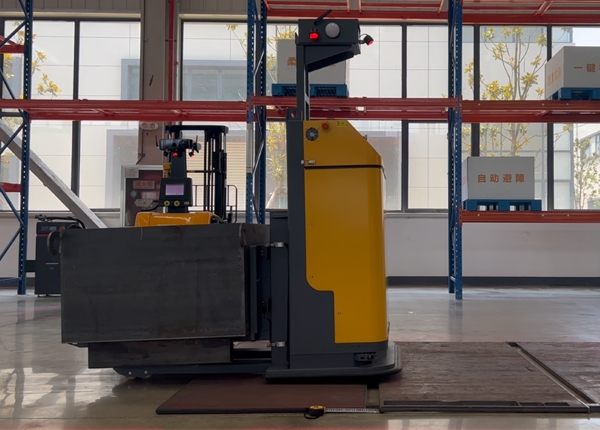
Pallet compatibility depends on more than the pallet's overall dimensions.
The AGV must account for fork-entry openings, pallet height, bottom structure, surface condition, load weight, center of gravity, material, reflectivity, and dimensional tolerances.
These variables should be evaluated before selecting the vehicle and finalizing the warehouse automation design.
The first step is to create a pallet profile database. For every pallet or load carrier used in the warehouse, record the physical characteristics that could affect automated handling.
Pallet length and width
Overall pallet height
Fork-entry opening dimensions
Bottom deck design
Fork pocket height
Maximum payload
Typical payload
Load center
Pallet material
Pallet weight
Surface condition
Dimensional tolerance
Damaged-pallet frequency
A Chinese AGV manufacturer can then determine whether the standard fork dimensions and sensing configuration are suitable or whether mechanical or software modifications are required.
Plastic pallets can generally be automated, but their surface and structural characteristics can differ significantly from traditional wooden pallets. Some plastic pallets have smooth surfaces, reinforced ribs, or different fork-entry geometries.
The important question is not simply whether an AGV can lift a plastic pallet. The engineering team should verify whether the pallet can be detected, centered, entered, lifted, transported, and deposited consistently under real operating conditions.
For slick plastic pallets, testing should consider:
Fork-to-pallet clearance
Fork entry depth
Pallet deformation under load
Surface friction
Load stability during acceleration
Braking behavior
Positioning accuracy during storage
If plastic pallets are used extensively, the customer should provide representative samples to the Chinese AGV manufacturer before finalizing the fork and navigation configuration.
Black or dark-colored plastic containers can present different sensing conditions from light-colored objects. The actual performance depends on the sensor technology, lighting conditions, viewing angle, object geometry, reflectivity, and software algorithms.
A vision system should therefore be tested using the actual containers rather than relying only on a specification sheet.
The test should include:
Black plastic containers
Different container orientations
Partially loaded containers
Containers with damaged edges
Different warehouse lighting conditions
Objects partially obscured by other pallets
If the AGV relies on vision for pallet or container detection, the manufacturer should demonstrate successful recognition under the actual warehouse conditions.
Color alone should not be treated as the only factor affecting detection. Modern industrial AGVs may combine multiple sensing technologies rather than relying exclusively on a camera.
Depending on the vehicle design, pallet detection can involve combinations of:
2D LiDAR
3D LiDAR
Industrial cameras
Depth cameras
Fork-mounted sensors
Proximity sensors
Load-position sensors
The customer should ask the Chinese supplier exactly which sensor is responsible for pallet detection and which sensor confirms successful fork insertion. This distinction is important because navigation sensors and load-handling sensors perform different functions.
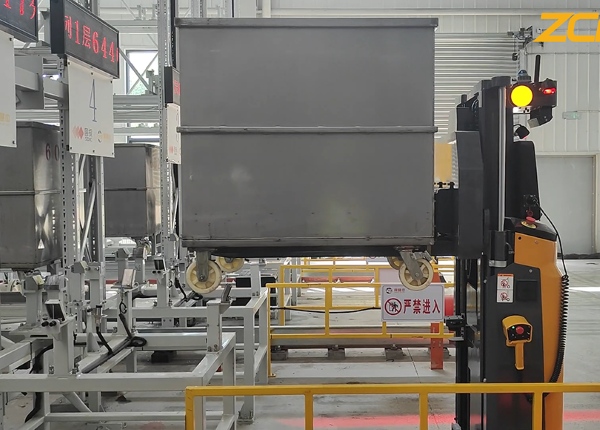
Wire mesh cages create a different challenge because their structure is open rather than solid. The AGV may need to identify the cage frame, fork pockets, and actual load position while avoiding incorrect detection of the empty spaces between the metal wires.
The engineering team should verify:
Cage dimensions
Fork-entry geometry
Mesh opening size
Metal frame thickness
Maximum cargo weight
Center of gravity
Load protrusion
Container deformation
If the cage contains irregular or unstable materials, load stability may become more important than the cage itself. The AGV's acceleration, braking, lifting, and steering parameters should therefore be evaluated with the actual loaded cage.
A hydraulic lifting system does not automatically guarantee gentle load handling. The overall motion profile is determined by the vehicle's hydraulic system, drive system, control software, load characteristics, and operating parameters.
For fragile or unstable loads, the control system may need carefully configured:
Lift acceleration
Lift deceleration
Travel acceleration
Travel deceleration
Maximum travel speed
Fork positioning speed
Load height limits
Emergency braking behavior
These settings should be validated with the actual load rather than simply selecting the slowest possible operating speed. Excessively slow movement can reduce warehouse throughput without necessarily solving the underlying load-stability problem.
Some AGV fleet management systems or vehicle controllers allow operating parameters to be associated with specific tasks, locations, load types, or operating zones. The exact level of configurability varies between manufacturers.
For example, a warehouse may require different handling parameters for:
Standard wooden pallets
Light plastic pallets
Heavy composite pallets
Wire mesh cages
Fragile loads
High-center-of-gravity loads
A slower fork-entry speed can be useful when the pallet has a narrow tolerance or fragile contents. However, the software should prevent unauthorized users from changing safety-critical parameters.
During the RFQ stage, ask whether pallet-specific operating profiles can be configured and which parameters can be adjusted by the customer.
Real warehouses rarely present perfectly positioned pallets. Pallets may be shifted several centimeters, rotated slightly, damaged, or placed unevenly inside a staging area.
An automated forklift should therefore be tested against realistic pallet-position tolerances.
The test should determine:
Maximum lateral offset
Maximum rotational deviation
Maximum pallet height deviation
Minimum fork-entry clearance
Detection distance
Recovery behavior when alignment is unsuccessful
The AGV should not simply continue driving when it cannot establish a safe fork-entry position. The appropriate behavior may be to stop, reposition, request a new task, or notify the operator depending on the system configuration.
A pallet compatibility test should be completed before the final vehicle configuration is approved. The customer should provide representative samples of every important pallet type.
A practical test matrix can include:
| Test | What to Verify |
|---|---|
| Detection | Can the AGV reliably identify the pallet or container? |
| Fork Entry | Can the forks enter the correct openings without collision? |
| Lifting | Can the vehicle lift the maximum specified load safely? |
| Travel | Does the load remain stable during acceleration and braking? |
| Positioning | Can the AGV place the load within the required tolerance? |
| Recovery | What happens when pallet alignment is outside the acceptable range? |
Yes. If a particular pallet type is essential to the project, compatibility should become a formal Factory Acceptance Test requirement rather than an informal demonstration.
The FAT should identify each approved pallet type and define measurable acceptance criteria. For example, the test can specify the pallet dimensions, payload, alignment tolerance, pickup success rate, placement accuracy, and required cycle time.
This protects both sides. The customer receives a clearly defined handling capability, while the Chinese manufacturer knows exactly which pallet conditions the AGV must support.
A useful RFQ package should contain more than pallet photographs. The engineering team should receive dimensional drawings, photographs, pallet samples when practical, and information about the actual loads.
Pallet CAD drawings
Overall dimensions
Fork-pocket dimensions
Empty pallet weight
Maximum loaded weight
Load center
Material specification
Representative photographs
Typical pallet condition
Damaged-pallet percentage
Required pickup and placement accuracy
Required cycle time
For unusual load carriers, physical samples are particularly valuable. A drawing may describe the nominal dimensions but cannot always show surface friction, deformation, flexibility, or the way the actual load behaves during acceleration and braking.
| Requirement | Question for the Supplier |
|---|---|
| Pallet Types | Which pallet materials and dimensions has this AGV been tested with? |
| Plastic Pallets | Can the vehicle reliably pick up smooth plastic pallets under the specified payload? |
| Black Containers | Which sensors detect dark or black plastic containers? |
| Wire Cages | Can the vehicle detect and safely handle wire mesh cages? |
| Speed Profiles | Can different pallet types have different fork-entry and travel parameters? |
| Alignment | What pallet position tolerance can the AGV compensate for automatically? |
| Testing | Can representative customer pallets be included in FAT and SAT testing? |
The safest approach is to treat pallet compatibility as an engineering requirement rather than a general product feature.
Start by identifying every pallet and load carrier used in the warehouse. Document their dimensions, materials, payloads, fork-entry geometry, condition, and tolerances. Then provide this information to the Chinese AGV manufacturer during the feasibility and design stage.
The final vehicle configuration should be validated with representative pallets under realistic warehouse conditions. Testing should cover pickup, lifting, transportation, braking, positioning, unloading, and recovery from abnormal alignment.
For warehouses using multiple pallet standards, the objective is not simply to prove that the AGV can lift one pallet successfully. The objective is to establish a repeatable handling envelope that defines which pallet profiles the fleet can process reliably and what operating parameters apply to each one.
FREE ENGINEERING SUPPORT Stop Gambling on Generic Platforms. Get an AGV/AMR Tailored to Your Warehouse.Buying automated guided vehicles involves complex safety standards (CE/ANSI), navigation setups (Laser SLAM), and ERP system integration. Don't risk your factory safety with middle-men. ✓ 100% Direct Factory: Customized payload up to 5 Tons. ✓ Free CAD Simulation: Send us your layout, and our engineers will simulate the optimal AGV routes. ✓ Global Support: Overseas installation guidance & local maintenance partners. |





 Chinese
 English