


Importing an AGV fleet from China does not end when the vehicles arrive at your warehouse.
A long-term spare parts strategy is equally important because a relatively inexpensive component can stop an automated forklift from operating if no replacement is available.
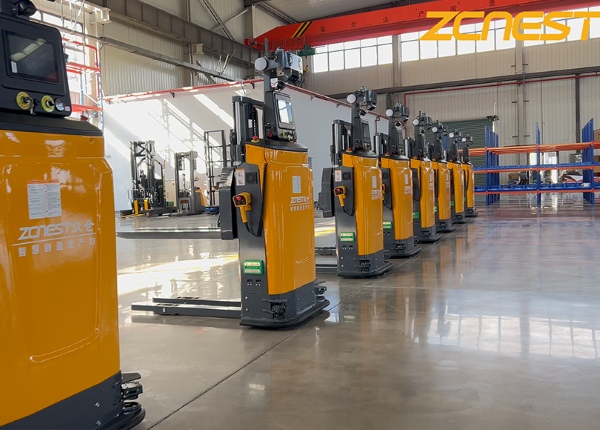
For an overseas warehouse, the problem is more complicated than simply buying a box of spare parts.
The customer must determine which components are likely to wear, which components can cause extended downtime, which parts should be stored locally, and which parts can be purchased from local suppliers.
A well-designed spare parts inventory should therefore be based on three factors: failure probability, replacement lead time, and operational impact.
The exact list depends on the AGV model, operating hours, payload, warehouse environment, and supplier design. However, an initial inventory for an overseas fleet commonly focuses on mechanical wear parts, sensors, electrical components, and critical control hardware.
Drive wheels or polyurethane tires
Load wheels and caster wheels
Fork-position sensors
Proximity sensors
Safety sensors
Navigation sensors
Encoders
Fuses and circuit protection components
Contactors and relays
Charging connectors
Hydraulic seals and filters
Hydraulic hoses
Drive motors or motor components
Battery-related components
Industrial computer or controller components
Communication modules
Emergency-stop components
Not every item needs to be stocked in large quantities. The objective is to identify the small number of components that could create disproportionate downtime if they fail.
There is no universal ranking because AGV designs differ considerably. A better approach is to divide parts into wear items and critical electronic components.
Wheels are exposed to continuous mechanical loading and floor contact. Their service life depends on operating hours, payload, floor condition, turning frequency, acceleration, braking, and wheel material.
For this reason, drive wheels and load wheels are among the first components an overseas warehouse should evaluate for local stocking.
Sensors can be damaged by impact, contamination, vibration, or environmental conditions. A failed sensor may stop the vehicle even when the mechanical system remains completely functional.
The spare-parts list should identify exactly which sensors are safety-critical and which are used only for positioning or process detection.
Automated forklifts with hydraulic lifting systems may require replacement filters, seals, hoses, valves, or other hydraulic components during their service life.
Small hydraulic components can be relatively inexpensive compared with the downtime caused by waiting for an international shipment.
Controllers, communication modules, power components, contactors, and other electronic hardware can have a lower replacement frequency than wheels but potentially create much longer downtime.
These parts therefore deserve a different inventory strategy: lower quantity but higher priority.
For electric AGVs, charging equipment is part of the operational system. Charging connectors, communication modules, fuses, contactors, and related components should be considered when creating the initial spare-parts package.
Yes, negotiating an initial spare-parts package before shipment can be more efficient than trying to identify every required component after the fleet has already entered service.
The initial package can contain a combination of:
Fast-wearing mechanical components
Critical sensors
Electrical protection components
Common connectors
Hydraulic consumables
Emergency electronic components
The supplier should provide a complete parts list with part numbers, descriptions, recommended quantities, unit prices, and estimated replacement intervals where available.
This information is particularly important for international customers because the same component may be difficult to identify later if the warehouse only has a photograph or informal component description.
The correct quantity depends on fleet size and expected wheel replacement frequency. Instead of using a generic number, calculate the expected consumption for the first operating period and then add a contingency quantity.
For example, if the supplier estimates that a particular wheel lasts a certain number of operating hours, the warehouse can estimate annual consumption based on:
Number of AGVs
Operating hours per day
Operating days per year
Average payload
Floor conditions
Expected wheel service life
The supplier should provide the wheel's exact part number and dimensions so that the customer can investigate whether an equivalent locally available component exists.
Possibly, but dimensional compatibility alone is not enough. A locally sourced wheel must match the mechanical and operational requirements of the original component.
The engineering team should compare:
Outer diameter
Width
Bore diameter
Mounting dimensions
Load rating
Hardness
Polyurethane formulation
Temperature range
Floor compatibility
Maximum operating speed
A wheel that physically fits the AGV may still alter traction, braking distance, steering behavior, or navigation accuracy.
Before replacing an original wheel with a local equivalent, obtain approval from the AGV manufacturer and validate the replacement under operating conditions.
Emergency delivery time depends on whether the part is already in stock, the supplier's logistics process, export documentation, carrier availability, customs clearance, and the delivery location in the United States.
A supplier should therefore provide more than a general statement such as "fast delivery." The purchasing agreement should identify:
Emergency response time
Parts availability
Order processing time
Typical air shipment time
Shipping responsibility
Customs documentation
Tracking information
Technical support during replacement
For a critical motherboard or industrial controller, the warehouse should ideally hold at least one locally available spare when the failure of that component could stop the entire fleet or a critical operating zone.
For larger fleets, critical electronic controllers deserve special attention. A controller may fail infrequently, but replacement can create significant downtime if the exact model must be shipped internationally.
Before purchasing, determine whether the replacement controller is:
Plug-and-play
Preconfigured
Required to be programmed by the supplier
Required to contain a specific software version
Required to receive a license or activation key
Required to be calibrated after installation
A spare controller that cannot be commissioned without remote assistance may not provide the same level of protection as a fully prepared replacement unit.
A useful way to categorize spare parts is by downtime risk.
| Category | Recommended Strategy |
|---|---|
| Fast-wearing parts | Keep multiple units locally |
| Common sensors | Keep several replacement units |
| Critical controller | Consider at least one emergency spare |
| Rare electronic component | Evaluate failure probability versus lead time |
| Large expensive assembly | Use supplier emergency-stock agreement where practical |
If the component is proprietary, the warehouse may have no practical local replacement option. This is why the spare-parts strategy should be developed during procurement rather than after the first failure.
Ask the supplier whether critical components are:
Proprietary
Industry-standard
Available from multiple suppliers
Locally replaceable
Software-locked
Dependent on manufacturer calibration
For proprietary components, consider keeping an emergency spare at the facility or negotiating a regional parts-stock arrangement.
A simple approach is to classify every part using three variables:
Probability of failure
Replacement lead time
Business impact of failure
A wheel may have a relatively high replacement frequency but a low unit cost. A main controller may have a very low failure frequency but a very high downtime impact. Both may therefore deserve inventory, but in very different quantities.
The most important question is:How long can the warehouse tolerate the AGV being unavailable?
If a vehicle can be removed from service for several days without affecting throughput, international emergency shipping may be acceptable. If one failed component can stop a critical warehouse process, keeping a local spare becomes much more valuable.
The supplier should provide a structured spare-parts catalog before the project enters mass deployment.
| Information | Why It Matters |
|---|---|
| Part Number | Prevents ordering the wrong component |
| Component Description | Makes identification easier for local maintenance teams |
| Expected Service Life | Helps forecast future inventory demand |
| Unit Price | Supports long-term TCO planning |
| Lead Time | Determines whether local inventory is necessary |
| Replacement Procedure | Allows local technicians to assess installation requirements |
| Calibration Requirement | Prevents unexpected commissioning delays |
Yes. For an overseas AGV project, the spare-parts package should be addressed during contract negotiation rather than treated as an after-sales detail.
The purchase agreement can define:
Initial spare-parts package
Recommended minimum stock
Critical spare components
Replacement-part pricing
Emergency shipping procedure
Technical support response time
Warranty replacement procedure
Software requirements for replacement controllers
Availability period for discontinued components
This creates a clearer long-term support model and reduces the risk of discovering an important spare-parts limitation after deployment.
The strongest strategy combines local inventory with a reliable international supply chain.
The warehouse should keep high-frequency and high-impact components locally while maintaining a defined emergency procurement process for expensive or rarely used parts.
The maintenance team should also record every component replacement. Over time, actual failure data will become more useful than the manufacturer's generic estimates because it reflects the warehouse's real operating conditions.
After several months of operation, review:
Parts consumed
Parts never used
Mean time between failures
Average replacement time
Supplier response time
International shipping time
Downtime caused by unavailable parts
The inventory can then be adjusted based on actual fleet performance.
| Question | Purpose |
|---|---|
| Which five parts are replaced most frequently? | Identify high-consumption inventory |
| Which failure can cause the longest downtime? | Identify critical spare parts |
| Which parts are proprietary? | Identify local sourcing limitations |
| Which components are standard industrial parts? | Identify local procurement opportunities |
| What is the normal parts lead time? | Determine required local inventory |
| What is the emergency air-shipment procedure? | Prepare for unexpected failures |
| Can replacement controllers be preconfigured? | Reduce commissioning downtime |
| How long will spare parts remain available? | Protect long-term fleet support |
The best strategy is not to purchase the largest possible inventory. It is to identify the components that create the greatest operational risk and make those components immediately available.
For most overseas fleets, this means maintaining local stocks of common wear parts and critical sensors while establishing a defined emergency supply channel with the Chinese manufacturer for specialized electronic and mechanical assemblies.
Before the first AGV arrives, obtain the complete parts catalog, replacement procedures, lead times, and recommended inventory levels. Then use actual failure data after deployment to refine the stock level.
A Chinese AGV can be technically reliable, but the practical reliability of the entire warehouse system also depends on how quickly the customer can recover from a component failure. A well-planned spare-parts inventory turns an unexpected component failure from a potentially long international logistics problem into a controlled maintenance event.
FREE ENGINEERING SUPPORT Stop Gambling on Generic Platforms. Get an AGV/AMR Tailored to Your Warehouse.Buying automated guided vehicles involves complex safety standards (CE/ANSI), navigation setups (Laser SLAM), and ERP system integration. Don't risk your factory safety with middle-men. ✓ 100% Direct Factory: Customized payload up to 5 Tons. ✓ Free CAD Simulation: Send us your layout, and our engineers will simulate the optimal AGV routes. ✓ Global Support: Overseas installation guidance & local maintenance partners. |





 Chinese
 English