


Floor condition is one of the most important infrastructure factors when deploying automated forklifts.
An AGV may have accurate navigation, powerful drive motors and advanced safety sensors, but poor floor conditions can still affect traction, positioning accuracy, vibration, braking, fork alignment and long-term mechanical reliability.
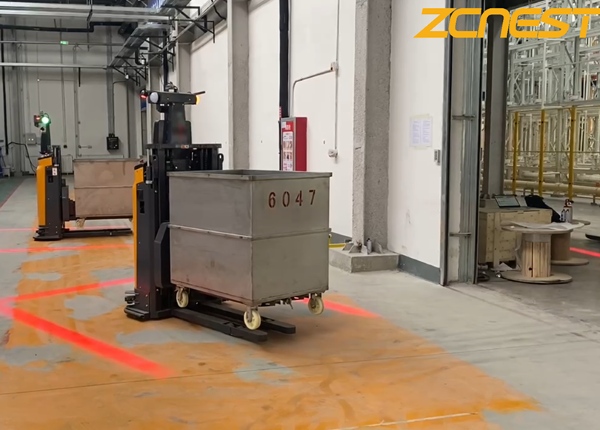
This is particularly important when importing automated forklifts from China because the vehicle is designed around specific operating conditions.
Before shipment, the customer should verify whether the actual warehouse floor meets the manufacturer's requirements for flatness, levelness, joints, thresholds, cracks, slopes and surface condition.
Yes, many industrial AGVs can operate on concrete warehouse floors that are not perfectly smooth. However, "rough floor" and "unacceptable floor" are not the same thing.
The vehicle's ability to tolerate unevenness depends on its mechanical structure, wheel configuration, suspension or damping system, ground clearance, drive-wheel design, navigation technology, operating speed and payload.
A floor that is acceptable at low speed may not provide the same performance at high speed. Similarly, a small surface defect may have little effect during empty travel but become more significant when the vehicle is carrying a heavy pallet at maximum lift height.
The correct approach is therefore to define measurable floor limits rather than simply asking whether the AGV can "handle uneven ground."
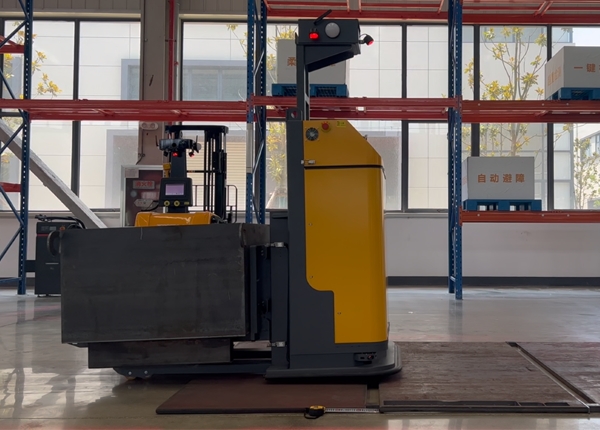
A 12mm steel plate does not automatically mean that an AGV will lose its navigation map. Navigation and mechanical floor traversal are separate issues.
The navigation system may continue to understand the vehicle's position correctly while the physical transition creates vibration, wheel impact or temporary traction changes.
The engineering team should evaluate:
Plate thickness
Plate width
Plate edge shape
Height difference between surfaces
Direction of travel
Vehicle wheel diameter
Ground clearance
Vehicle speed
Payload weight
Fork height during traversal
A beveled transition is generally easier for an industrial vehicle to negotiate than a sharp vertical edge. The actual limit should be confirmed through supplier testing using the specific AGV model and operating configuration.
Most industrial warehouses contain construction joints or expansion joints. The presence of a joint does not automatically prevent AGV operation.
The critical factors are the joint width, depth, vertical offset and whether the joint contains a smooth transition.
A narrow joint with minimal height variation may be relatively easy for a vehicle to cross. A wide or damaged joint can create repeated impacts on the wheels and chassis.
For an automated forklift, the problem becomes more important when the vehicle is carrying a heavy load or operating at high speed.
During a site survey, measure the worst sections of the warehouse instead of relying on an average floor condition.
A small surface crack does not necessarily prevent automated forklift operation. The important distinction is whether the crack is merely a surface defect or represents a significant discontinuity in the driving surface.
Inspect the following characteristics:
Crack width
Crack depth
Vertical displacement
Length of the damaged section
Number of repeated crossings
Vehicle speed
Wheel diameter
Payload
A crack that produces no meaningful height difference may be much less problematic than a damaged joint with a raised concrete edge.
The supplier should evaluate the actual floor condition during the feasibility study rather than approving the site solely from photographs.
Different AGV designs use different mechanical approaches to maintain wheel contact and reduce vibration. Some vehicles use suspension or compliant wheel assemblies, while others rely primarily on wheel design, chassis geometry and controlled operating speed.
The purpose of the mechanical system is not simply to make the ride more comfortable. It can also help maintain:
Wheel-floor contact
Traction
Vehicle stability
Navigation sensor stability
Fork positioning stability
Electronic component protection
Repeated shocks can also contribute to long-term mechanical and electrical stress. For this reason, the floor specification should be considered part of the AGV's reliability requirements.
Floor vibration can affect sensor measurements indirectly if it causes significant movement of the sensor assembly. However, the impact depends on the vehicle design and navigation architecture.
For a laser SLAM AGV, the navigation system continuously estimates vehicle position using environmental features detected by the laser sensor. If the vehicle experiences substantial vibration or wheel slip, localization performance may be affected depending on the system's sensor fusion and control algorithms.
A proper engineering test should therefore examine navigation performance while the AGV crosses the actual floor defects at the intended operating speed.
Yes. Uneven surfaces can reduce the effective contact between the drive wheel and the floor. The effect becomes more significant when the floor is dusty, wet, oily or highly polished.
Wheel slip can affect both vehicle movement and positioning. If the AGV uses wheel encoders as part of its localization system, unexpected wheel rotation without corresponding vehicle movement can increase odometry error.
Modern AGVs may combine multiple sensors to compensate for this type of error, but the customer should not assume that sensor fusion eliminates every floor-related limitation.
The safest approach is to specify the required floor condition and validate the AGV on representative sections of the actual warehouse.
There is no single floor-flatness value that applies to every Chinese AGV. The required specification depends on the vehicle type, speed, payload, lift height, wheel configuration and operating environment.
A high-lift reach AGV may require more demanding floor conditions than a low-speed pallet transport vehicle because floor-induced movement can affect load stability and high-level placement accuracy.
When requesting a quotation, ask the supplier to provide the exact floor requirements for the selected vehicle. The specification should identify measurable limits for:
Flatness
Levelness
Floor slope
Joint width
Height differences
Crack dimensions
Surface roughness
Floor load capacity
Floor imperfections become more important as the lifting height increases. When a load is lifted several meters above the floor, small vehicle movements can produce larger movements at the load.
This can affect:
Rack approach accuracy
Pallet insertion
Load stability
Mast movement
Fork positioning
Rack clearance
For high-bay warehouses, floor flatness should therefore be evaluated together with rack geometry and AGV positioning accuracy.
Do not rely only on a visual inspection. A professional site assessment should measure the actual driving areas used by the AGVs.
The survey should cover:
Main travel lanes
Turning areas
Pickup stations
Rack aisles
Charging areas
Docking locations
Door thresholds
Expansion joints
Damaged concrete sections
The measurement method should be agreed with the AGV supplier because different floor standards use different measurement procedures and reference lengths.
The goal is to create a floor-condition map that can be compared directly with the vehicle manufacturer's technical requirements.
A floor that does not meet the manufacturer's specification does not necessarily mean that the automation project must be cancelled. There may be several engineering options.
Repair damaged concrete
Grind high spots
Fill cracks or joints
Install beveled transition plates
Reduce vehicle speed in specific zones
Create restricted operating areas
Adjust navigation paths
Modify wheel configuration
Use a different AGV model
The best solution depends on whether the problem is isolated or widespread. Repairing several localized defects may be much cheaper than modifying the entire warehouse floor.
Some fleet management systems can apply different speed limits to predefined zones. This can be useful when a warehouse contains a small number of areas where the floor condition is worse than the main travel lanes.
For example, the customer may define reduced-speed zones near:
Expansion joints
Dock doors
Floor transitions
Pedestrian crossings
Charging areas
Uneven concrete sections
However, software speed control should not be used as a substitute for correcting a serious structural floor defect. The supplier should determine whether the vehicle can safely traverse the location even at reduced speed.
Floor defects can affect throughput even when they do not cause outright failures. If an AGV must slow down at multiple locations, the total travel time per mission can increase.
For a fleet running hundreds or thousands of pallet movements per day, small delays can accumulate into significant capacity loss.
During the feasibility study, compare:
Nominal vehicle speed
Actual speed on the warehouse floor
Number of slow zones
Average stop frequency
Acceleration and braking time
Average mission cycle time
This produces a more realistic throughput estimate than calculating capacity from the AGV's maximum advertised speed.
The floor specification should be documented before the final system design is approved. This prevents disagreements later about whether a performance problem is caused by the vehicle or the facility.
The project documentation should define:
Maximum permitted floor deviation
Maximum joint width
Maximum vertical transition
Maximum floor slope
Required surface condition
Minimum floor load capacity
Permitted crack dimensions
Measurement method
Acceptance criteria
If specific floor defects are known before installation, include their locations in the site acceptance documentation.
| Question | Why It Matters |
|---|---|
| What is the maximum floor flatness deviation? | Defines the basic floor requirement |
| What is the maximum permitted vertical transition? | Determines whether thresholds and plates can be crossed |
| What joint width can the vehicle safely cross? | Helps evaluate expansion joints |
| Does the vehicle use suspension or compliant wheels? | Shows how the chassis handles vibration |
| Can floor defects affect localization? | Addresses navigation reliability |
| Can speed be reduced in specific zones? | Provides a potential mitigation strategy |
| What floor conditions were used during testing? | Allows comparison with the customer's actual facility |
The best test is performed on the actual warehouse floor or on a representative test section. The vehicle should be evaluated under both empty and loaded conditions.
A practical test can include:
Normal travel speed
Reduced-speed travel
Maximum rated payload
Empty travel
Threshold crossing
Expansion-joint crossing
Concrete crack crossing
Turning near floor defects
Emergency braking
High-lift operation after crossing the defect
Record navigation stability, wheel slip, vibration, load movement, fork positioning and cycle time. This provides much stronger evidence than simply asking the supplier whether the AGV is suitable for uneven floors.
The answer depends on the actual floor condition rather than the country where the AGV was manufactured. A properly engineered Chinese AGV can be designed for demanding industrial environments, but every vehicle has defined mechanical and operating limits.
Before placing the order, measure the floor, document the defects, provide the data to the manufacturer, and obtain written confirmation of the required operating conditions.
For high-speed or high-lift applications, pay particular attention to floor flatness, vertical transitions, expansion joints, wheel traction and vibration. These factors can affect not only navigation but also pallet placement accuracy, equipment wear and overall fleet throughput.
The most reliable procurement approach is to make floor compatibility part of the technical specification and FAT/SAT acceptance criteria. That turns an uncertain question about whether an AGV can "handle a rough floor" into measurable engineering requirements that both the buyer and Chinese manufacturer can verify.
FREE ENGINEERING SUPPORT Stop Gambling on Generic Platforms. Get an AGV/AMR Tailored to Your Warehouse.Buying automated guided vehicles involves complex safety standards (CE/ANSI), navigation setups (Laser SLAM), and ERP system integration. Don't risk your factory safety with middle-men. ✓ 100% Direct Factory: Customized payload up to 5 Tons. ✓ Free CAD Simulation: Send us your layout, and our engineers will simulate the optimal AGV routes. ✓ Global Support: Overseas installation guidance & local maintenance partners. |





 Chinese
 English