

When purchasing an automated forklift from China, buyers are not always limited to the supplier's standard component list. Depending on the vehicle architecture, electrical interfaces, safety system design and project requirements, a Chinese manufacturer may be able to integrate specified Western safety components such as safety scanners, sensors, controllers or other industrial electronics. However, changing safety-critical components can affect engineering cost, validation, delivery time and compliance documentation.
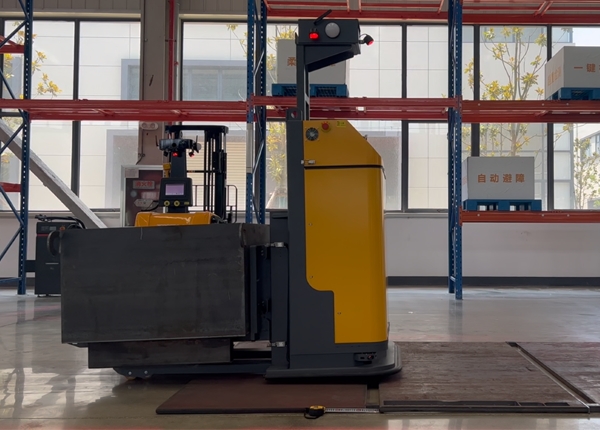
Yes, a Chinese AGV manufacturer may accept customer-specified Western safety components, but this should be agreed during the RFQ and engineering design stage. Compatibility is not determined simply by whether the component is a well-known brand. The manufacturer must verify electrical interfaces, communication protocols, safety architecture, mounting dimensions, software compatibility and the resulting safety validation requirements.
In many custom automation projects, customers can request a specific safety scanner or other safety component. A Chinese AGV manufacturer may agree to install a SICK scanner instead of its standard domestic component if the selected device can be integrated into the vehicle's safety architecture.
The important question is therefore not simply whether the factory “uses SICK.” Your engineering team should confirm whether the requested scanner can communicate correctly with the safety controller and whether its protective fields can be configured for the vehicle's speed, dimensions and braking characteristics.
Electrical Compatibility
Voltage, wiring, connectors and I/O characteristics must match the AGV's electrical architecture.
Communication
The safety device must communicate correctly with the relevant safety controller or vehicle system.
Mechanical Installation
Mounting location, dimensions, cable routing and protection must be incorporated into the vehicle design.
If your company has an internal approved-vendor list, it is better to communicate those requirements before the quotation is finalized. Safety-critical component substitutions become more complicated after the vehicle design and electrical drawings have already been frozen.
| Component Category | What to Confirm |
|---|---|
| Safety Laser Scanner | Detection range, protective fields, interface and safety-controller compatibility. |
| Safety Controller | I/O architecture, safety logic, programming environment and validation requirements. |
| Emergency Stop | Electrical configuration, mounting and integration into the emergency-stop circuit. |
| Safety Switch | Switch type, electrical interface and safety circuit compatibility. |
| Industrial Sensors | Voltage, communication protocol, mounting and software integration. |
The additional project cost is not limited to the price difference between two components. A Western component can also introduce engineering, integration, software configuration, testing and procurement costs.
Price difference between the standard and specified component.
Additional mounting or electrical modifications.
Software-driver or communication integration.
Engineering design and drawing changes.
Additional safety validation and testing.
International procurement and logistics costs.
Potential spare-parts inventory requirements.
Ask for an Itemized Engineering Change Quote
Instead of asking only “How much extra for SICK?”, request a breakdown covering the component itself, engineering changes, software integration, testing, spare parts and any effect on delivery time.
This can be a practical option when your company already has an approved local distributor or wants to standardize safety components across multiple facilities.
However, the procurement arrangement should be clearly defined. The manufacturer needs to know exactly which part number, revision and quantity must be supplied, and both sides should agree who is responsible for shipping, incoming inspection, warranty and replacement parts.
Customer-Supplied Parts
Your company purchases and sends approved components to the Chinese factory.
Factory-Sourced Parts
The Chinese manufacturer purchases the specified brand and incorporates it into the AGV.
Distributor Coordination
A local distributor supplies the components while the AGV factory handles engineering integration.
Changing a safety-critical component can require additional engineering review and validation. You should not assume that an existing conformity declaration automatically covers a substantially modified vehicle configuration.
The manufacturer should identify which technical documentation, risk assessment, electrical drawings, safety calculations or validation tests are affected by the component substitution.
Do Not Treat a Certificate as a Permanent “Blanket Approval”
If the AGV's safety architecture changes, the manufacturer should determine whether the modification affects the conformity assessment or other applicable compliance documentation. The exact requirements depend on the target market and the final machine configuration.
For safety-critical components, earlier is better. The ideal time is during the technical RFQ and design-review stage, before the electrical architecture and mechanical layout are finalized.
1
Define Approved Brands
2
Issue Technical RFQ
3
Confirm Compatibility
4
Freeze Component List
5
Build & Validate
6
Complete Site Testing
If Western safety components are important to your organization, do not leave the requirement as a casual note in an email. Put the approved component information into the technical specification or purchase documentation.
Manufacturer and exact component model.
Required quantity per AGV.
Required communication interface.
Required safety performance characteristics.
Approved equivalent components, if substitutions are permitted.
Who purchases and supplies the component.
Who is responsible for integration testing.
How component changes affect warranty and compliance documentation.
Yes, potentially. The key issue is whether the substituted component was approved and integrated by the AGV manufacturer. An officially engineered and documented component change is very different from a customer replacing a safety component after delivery.
Before approving the modification, clarify whether the supplier's warranty covers the modified safety system, associated wiring, software integration and resulting failures.
Factory-Approved Change
The manufacturer designs, integrates and validates the specified component.
Customer Modification
A local team changes the safety component after delivery without factory approval.
For a customized Chinese AGV, specifying Western safety components can be a reasonable procurement strategy when your company has global component standards or local service requirements. The safest approach is to define the exact component model during the RFQ stage, have the Chinese manufacturer confirm electrical, mechanical and software compatibility, document all engineering changes, and complete validation before shipment.
FREE ENGINEERING SUPPORT Stop Gambling on Generic Platforms. Get an AGV/AMR Tailored to Your Warehouse.Buying automated guided vehicles involves complex safety standards (CE/ANSI), navigation setups (Laser SLAM), and ERP system integration. Don't risk your factory safety with middle-men. ✓ 100% Direct Factory: Customized payload up to 5 Tons. ✓ Free CAD Simulation: Send us your layout, and our engineers will simulate the optimal AGV routes. ✓ Global Support: Overseas installation guidance & local maintenance partners. |





 Chinese
 English