

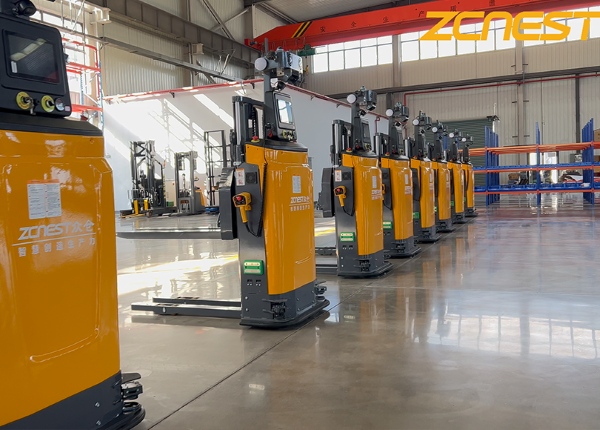
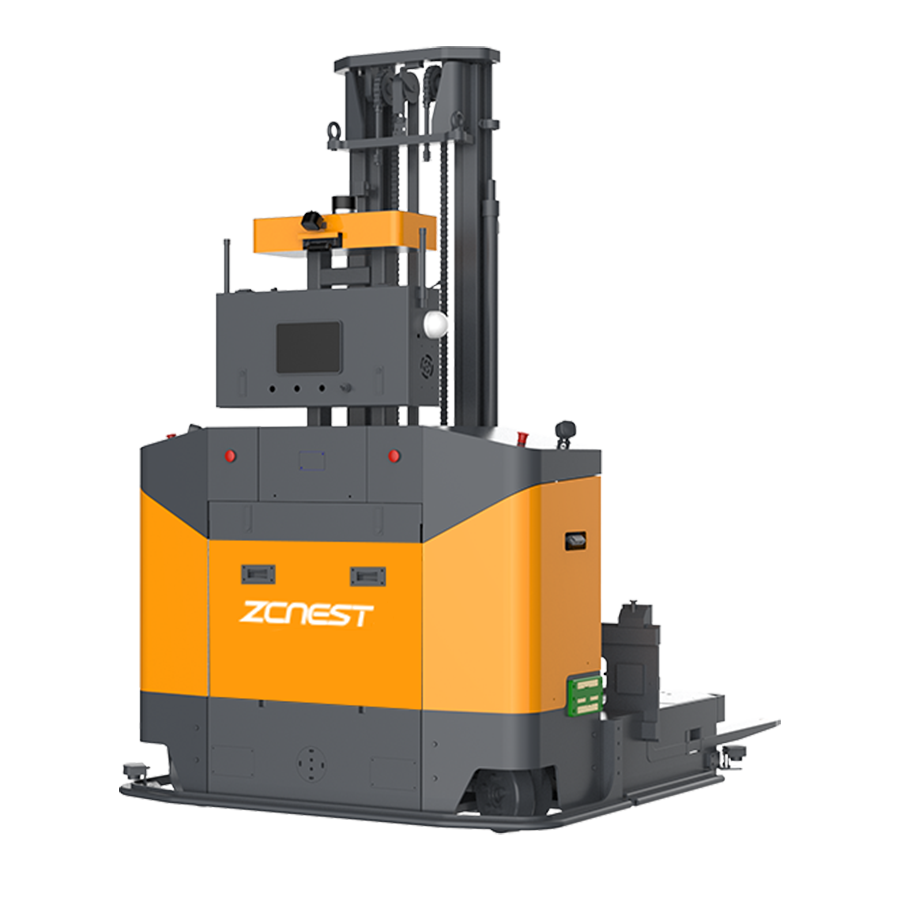
Fork tilt accuracy is an important consideration when an autonomous reach AGV handles pallets at high rack positions. The practical performance depends on the hydraulic cylinder, tilt mechanism, position sensors, control valve, controller and software calibration. Buyers should evaluate not only the nominal tilt angle, but also repeatability, response speed, load conditions and how the system behaves during acceleration, braking and mast movement.
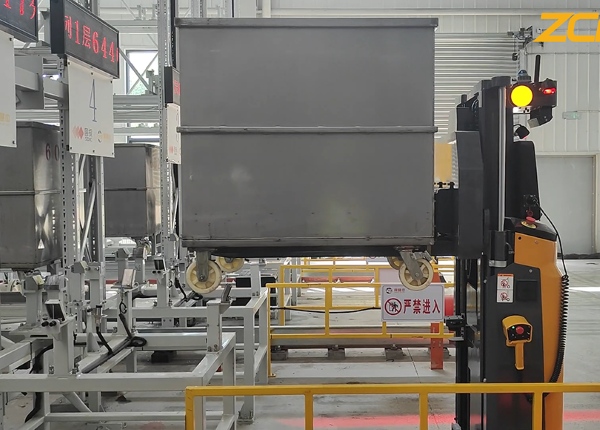
There is no single tilt-angle resolution shared by all Chinese reach AGVs. A manufacturer's actual performance depends on its hydraulic architecture, sensor resolution, controller and mechanical design. For procurement, ask for the specified tilt range, minimum adjustment increment, repeatability, maximum tilt speed and accuracy under representative pallet loads, then verify these values during factory or site acceptance testing.
The tilt adjustment resolution is the smallest change in fork angle that the control system can command or detect. It should not be confused with the overall tilt range of the forks.
For example, a reach AGV may have a relatively large total forward-and-backward tilt range while using a much smaller control increment. The actual useful accuracy also depends on mechanical backlash, hydraulic response, sensor accuracy and calibration.
Tilt Range
Defines how far the forks can tilt forward or backward.
Resolution
Defines the smallest controllable or measurable change in angle.
Repeatability
Shows how consistently the mechanism can return to the same target angle.
Ask for Repeatability, Not Just Resolution
A very small software adjustment step does not automatically mean that the physical forks will repeatedly reach that angle. Hydraulic response, mechanical tolerances and load conditions can affect the final position.
An automated reach AGV typically combines hydraulic components with electronic feedback. The controller sends a target command, while sensors provide information about the current position or operating state. The control system then adjusts the hydraulic actuator to approach the target position.
The exact architecture varies by manufacturer. Some systems may use dedicated position sensors, proportional hydraulic valves or other feedback mechanisms to achieve controlled movement.
1
Target Tilt Angle
2
Sensor Feedback
3
Controller Calculates Error
4
Hydraulic Adjustment
5
Position Verification
Fork tilt is only one factor affecting pallet stability. A high or unevenly loaded pallet can become unstable because of load distribution, mast movement, acceleration, braking, floor conditions and fork positioning.
A properly designed autonomous forklift can coordinate vehicle speed, lifting height and movement parameters according to its operating logic. The goal is to avoid unnecessarily aggressive movements that could increase load instability.
Controlled Acceleration
Smooth acceleration reduces sudden forces acting on the pallet.
Controlled Tilt
The system can limit aggressive fork movement during automated handling.
Load Position
Correct fork insertion and pallet positioning are essential for stable transportation.
Lift Height
Higher loads generally require more conservative movement parameters.
Tilt Control Cannot Guarantee Pallet Stability by Itself
A stable load requires the correct pallet condition, load distribution, fork insertion, mast configuration and operating parameters. Fork tilt control is one part of the overall vehicle stability system.
Potentially, yes. Some AGV control systems allow authorized engineers to configure motion parameters such as tilt speed, acceleration and deceleration. However, whether the operator can directly change these settings through the fleet software depends on the vehicle's software architecture and safety permissions.
Safety-critical parameters should not normally be treated like ordinary dispatch settings. Changes may require engineering authorization, testing and validation before being released to production.
Maximum fork tilt speed.
Forward and backward tilt limits.
Acceleration and deceleration during fork movement.
Maximum movement speed at different lift heights.
Different parameters for loaded and unloaded travel.
Authorization required to modify safety-related parameters.
A fork-mounted camera can provide visual information about the pallet, rack position, fork alignment or load condition. Whether it directly measures fork tilt depends on the camera system and software configuration.
A camera should not automatically be assumed to replace a dedicated mechanical position sensor. In many designs, fork or mast position is measured through dedicated sensors, while cameras provide complementary visual information.
Camera
Can provide visual information about pallets, racks and fork positioning.
Position Sensor
Can provide direct feedback about the mechanical position of the relevant assembly.
Control Software
Combines sensor information and operating logic to command the vehicle's movement.
The same vehicle can show different practical results depending on payload, hydraulic temperature, mechanical wear and operating conditions.
| Factor | Potential Effect |
|---|---|
| Payload Weight | Changes the forces acting on the hydraulic and mechanical system. |
| Hydraulic Temperature | Can influence hydraulic response characteristics. |
| Mechanical Wear | Backlash or wear can affect repeatability over the equipment's service life. |
| Sensor Calibration | Incorrect calibration can introduce position errors. |
| Mast Configuration | High lift positions can introduce additional mechanical movement or deflection. |
| Floor Conditions | Uneven surfaces can affect vehicle and load movement. |
The best approach is to define a measurable acceptance test rather than relying only on a manufacturer's catalog specification.
1
Set Target Angle
2
Measure Actual Angle
3
Repeat Multiple Cycles
4
Test With Rated Load
5
Test Different Lift Heights
6
Record Repeatability
For a procurement project, the following information is more useful than a general statement that the AGV has “high-precision hydraulic control.”
Total fork tilt range.
Tilt adjustment resolution.
Measured tilt accuracy and repeatability.
Maximum and minimum tilt speeds.
Rated load used during accuracy testing.
Fork position sensor model and resolution.
Hydraulic control architecture.
Calibration procedure and recommended calibration interval.
Factory acceptance test and site acceptance test requirements.
When sourcing a Chinese reach AGV, do not evaluate hydraulic fork tilt solely by the smallest software adjustment increment. Ask the manufacturer for actual accuracy and repeatability data, test the vehicle with representative pallets and rated loads, and verify tilt performance at different lift heights. For high-bay applications, this provides a much more meaningful indication of whether the automated forklift can consistently position and stabilize loads.
FREE ENGINEERING SUPPORT Stop Gambling on Generic Platforms. Get an AGV/AMR Tailored to Your Warehouse.Buying automated guided vehicles involves complex safety standards (CE/ANSI), navigation setups (Laser SLAM), and ERP system integration. Don't risk your factory safety with middle-men. ✓ 100% Direct Factory: Customized payload up to 5 Tons. ✓ Free CAD Simulation: Send us your layout, and our engineers will simulate the optimal AGV routes. ✓ Global Support: Overseas installation guidance & local maintenance partners. |





 Chinese
 English