


Adding more autonomous forklifts can increase warehouse throughput, but simply increasing fleet size does not guarantee higher productivity. As traffic density rises, AGVs may spend more time waiting at intersections, rack aisles, charging stations and pickup points. A well-designed Chinese AGV system should therefore combine traffic rules, dynamic routing, task scheduling and congestion management rather than relying only on the number of vehicles deployed.
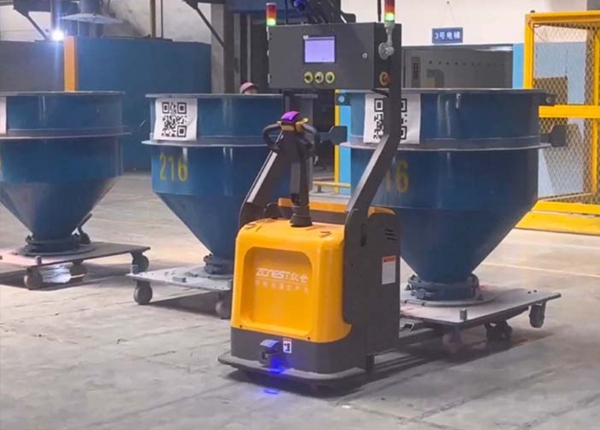
There is no universal “maximum number” of Chinese AGVs for a 10,000 sq ft warehouse zone. The practical fleet size depends on aisle layout, travel distances, intersection density, pallet demand, charging strategy, wireless coverage and the capacity of the fleet-management system. Before adding vehicles, measure utilization, queue time and completed pallet moves. If AGVs are frequently waiting rather than transporting loads, adding more robots may make congestion worse instead of increasing throughput.
Floor area alone is a poor way to determine fleet size. Two warehouses with the same 10,000 sq ft footprint can require very different numbers of autonomous forklifts if one has long travel routes and narrow aisles while the other has short routes and several independent work zones.
A better approach is to calculate the required pallet moves per hour and compare that demand with the actual cycle capacity of one AGV.
Pallet Demand
Required pallet movements per hour and per shift.
Travel Distance
Average distance between pickup and delivery points.
Aisle Capacity
Number and width of available travel lanes.
Intersection Density
How frequently vehicles must share crossing points.
Charging Demand
How many vehicles need charging at the same time.
Fleet Software
Dispatch and traffic-management capacity of the control system.
For procurement, the better question is not “How many AGVs can the software support?” but “How many AGVs can this warehouse operate before traffic waiting time begins reducing the throughput of the entire fleet?”
Before purchasing additional Chinese automated forklifts, collect operational data from the existing fleet. The most useful indicators show where vehicles spend time without actually moving pallets.
Intersection Waiting
Measures how long vehicles wait for another AGV to clear a shared crossing.
Aisle Waiting
Shows whether narrow warehouse aisles are limiting vehicle throughput.
Queue Time
Tracks how long AGVs wait for pickup or delivery locations.
Idle Time
Helps distinguish genuine workload shortages from traffic-related delays.
More AGVs Can Sometimes Reduce Throughput
If several vehicles compete for the same narrow aisle or intersection, adding another AGV increases the number of potential conflicts. Fleet expansion should therefore be based on measured throughput and congestion data rather than vehicle count alone.
A larger fleet increases the amount of wireless communication, but vehicle count by itself does not determine whether a warehouse network will become a bottleneck. The impact depends on how the AGVs communicate with the fleet-management server, how frequently telemetry is transmitted, the network architecture and the quality of wireless coverage.
The fleet should be tested under peak conditions rather than evaluated only when a few vehicles are operating.
Wireless signal strength throughout the complete AGV operating area.
Network latency between vehicles and the fleet-management server.
Packet loss during vehicle movement.
Access-point utilization during peak fleet activity.
Roaming performance when AGVs move between wireless access points.
Network behavior when the fleet reaches its planned maximum vehicle count.
When different autonomous vehicle types share the same warehouse, traffic rules should account for their dimensions, load characteristics, turning radius and operating speed. A small AMR may be physically more maneuverable than a counterbalanced forklift, but that does not automatically mean it should always receive priority.
The fleet-management system can use configured right-of-way rules to determine which vehicle proceeds first and which vehicle waits.
Loaded Vehicle
A loaded forklift may receive priority over an empty vehicle.
Main Aisle
Vehicles on designated primary routes can receive right-of-way.
Task Priority
Urgent warehouse tasks can be assigned higher dispatch priority.
Vehicle Type
Different AGV classes can be assigned different traffic rules.
Emergency access should not depend on the normal AGV routing algorithm. A warehouse should have clearly defined pedestrian and emergency access arrangements that remain usable even when multiple autonomous forklifts are operating simultaneously.
From a fleet-management perspective, designated restricted areas can also be configured so that AGVs avoid certain corridors or reduce their speed when specific conditions occur.
Restricted Zone
AGVs are prevented from entering designated areas.
Slow Zone
Vehicle speed is reduced in high-risk or congested areas.
Temporary Block
A route can be temporarily removed from normal dispatching.
Emergency Route
A predefined route can remain available for emergency access.
The safest approach is incremental fleet expansion. Instead of deploying the maximum number of vehicles immediately, establish a baseline with a smaller fleet, measure the resulting throughput and then add vehicles in controlled stages.
1
Establish Baseline
2
Identify Bottlenecks
3
Add Small Fleet Increment
4
Measure Throughput
5
Optimize Routing
6
Repeat Expansion
| Metric | Why It Matters |
|---|---|
| Pallets per Hour | Shows actual warehouse throughput. |
| Vehicle Utilization | Shows whether the current fleet is being fully utilized. |
| Average Waiting Time | Identifies traffic-related delays. |
| Intersection Queue Length | Shows whether shared junctions are becoming bottlenecks. |
| Charging Queue | Indicates whether charging infrastructure is limiting fleet availability. |
| Task Completion Time | Shows whether additional vehicles actually improve task execution. |
What is the tested maximum fleet size for the proposed warehouse-management system?
How many AGVs can operate simultaneously in a single traffic zone?
How does the dispatch system detect and resolve traffic congestion?
Can different AGV models share the same traffic-control system?
Can I configure right-of-way rules for different vehicle types?
Can specific intersections receive different traffic priorities?
Can temporary restricted and low-speed zones be configured through software?
How does the system respond when an AGV becomes immobilized in a critical aisle?
What network architecture does the manufacturer recommend for the target fleet size?
Can the supplier perform a traffic simulation using my actual warehouse layout before deployment?
For a Chinese AGV project, fleet expansion should be treated as a traffic-engineering problem. Before adding vehicles, analyze intersection queues, aisle utilization, wireless performance, charging demand and completed pallet movements. A supplier that can simulate your actual warehouse layout and demonstrate traffic behavior at the planned fleet size can provide much stronger evidence than a simple claim about the maximum number of robots supported by its software.
FREE ENGINEERING SUPPORT Stop Gambling on Generic Platforms. Get an AGV/AMR Tailored to Your Warehouse.Buying automated guided vehicles involves complex safety standards (CE/ANSI), navigation setups (Laser SLAM), and ERP system integration. Don't risk your factory safety with middle-men. ✓ 100% Direct Factory: Customized payload up to 5 Tons. ✓ Free CAD Simulation: Send us your layout, and our engineers will simulate the optimal AGV routes. ✓ Global Support: Overseas installation guidance & local maintenance partners. |





 Chinese
 English