


Wood processing facilities create a challenging environment for autonomous forklifts. Fine sawdust can accumulate on sensors, enter cooling systems, reduce visibility for optical scanners and increase the maintenance burden on moving equipment. A Chinese AGV can be suitable for this type of warehouse, but the correct configuration depends on the dust concentration, floor conditions, operating temperature, sensor protection and required safety certification.
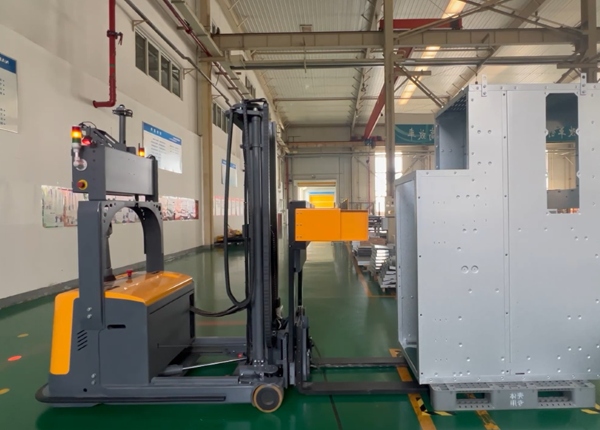
Chinese automated forklifts can be configured for dusty industrial environments, but buyers should not assume that a standard warehouse AGV is automatically suitable for a wood-processing plant. The important factors are enclosure and ingress protection, cooling design, sensor placement, lens protection, cleaning procedures, traction performance and—where combustible dust creates a hazard—the appropriate hazardous-location certification for the specific installation.
Specialized Chinese manufacturers may offer AGVs designed for dusty industrial environments. However, “dust-resistant” and “certified for hazardous combustible-dust locations” are not the same thing.
A wood-processing facility should first determine whether the intended AGV operating area is simply dusty or whether the facility's hazard assessment identifies combustible wood dust as a regulated hazardous location. The required vehicle configuration and certification should then be matched to that classification.
Do Not Evaluate Certification by the Marketing Description Alone
Ask the Chinese manufacturer for the exact certification documents, applicable standards, certified equipment configuration and limitations of use. A general IP rating does not by itself establish suitability for a combustible-dust hazardous location.
What dust environment was the AGV designed and tested for?
What enclosure or ingress-protection rating applies to the complete vehicle?
Are the motors, electrical cabinets and sensors protected against dust ingress?
Does the proposed configuration have certification for the specific hazardous-location classification?
Are there restrictions on operating the vehicle around combustible wood dust?
Dust protection is not limited to the outside of the robot. Fine particles can become a problem when electronic components depend on forced-air cooling. If unfiltered air is continuously pulled through an enclosure, sawdust can accumulate around fans, heat sinks and electrical components.
A better industrial design may use sealed electrical compartments, filtered cooling airflow, protected ventilation paths or thermal-management methods that reduce direct exposure to the surrounding environment.
Protected Electronics
Electrical control components should be positioned inside appropriately protected compartments.
Filtered Airflow
Where fans are required, filtration can reduce the amount of dust entering cooling passages.
Protected Cooling
Thermal management should maintain component temperatures without unnecessarily exposing electronics to contaminated air.
Maintenance Access
Filters and cooling components should be accessible for inspection and cleaning.
For procurement, request the AGV's cooling architecture and maintenance instructions rather than simply asking whether the robot is “dustproof.”
Fine sawdust can accumulate on the optical surfaces of LiDAR scanners and other sensors. A contaminated lens may reduce the quality of the sensor data and, depending on the navigation architecture, may eventually cause warnings, degraded localization or a safety-related stop.
The effect depends on the particle concentration, scanner position, airflow, lens design and the manufacturer's protective measures. There is therefore no universal number of hours after which a laser scanner will become unusable in a woodworking facility.
Protected Position
Mount sensors where they are less exposed to direct dust accumulation.
Optical Cover
Use an appropriately designed protective window without compromising sensor performance.
Contamination Monitoring
The navigation system may provide warnings when sensor performance deteriorates.
Scheduled Cleaning
Cleaning frequency should be established from actual dust exposure and sensor inspection.
There is no reliable universal cleaning interval such as “once every seven days.” A high-volume sawmill or carpentry operation may expose sensors to much more dust than a finished-goods warehouse located elsewhere in the same building.
Instead, establish the initial cleaning interval through a site trial. Inspect the sensor windows during each shift and gradually adjust the maintenance schedule according to the amount of contamination observed.
1
Inspect
2
Record Dust Level
3
Clean Sensors
4
Check Navigation Performance
5
Adjust Interval
Avoid Cleaning Optical Sensors With Improper Materials
The sensor manufacturer's cleaning procedure should be followed. Abrasive materials, unsuitable solvents or aggressive compressed-air cleaning can damage optical surfaces or protective components.
Yes. Dust accumulation can affect more than navigation. Safety scanners, cameras and proximity sensors may also experience degraded performance when their sensing surfaces become contaminated.
A suitable AGV configuration should therefore consider the entire sensor package rather than protecting only the primary navigation LiDAR.
Navigation LiDAR or laser scanner.
Safety laser scanners.
Fork-position sensors.
Fork cameras or vision sensors.
Obstacle-detection sensors.
Wheel and drive-system sensors where dust can affect mechanical components.
Dust is only one part of the feasibility assessment. Wood-processing warehouses may also contain uneven floors, wood chips, narrow aisles, changing pallet conditions and areas with significant forklift traffic.
Floor Condition
Check cracks, thresholds, joints and surface flatness.
Wood Chips
Evaluate whether larger debris can enter the vehicle path.
Pallet Quality
Check whether pallets are consistent and suitable for automated fork entry.
Temperature
Confirm operating temperatures are within the specified range.
Traffic
Analyze interaction with manual forklifts and pedestrians.
Dust Concentration
Measure actual conditions in the proposed AGV operating area.
The complete AGV dust and environmental specification.
Ingress-protection ratings for relevant electrical and sensor enclosures.
Cooling and filtration architecture.
Sensor contamination and cleaning requirements.
Recommended maintenance intervals for dusty environments.
Documentation for any hazardous-location certification claimed by the manufacturer.
Operating limitations for combustible wood-dust environments.
Test records demonstrating performance under the proposed environmental conditions.
Replacement specifications for sensor windows, filters and other dust-exposed components.
A site-specific feasibility assessment before final equipment selection.
| Area | What to Verify |
|---|---|
| Sensors | Dust exposure, protection, contamination warnings and cleaning requirements. |
| Electronics | Enclosure design, cooling method and dust ingress protection. |
| Safety | Performance of safety sensors under expected environmental conditions. |
| Certification | Exact certification applicable to the intended installation. |
| Maintenance | Cleaning frequency, filter replacement and inspection procedures. |
| Floor | Cracks, joints, thresholds, debris and flatness. |
For a wood-processing warehouse, the key question is not simply whether a Chinese AGV is “dustproof.” The equipment should be evaluated against the actual dust conditions, sensor exposure, cooling architecture, floor environment, maintenance requirements and any applicable hazardous-location requirements. A site-specific test and clearly documented environmental specification can significantly reduce the risk of selecting a standard warehouse AGV that is unsuitable for a high-dust application.
FREE ENGINEERING SUPPORT Stop Gambling on Generic Platforms. Get an AGV/AMR Tailored to Your Warehouse.Buying automated guided vehicles involves complex safety standards (CE/ANSI), navigation setups (Laser SLAM), and ERP system integration. Don't risk your factory safety with middle-men. ✓ 100% Direct Factory: Customized payload up to 5 Tons. ✓ Free CAD Simulation: Send us your layout, and our engineers will simulate the optimal AGV routes. ✓ Global Support: Overseas installation guidance & local maintenance partners. |





 Chinese
 English