


Outdoor yard ramps create a different set of requirements for autonomous forklifts than smooth indoor warehouse floors. A heavy counterbalanced AGV must maintain traction, stability, localization and braking performance while traveling over an inclined and potentially uneven surface. For Chinese AGVs used around loading docks, the key issue is not simply whether the vehicle can climb a ramp, but whether the complete vehicle, navigation system and load-handling configuration are designed for that environment.
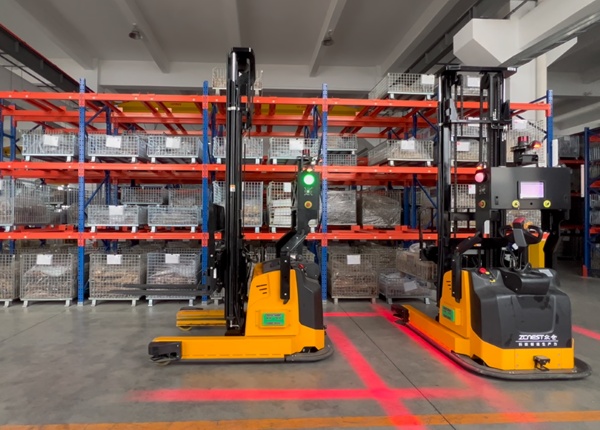
A heavy counterbalanced AGV can potentially operate across a yard ramp when its rated gradeability, ground clearance, tire configuration, braking system, load capacity and navigation technology are suitable for the site. However, ramp operation should be validated using the actual slope, surface condition, load, travel direction and docking configuration rather than relying only on a manufacturer's maximum climbing-angle specification.
When an autonomous forklift moves onto an incline, the load position relative to the chassis changes and the available traction can also change. The vehicle therefore has to manage speed, acceleration, braking and steering while carrying the intended pallet load.
A counterbalanced AGV may use a combination of vehicle geometry, drive control, wheel traction, speed limits and load-handling parameters to maintain stable operation. The exact strategy varies by vehicle design.
Gradeability
Verify the manufacturer's rated maximum gradient for the actual vehicle configuration.
Load Position
The pallet's weight, height and center of gravity can affect stability on a ramp.
Speed Control
Ramp sections may require lower travel speeds and controlled acceleration.
Braking
The braking system must safely stop the vehicle and load under the site's expected conditions.
Do Not Select the AGV From Gradeability Alone
A vehicle advertised as capable of climbing a particular percentage grade may have that rating under specific load, speed, surface and traction conditions. Ask the manufacturer for the operating conditions behind the published figure.
Dock ramps introduce a more demanding positioning problem than ordinary warehouse travel. The ramp may move slightly, the transition angle can change and the vehicle may need to approach the trailer or dock at a precise position.
For an automated forklift, successful docking depends on the combined performance of navigation, obstacle detection, vehicle positioning and the physical geometry of the dock interface.
Ramp width and usable driving surface.
Maximum ramp angle.
Transition angle between yard, ramp and dock.
Height difference between the AGV and loading platform.
Ramp surface material and traction characteristics.
Potential movement or deflection of a mobile ramp.
Required stopping and docking accuracy.
For a project involving mobile dock plates or vehicle ramps, the manufacturer should validate the complete docking sequence rather than testing the AGV only on a fixed indoor slope.
Ground clearance becomes particularly important when an AGV transitions between different outdoor surfaces. A vehicle that performs well on a flat concrete floor may encounter problems when crossing a raised threshold, damaged asphalt section, ramp transition or uneven expansion joint.
The required clearance depends on the chassis design, wheel diameter, wheelbase and the geometry of the obstacle. There is no single ground-clearance number that works for every yard application.
Wheel Diameter
Larger wheels can improve the ability to pass over small surface irregularities.
Wheelbase
Chassis geometry affects how the vehicle approaches changes in surface elevation.
Lowest Component
The lowest chassis component can be more important than nominal chassis clearance.
Ramp Transition
A steep transition can cause chassis contact even when the overall ramp is relatively smooth.
A rough ramp does not automatically mean that a laser-SLAM AGV will lose its map. However, vibration, wheel slip, temporary sensor obstruction and rapid changes in the sensor's view can affect localization performance.
The navigation system normally combines sensor information with vehicle movement estimation to determine its position. If the vehicle experiences significant wheel slip or the environment changes substantially, localization may become less reliable.
Wheel Slip
Can introduce differences between commanded and actual vehicle movement.
Vibration
Repeated impacts can affect sensor measurements and vehicle components.
Changing Environment
Trailers, trucks and other temporary objects can change the sensor environment.
Sensor Contamination
Dust, rain or dirt on optical surfaces can reduce sensing performance.
The most useful test is not an unloaded demonstration on a clean ramp. The AGV should be evaluated under conditions that represent the actual warehouse operation.
01
Measure Ramp
02
Test Empty
03
Test Rated Load
04
Test Wet Surface
05
Validate Docking
| Specification | What to Confirm |
|---|---|
| Maximum Grade | Rated slope under the intended load and operating conditions. |
| Ground Clearance | Lowest chassis point and transition-angle limitations. |
| Tire Specification | Tire type, surface compatibility and traction characteristics. |
| Braking | Stopping performance on the specified slope and load. |
| Navigation | Localization performance over uneven surfaces and ramp transitions. |
| Docking | Positioning accuracy at the loading dock or mobile ramp. |
A site-specific technical review will be much more useful if the supplier receives accurate information about the outdoor operating area before selecting the vehicle.
Ramp length and maximum slope.
Ramp width and transition geometry.
Surface material and expected traction conditions.
Maximum pallet weight.
Pallet dimensions and load center.
Required travel speed.
Ground-clearance obstacles and thresholds.
Dock height and mobile ramp dimensions.
Expected rain, snow, dust or other environmental exposure.
Whether manual forklifts and pedestrians share the ramp.
What is the maximum rated grade for the AGV with its intended payload?
Is the gradeability specification based on dry concrete, asphalt or another surface?
What is the minimum ground clearance at the lowest point of the chassis?
What ramp transition angle can the vehicle safely negotiate?
How does the navigation system handle wheel slip and vibration?
Can the AGV automatically reduce speed on an inclined or uneven section?
What tire options are available for outdoor asphalt and ramp surfaces?
Can the vehicle reliably dock with a mobile loading ramp?
What happens if the vehicle temporarily loses localization while crossing the ramp?
Can the manufacturer conduct a site-specific ramp simulation or on-site validation before final deployment?
For a Chinese counterbalanced AGV operating around loading docks, ramp capability should be treated as a complete vehicle-and-site requirement. Gradeability, ground clearance, tires, braking, load stability and navigation performance all need to work together. Providing the Chinese manufacturer with accurate ramp dimensions, surface conditions and load information before the RFQ can help prevent an indoor warehouse AGV from being selected for an outdoor application it was never designed to handle.
FREE ENGINEERING SUPPORT Stop Gambling on Generic Platforms. Get an AGV/AMR Tailored to Your Warehouse.Buying automated guided vehicles involves complex safety standards (CE/ANSI), navigation setups (Laser SLAM), and ERP system integration. Don't risk your factory safety with middle-men. ✓ 100% Direct Factory: Customized payload up to 5 Tons. ✓ Free CAD Simulation: Send us your layout, and our engineers will simulate the optimal AGV routes. ✓ Global Support: Overseas installation guidance & local maintenance partners. |





 Chinese
 English