


Importing an AGV charging system from China does not automatically mean the charging equipment can be connected directly to a US warehouse electrical system. Voltage, phase configuration, overcurrent protection, grounding, disconnects, emergency-stop functions and equipment certification all need to be reviewed before installation. The safest approach is to treat the Chinese charger as industrial electrical equipment that must be evaluated against the requirements applicable at the actual US facility.
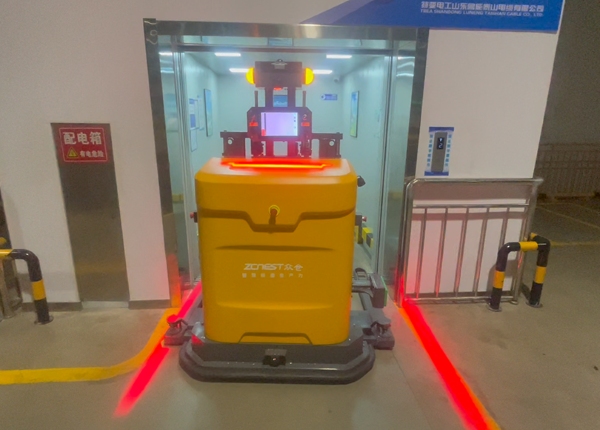
A Chinese AGV charging station may be designed for a US-compatible electrical configuration, but the buyer should not assume compatibility from the voltage label alone. The charging unit, distribution equipment, disconnecting means, grounding and protective devices must be reviewed against the electrical requirements applicable to the installation. Local authority requirements and the equipment's certification or listing status can also affect whether the installation can be approved.
Many industrial US warehouses use three-phase electrical distribution, including 480V systems. However, a charger designed for an overseas market should not be assumed to match the site's available voltage, frequency, phase arrangement or grounding configuration.
Before ordering an AGV charging system from China, the electrical specification should be compared directly with the facility's available service. The manufacturer should provide a complete electrical datasheet rather than only stating that the charger supports “480V.”
Voltage
Confirm the charger's nominal input voltage and allowable operating range.
Phase
Confirm whether the charger requires single-phase or three-phase power.
Frequency
Verify compatibility with the site's electrical frequency.
Grounding
Confirm the required grounding and bonding arrangement.
Do Not Specify a Charger From Voltage Alone
“480V compatible” does not by itself establish that the equipment is suitable for the site's complete electrical configuration or that it satisfies the requirements of the local electrical authority.
This is one of the most important questions to resolve before importing an AGV charging station. An electrical inspector or authority having jurisdiction may require equipment to be listed, labeled or otherwise evaluated by an organization recognized for the applicable purpose.
The exact requirement depends on the equipment, installation and jurisdiction. Therefore, an overseas manufacturer's statement such as “CE certified” should not automatically be treated as equivalent to a US NRTL listing.
Complete charger electrical specifications.
Input voltage, phase and frequency requirements.
Maximum input current and recommended circuit rating.
Grounding and bonding requirements.
Electrical schematics and wiring diagrams.
Protection-device specifications.
Available certification, listing or evaluation documentation.
Installation and commissioning instructions.
There is no single code that answers every question for an imported AGV charging system. The installation may involve requirements covering electrical distribution, wiring methods, grounding, overcurrent protection, disconnecting means and industrial equipment.
For a US warehouse project, the electrical contractor should determine which editions and locally adopted requirements apply to the facility. The review may involve the National Electrical Code together with applicable local amendments and equipment-specific requirements.
Electrical Distribution
Verify compatibility with the building's available distribution system.
Branch Circuit
Determine conductor, overcurrent and circuit requirements.
Grounding
Confirm grounding and bonding arrangements for the charger.
Disconnect
Determine the required means of disconnecting the equipment.
Emergency Stop
Review how emergency-stop functions interact with the charging equipment and AGV.
Equipment Evaluation
Confirm whether the local authority requires listed or otherwise evaluated equipment.
A charging area may require an emergency-stop function that allows personnel to stop hazardous charging or associated automated movement. The exact architecture should be designed by the electrical and controls engineers responsible for the installation.
The emergency-stop circuit should not be improvised by simply interrupting a high-current charging cable. The system should define what happens to the charger, AGV, battery connection and surrounding automation when the emergency-stop function is activated.
Does the charger provide a dedicated emergency-stop input?
What type of safety circuit does the input require?
Does activation remove charging power immediately?
What happens to an AGV that is physically connected to the charger?
Does the charger provide a status signal to the fleet-management system?
How is the system reset after an emergency stop?
Important Safety Point
Emergency-stop design should be reviewed as part of the complete machine and facility safety system. The correct circuit depends on the charger architecture, AGV design, local electrical requirements and the site's risk assessment.
Cable construction and transformer specifications should be evaluated according to the electrical characteristics of the installation. “Shielded” is also not a sufficient specification by itself because different components can require different types of insulation, grounding, shielding or mechanical protection.
For an imported charging system, the buyer should request detailed cable and transformer specifications and have the local electrical contractor determine whether additional equipment or modifications are required.
| Component | Information to Confirm |
|---|---|
| Power Cable | Conductor size, insulation rating, temperature rating and installation method. |
| Transformer | Input/output voltage, capacity, frequency and applicable certification. |
| Grounding | Grounding and bonding requirements. |
| Protection | Overcurrent, short-circuit and thermal protection. |
| Charging Interface | Connector, communication and charging-control specifications. |
Electrical preparation should begin before the charger is shipped. Waiting until the equipment reaches the warehouse can create unexpected installation delays if the site's distribution system, disconnect arrangement or certification requirements do not match the imported equipment.
01
Confirm Facility Voltage
02
Confirm Phase & Frequency
03
Review Charger Certification
04
Design Branch Circuit
05
Verify Grounding
06
Validate Emergency Stop
Complete charger model and electrical datasheet.
Rated input voltage and allowable voltage range.
Phase and frequency requirements.
Maximum continuous and peak input current.
Recommended circuit and overcurrent protection.
Grounding and bonding diagram.
Emergency-stop interface diagram.
Charging connector specifications.
Transformer specifications, if a transformer is supplied.
Electrical schematics and wiring diagrams.
Certification, listing or third-party evaluation documentation applicable to the equipment.
Is the charger designed specifically for the electrical configuration available at my US facility?
What are the exact input voltage, phase and frequency requirements?
What is the maximum input current at full charging power?
What certification or third-party evaluation does the charger have?
Will the equipment satisfy the requirements of the local authority having jurisdiction?
Does the charger have a dedicated emergency-stop interface?
What overcurrent and thermal protection is built into the charger?
Are transformers, cables and disconnect components included?
Can the manufacturer provide complete English electrical schematics?
Can the supplier support the local electrical contractor during installation and commissioning?
For a Chinese AGV project in the United States, charging infrastructure should be reviewed before the equipment leaves the factory. Confirm the facility's voltage and phase configuration, charger input requirements, protective devices, grounding, emergency-stop architecture and applicable equipment evaluation requirements. Getting the local electrical contractor and the Chinese AGV supplier to review the same electrical drawings before shipment can prevent expensive modifications after the equipment arrives.
FREE ENGINEERING SUPPORT Stop Gambling on Generic Platforms. Get an AGV/AMR Tailored to Your Warehouse.Buying automated guided vehicles involves complex safety standards (CE/ANSI), navigation setups (Laser SLAM), and ERP system integration. Don't risk your factory safety with middle-men. ✓ 100% Direct Factory: Customized payload up to 5 Tons. ✓ Free CAD Simulation: Send us your layout, and our engineers will simulate the optimal AGV routes. ✓ Global Support: Overseas installation guidance & local maintenance partners. |













 Chinese
 English




