


Lithium batteries are a critical part of an automated forklift fleet. In warehouses exposed to humidity, dust, chemical vapors or frequent temperature changes, battery protection involves more than simply selecting a lithium-ion battery.
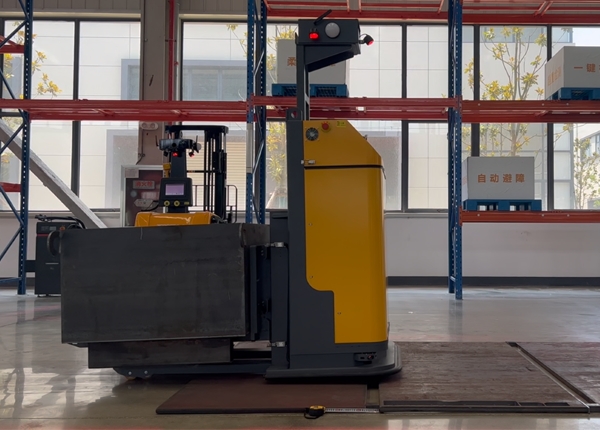
When sourcing AGVs from China, buyers should evaluate the battery enclosure, terminal protection, battery management system, charging controls and available monitoring functions as part of the complete vehicle specification.
A properly configured Chinese AGV can use a protected battery enclosure, sealed electrical connections, a battery management system (BMS) and controlled charging strategy to reduce risks caused by moisture, dust and abnormal battery conditions. However, the actual protection level depends on the battery and vehicle configuration, so buyers should request the enclosure rating, BMS functions, charging limits and relevant test documentation before placing an order.
The battery compartment is one of the first areas to inspect when an AGV will operate in a demanding environment. Moisture and corrosive contaminants can affect electrical terminals, connectors and other conductive components if the enclosure is not appropriately protected.
For warehouse applications involving humidity, cleaning chemicals or airborne contaminants, the buyer should ask the Chinese manufacturer how the battery enclosure and electrical connectors are protected.
Battery Enclosure
Check how the battery housing protects internal components from moisture, dust and accidental contamination.
Electrical Connectors
Ask about connector sealing and protection around high-current battery terminals.
Cable Routing
Inspect how battery cables are routed and protected against mechanical or environmental damage.
Protection Rating
Request the applicable enclosure or component protection rating rather than assuming all AGV batteries have the same protection level.
Do Not Assume an IP Rating for the Entire AGV
An IP rating may apply to a particular enclosure or component rather than the complete vehicle. When the AGV will operate in a corrosive or wet environment, request the exact component-level protection information from the manufacturer.
Modern lithium battery systems can use a battery management system to monitor parameters such as voltage, current and temperature. The exact information available to the operator depends on the battery BMS and the communication interface implemented by the AGV manufacturer.
Some systems may expose detailed battery information through the fleet management platform, while others provide only vehicle-level battery status. A mobile application should therefore not be assumed to provide cell-level information unless the manufacturer specifically supports that function.
Pack Voltage
Overall battery voltage.
Cell Voltage
Available only when supported by the BMS interface.
Battery Temperature
Temperature information from available sensors.
State of Charge
Remaining battery capacity estimate.
Charging Status
Charging, idle or other available operating states.
Fault Information
Available BMS or charging fault codes.
Battery safety should be evaluated at the system level. Instead of asking only which battery cells are installed, an international buyer should understand how the battery pack, BMS, vehicle controller and charger interact.
| Function | What to Confirm |
|---|---|
| Overvoltage Protection | How the BMS responds when voltage exceeds the configured operating limit. |
| Overcurrent Protection | Protection against abnormal current conditions. |
| Temperature Monitoring | Battery temperature sensing and configured protective responses. |
| Charging Control | How charging current and voltage are controlled by the charger and BMS. |
| Cell Balancing | Whether the BMS supports cell balancing and how it is managed. |
| Fault Logging | Whether battery faults can be recorded and retrieved for maintenance analysis. |
There is no single fire-suppression configuration that should be assumed for every Chinese AGV. Battery protection depends on the vehicle design, battery chemistry, enclosure and the requirements of the application.
If the warehouse has elevated fire-risk requirements, the buyer should specifically request information about thermal monitoring, battery fault protection, emergency isolation and any optional fire detection or suppression equipment.
Does the battery pack include temperature monitoring?
What conditions cause the BMS to disconnect or restrict charging?
Is battery emergency isolation provided?
Is thermal or smoke detection available as an option?
Does the battery enclosure have a defined protection rating?
What battery safety tests and documentation are available for the selected configuration?
Humidity itself does not determine the correct charging current. The charging system should operate according to the battery manufacturer's specified charging parameters, while the BMS monitors battery conditions and can trigger protective actions when abnormal conditions are detected.
For an automated warehouse operating around the clock, buyers should also examine how the charging system handles long idle periods, partial charging, scheduled charging and abnormal battery temperatures.
Charging Limits
Charging voltage and current should remain within the battery manufacturer's specified operating limits.
Temperature Monitoring
The BMS can monitor available temperature sensors during charging.
Abnormal Conditions
The system should define how charging responds to battery or charger faults.
Idle Periods
Confirm how the charging strategy handles AGVs that remain unused for extended periods.
For an international AGV purchase, battery specifications should be included in the technical quotation rather than treated as a secondary component.
Battery chemistry and nominal voltage
Rated battery capacity
Battery manufacturer and model
BMS manufacturer and available functions
Battery enclosure protection information
Charging voltage and current
Expected charging time
Battery operating temperature range
Available battery monitoring data
Relevant battery transportation and safety documentation
Recommended inspection and maintenance procedures
Battery performance should be checked during commissioning rather than evaluated only from the manufacturer's datasheet.
| Test Area | What to Check |
|---|---|
| Charging | Confirm charging starts, terminates and reports status correctly. |
| BMS | Verify available battery status and fault information. |
| Temperature | Check battery temperature monitoring under representative operating conditions. |
| Emergency Stop | Verify the agreed emergency response and battery isolation behavior. |
| Fleet Monitoring | Confirm what battery information is visible through the fleet management interface. |
| Documentation | Check that the delivered battery configuration matches the approved technical specification. |
For a Chinese AGV fleet, battery selection, BMS protection, charging equipment and fleet monitoring should be evaluated together. This is especially important when the vehicles will operate in humid, dusty or chemically demanding environments.
Before approving an international AGV order, request the exact battery configuration, BMS functions, charging parameters, enclosure protection information and available safety documentation for the model being quoted.
FREE ENGINEERING SUPPORT Stop Gambling on Generic Platforms. Get an AGV/AMR Tailored to Your Warehouse.Buying automated guided vehicles involves complex safety standards (CE/ANSI), navigation setups (Laser SLAM), and ERP system integration. Don't risk your factory safety with middle-men. ✓ 100% Direct Factory: Customized payload up to 5 Tons. ✓ Free CAD Simulation: Send us your layout, and our engineers will simulate the optimal AGV routes. ✓ Global Support: Overseas installation guidance & local maintenance partners. |





 Chinese
 English