


When an enterprise imports an automated forklift or AGV fleet from China, the physical vehicles are only one part of the deployment.
The fleet management platform, dispatch server, database, network architecture and operator interfaces can become equally important from an IT security perspective.
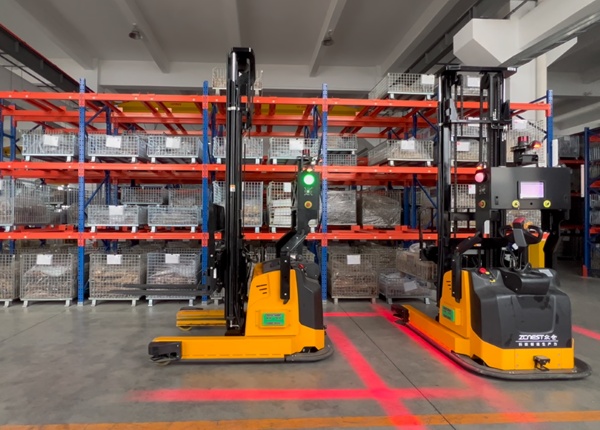
For companies with strict cybersecurity requirements, the key question is not simply whether the Chinese AGV software works.
It is:
Can the entire fleet-control infrastructure operate inside the company's existing IT architecture without creating unnecessary external connections?
Before signing an AGV procurement contract, the IT department should confirm the supported operating systems, database architecture, containerization options, network requirements and offline operating capabilities.
It depends entirely on the software architecture supplied by the manufacturer.
Some fleet-management platforms may be designed specifically for Windows environments, while others may support Linux-based servers.
If your enterprise standardizes on Red Hat Enterprise Linux, do not assume that a Windows-based application can simply be transferred to Linux.
Ask the Chinese AGV manufacturer to provide:
Supported operating systems
Supported OS versions
CPU requirements
RAM requirements
Storage requirements
Virtual-machine compatibility
Database requirements
Required runtime frameworks
Required network ports
Required background services
Installation dependencies
The manufacturer should ideally provide an official server deployment specification before the project begins.
The fleet-control server may be responsible for:
Vehicle dispatch
Task allocation
Map management
Traffic control
Charging management
Vehicle status monitoring
Alarm management
Historical data storage
If the software depends on a specific operating system, changing the server environment after deployment could introduce unnecessary integration and support problems.
Therefore, the server operating system should be agreed upon during the technical design stage.
Containerized deployment can be attractive to enterprise IT departments because Docker can simplify:
Application isolation
Version management
Deployment
Backup
Resource allocation
Environment replication
Disaster recovery
However, Docker compatibility should never be assumed.
The software may depend on:
Host-level hardware access
USB devices
Serial interfaces
Network interfaces
Real-time communication
Specific drivers
Local databases
Proprietary middleware
These dependencies can make containerization more complicated than simply packaging the application into a Docker image.
Ask the Chinese engineering team:
Is Docker officially supported?
Is Kubernetes supported?
Is there an official container image?
What Linux distribution is supported?
Which container runtime is required?
Does the application require privileged containers?
Does it require host-network mode?
Does it require direct hardware access?
Can the database run in a separate container?
Is containerized deployment covered by the manufacturer's warranty?
The last question is particularly important.
A technically possible deployment is not necessarily an officially supported deployment.
The fleet-management system needs to store operational information such as:
Vehicle status
Task history
Error codes
Battery information
Navigation events
Traffic events
User activity
Map data
System configuration
The underlying database could vary according to the manufacturer's software architecture.
Rather than asking only:
“What SQL database do you use?”
Enterprise IT teams should ask for the complete database architecture.
Important questions include:
Database engine
Database version
Database location
Data format
Backup method
Retention policy
Encryption support
Database administrator requirements
Export capability
API access
Disaster-recovery procedure
If the database is proprietary or embedded, ask whether operational data can be exported in a standard format.
For enterprises with strict data-security requirements, local storage is often an important architectural consideration.
A locally deployed fleet server can potentially keep operational information inside the company's internal network.
Depending on the software design, local data may include:
Vehicle coordinates
Battery status
Task history
Fault records
Traffic information
Warehouse maps
User accounts
Performance statistics
However, local hosting does not automatically mean that no data leaves the facility.
The software may still contain:
Cloud synchronization
Remote diagnostics
Software-update services
License verification
Remote-support connections
External APIs
Therefore, the IT department should perform a network-flow assessment before production deployment.
Potentially, but this must be confirmed by the manufacturer at the architecture level.
An absolute air-gapped deployment means the AGV infrastructure has no direct network connection to external networks.
That can include isolation from:
Public Internet
Corporate WAN
Cloud services
External vendor servers
Remote-support infrastructure
The challenge is that some AGV systems may expect an external connection for software updates, licensing, monitoring or remote technical support.
Therefore, the procurement specification should explicitly state:
The AGV fleet-control system must support fully offline operation without mandatory communication with external servers.
Then require the supplier to identify every external dependency.
The Chinese manufacturer should provide a diagram showing:
AGV → Wi-Fi → Fleet Server → Database → WMS/ERP
and any additional connections to:
Cloud / Vendor Server / Remote Support / Update Server
The IT department can then determine whether those connections are acceptable.
An air-gapped warehouse can make remote technical support more difficult.
Instead of permanent Internet access, an enterprise may establish a controlled support process.
For example:
Local fault → IT approval → temporary connection → encrypted remote session → troubleshooting → connection removed
The exact mechanism should be determined by the company's cybersecurity team.
The important requirement is that remote access should be:
Authorized
Logged
Time-limited
Encrypted
Revocable
Auditable
The AGV manufacturer should not require unrestricted permanent access to the production network simply because remote troubleshooting is convenient.
This is one of the most important questions for an enterprise firewall team.
Ask the supplier to document:
IP addresses
TCP ports
UDP ports
Communication protocols
Broadcast requirements
Multicast requirements
DNS requirements
NTP requirements
Internet dependencies
External domains
API endpoints
The security team can then create firewall rules based on documented requirements rather than allowing broad network access.
For example, the fleet network might be segmented into:
AGV VLAN → Fleet Server → Database → WMS Interface
with only the necessary communication paths permitted.
In many enterprise environments, network segmentation is preferable to placing autonomous vehicles directly on the general office network.
A dedicated AGV network can separate:
Robot traffic
Fleet-control traffic
Database traffic
WMS integration
Corporate user traffic
Internet access
The architecture could use separate VLANs or security zones according to the company's network design.
The exact topology depends on the warehouse and cybersecurity requirements.
The key principle is:
The AGV does not need unrestricted access to the corporate network simply because it needs network connectivity.
Before importing the fleet, request a technical package containing:
Supported operating systems
Hardware requirements
Virtualization requirements
Docker compatibility
Database requirements
Storage requirements
Network architecture
Required ports
Required protocols
IP requirements
External connections
Cloud dependencies
Remote-support requirements
Application architecture
API documentation
Authentication method
User-management structure
Update mechanism
Backup procedure
Logging capabilities
Software bill of materials where available
Third-party libraries
Vulnerability-management process
Security update process
Encryption methods
Remote-access mechanism
This information should be reviewed before the production network is connected.
There is no single architecture that fits every warehouse.
A company with moderate security requirements might use:
AGVs → Fleet Server → Database → WMS/ERP
A company with stricter IT requirements might use:
AGV VLAN → Firewall → Application Server → Database Server → Controlled WMS Interface
An enterprise requiring maximum isolation could consider:
AGV VLAN → Local Fleet Server → Local Database
with no direct Internet connection.
The appropriate architecture depends on the company's cybersecurity policy and the capabilities officially supported by the AGV manufacturer.
Instead of asking the supplier whether their software is “secure,” write measurable technical requirements into the RFQ.
For example:
Local server deployment required
No mandatory cloud dependency
Offline operation required
External network connections must be documented
Required TCP/UDP ports must be disclosed
Database architecture must be documented
Backup and restore procedures must be provided
Docker support must be explicitly confirmed
Supported Linux distributions must be listed
Remote access must require customer authorization
Software updates must support controlled offline procedures
Operational data must remain locally stored unless explicitly approved
These requirements give the IT department something concrete to evaluate.
The safest approach is to treat the fleet-management platform as part of the warehouse's industrial IT infrastructure.
Before production deployment, the project team should complete:
Architecture review → Server compatibility test → Network-flow review → Vulnerability assessment → Backup test → Offline-operation test → Site acceptance
This approach helps identify problems before dozens of automated forklifts depend on the same central software.
For a Chinese AGV import project, the most important question is therefore not simply “Can your software run on our server?”
A better question is:
“Can your complete fleet-control architecture operate inside our approved enterprise security boundary, and can you document every technical dependency required to do so?”
FREE ENGINEERING SUPPORT Stop Gambling on Generic Platforms. Get an AGV/AMR Tailored to Your Warehouse.Buying automated guided vehicles involves complex safety standards (CE/ANSI), navigation setups (Laser SLAM), and ERP system integration. Don't risk your factory safety with middle-men. ✓ 100% Direct Factory: Customized payload up to 5 Tons. ✓ Free CAD Simulation: Send us your layout, and our engineers will simulate the optimal AGV routes. ✓ Global Support: Overseas installation guidance & local maintenance partners. |
📖 AGV Forklift Guide — Essential manual for selection and safety.
⚙️ How AGV Systems Work — A deep dive into navigation and logic.
⚖️ AGV vs. AMR Comparison — Choosing the right technology for your facility.
💰 AGV Cost and ROI — Evaluating investment and payback periods.





 Chinese
 English