


A warehouse may use an automated forklift or AMR sourced from China while the pallet wrapping, strapping, labeling, or packing equipment is supplied by a local manufacturer. This does not necessarily create an integration problem, but the two systems need a clearly defined interface.
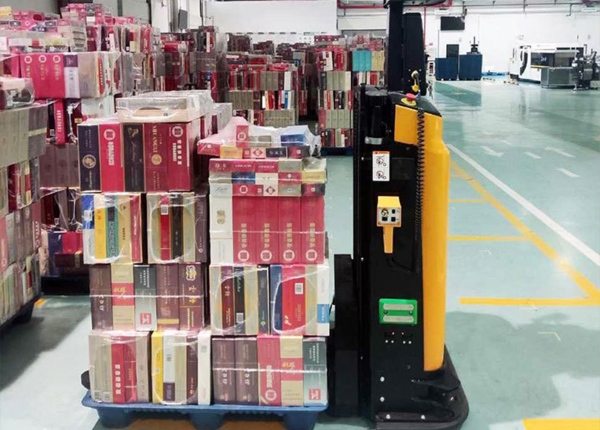
The most practical architecture is usually not to make the Chinese AGV directly control the packaging machine. Instead, the AGV fleet system, a local PLC, or an integration layer exchanges defined status and task signals with the packaging equipment.
For a B2B warehouse project, the important question is therefore not simply “Can the Chinese AGV communicate with my wrapper?” It is “Which system owns the sequence, which signals are exchanged, and which safety functions remain independent?”
A pallet-packing station normally needs only a relatively small set of operational signals. The exact interface depends on the equipment manufacturer and the AGV fleet software.
| Signal | Typical Meaning |
|---|---|
| Pallet arrived | AGV has reached the designated handoff position |
| Ready for transfer | AGV or conveyor is ready for the next operation |
| Machine ready | Packaging equipment can accept the pallet |
| Cycle complete | Wrapping, strapping, or packing operation has finished |
| Fault | Packaging station cannot complete the requested operation |
| Pallet released | AGV may retrieve the pallet |
These signals allow the two systems to coordinate the workflow without requiring the AGV to understand the internal mechanics of the packaging machine.
A physical interface can range from simple digital I/O to an industrial network connection. The correct choice depends on the PLC architecture and the capabilities of both systems.
Digital I/O: Useful for simple ready, busy, complete, fault, and request signals.
Relay interfaces: Can provide electrically isolated dry-contact signals between equipment where appropriate.
Industrial Ethernet: Protocols such as PROFINET or EtherNet/IP may be used when both control systems support them.
Modbus: Modbus TCP or another supported Modbus implementation can exchange defined registers or status information.
PLC integration: A local PLC can act as the coordination layer between the packaging equipment and the AGV fleet.
A relay is not automatically required just because the AGV and packaging machine come from different countries. In many projects, the PLC or industrial Ethernet interface provides the primary operational communication, while relay or hardwired circuits are reserved for specific control or interlock functions.
The wiring design should also consider electrical isolation, voltage levels, grounding, cable routing, connector type, and the required response time. These details should be defined by the system integrator rather than improvised during installation.
Sometimes, but this should never be assumed as a standard feature.
A Chinese AGV fleet-management system may provide API interfaces, PLC communication functions, digital I/O interfaces, Modbus communication, industrial Ethernet support, or configurable task triggers. However, the available protocols and software modules vary considerably between manufacturers and product platforms.
A supplier may already have a reusable integration template for common equipment such as conveyors, wrapping machines, elevators, doors, or automated storage systems. That can reduce engineering time, but a “pre-configured block” does not necessarily mean the system can connect to any local packaging machine without modification.
For procurement, ask the supplier to provide the actual interface documentation before signing the final contract.
Supported PLC brands and communication protocols
Digital I/O specifications
Modbus register or tag definitions, if applicable
API documentation
Message format and handshake sequence
Communication timeout behavior
Fault and recovery logic
Engineering fees for custom interfaces
This prevents a common procurement problem: the quotation says “PLC integration supported,” while the buyer later discovers that the actual PLC mapping, testing, and software engineering are treated as a separate project.
Yes, this is a common type of warehouse workflow when the AGV fleet software supports task sequencing and the packaging station provides the required status signals.
A typical workflow could look like this:
The warehouse system creates a pallet transport task.
The fleet manager assigns the task to an available AMR or automated forklift.
The vehicle transports the pallet to the designated packaging station.
The AGV reaches the handoff position and confirms arrival.
The packaging machine confirms that it is ready to receive the pallet.
The AGV places or transfers the pallet and receives confirmation that the pallet has been released.
The packaging machine performs the wrapping or strapping cycle.
The machine sends a cycle-complete or pallet-ready signal.
The AGV receives a retrieval task and returns the pallet to the designated storage location.
The AGV does not necessarily need to remain physically connected to the packaging machine throughout the entire cycle. In many layouts, it can leave the station after the pallet is securely transferred and return when the machine signals that the pallet is ready.
This can improve fleet utilization because the vehicle is not unnecessarily occupied while a relatively slow wrapping or strapping cycle is running.
This is where buyers need to distinguish operational communication from safety functions.
A normal PLC message such as “machine ready” or “cycle complete” is not automatically a safety-rated signal. Likewise, Modbus, PROFINET, Ethernet/IP, or another communication protocol should not be assumed to provide a complete safety function merely because it is used for machine control.
The safety architecture should be designed around the actual hazards at the interface. Depending on the equipment, this may involve safety-rated scanners, gates, interlocks, emergency stops, safety relays, safety PLCs, or appropriate safety communication systems.
For example, a packaging cell may require the following sequence:
AGV enters the defined handoff area.
The packaging system confirms that the transfer zone is available.
The pallet transfer operation is permitted.
Personnel access to the hazardous machine area is controlled by the packaging cell's safety system.
If a safety device is activated, the relevant equipment enters its defined safe state.
Normal task communication resumes only after the required reset and safety conditions are satisfied.
The exact safety architecture should be determined from the risk assessment, machine design, applicable local requirements, and the safety functions of both the AGV and packaging equipment.
The integration should include timeout and fault-handling logic rather than assuming that every machine cycle will complete normally.
For example, if the AGV has delivered a pallet but the wrapper does not return a “ready” or “complete” signal within the defined time, the fleet system could place the task into an exception state and notify an operator.
Depending on the warehouse design, the system may then:
Keep the AGV waiting at a safe staging location
Release the AGV for another task
Send an alarm to the fleet supervisor
Create a recovery task after the packaging station becomes available
Require an operator to confirm the abnormal condition
The correct behavior depends on whether the pallet remains physically on the AGV, has been transferred to a conveyor, or is inside the packaging machine. This should be explicitly defined during integration design.
For an imported AGV connected to locally sourced packaging equipment, communication should be tested as an integrated system rather than only demonstrating that each individual machine works.
| Test | Acceptance Question |
|---|---|
| Arrival handshake | Does the packaging station correctly recognize AGV arrival? |
| Pallet transfer | Can the pallet be transferred without positioning or communication errors? |
| Cycle complete | Does the AGV receive the correct completion status? |
| Machine fault | Does the AGV respond correctly when the packaging machine reports a fault? |
| Communication loss | What happens if network communication is interrupted? |
| Safety activation | Does the defined safety function place the relevant equipment into the required safe state? |
| Recovery | Can the task resume or be safely reissued after a fault? |
FAT can verify the interface logic before shipment or site deployment. SAT should then repeat the critical scenarios using the actual local packaging machine, network infrastructure, pallet geometry, safety devices, and warehouse traffic conditions.
If the packaging line is purchased separately, the AGV contract should still clearly define the supplier's integration responsibility.
Supported communication protocol
PLC or controller interface
Digital I/O requirements
Network and IP requirements
Signal and handshake definitions
Task sequence and timeout behavior
Fault and recovery logic
Safety interface responsibilities
FAT/SAT integration tests
Engineering and commissioning costs
Documentation and source/interface ownership
It is also useful to identify which party owns each interface. The local packaging supplier may own the wrapper PLC, the AGV manufacturer may own the fleet software, and a system integrator may be responsible for the interface between them.
Without this responsibility matrix, a communication problem can quickly become a dispute in which the AGV supplier blames the packaging supplier and the packaging supplier blames the AGV supplier.
The cleanest architecture is often to let each machine control its own core functions while exchanging only the information required for the warehouse workflow.
The packaging machine controls its wrapping or strapping cycle. The AGV controls its navigation, pallet handling, and vehicle motion. The fleet-management or integration layer coordinates the sequence between them.
This separation makes troubleshooting easier and reduces unnecessary dependencies between equipment from different manufacturers.
When evaluating a Chinese AMR or automated forklift for a warehouse with locally sourced packing equipment, ask for the complete interface specification before purchase—not just a statement that “PLC communication is supported.”
The strongest proposal should show the physical interface, communication protocol, handshake sequence, fault behavior, safety architecture, FAT procedure, and SAT acceptance criteria. That gives the warehouse team a much clearer way to determine whether the imported AGV will actually work as part of the existing automation system.





 Chinese
 English