


Scaling a warehouse from a small group of automated forklifts to dozens or even hundreds of Chinese AGVs is not simply a matter of adding more robots. The network, fleet-management server, wireless infrastructure, charging system, traffic-control logic, and warehouse map all need to scale together.
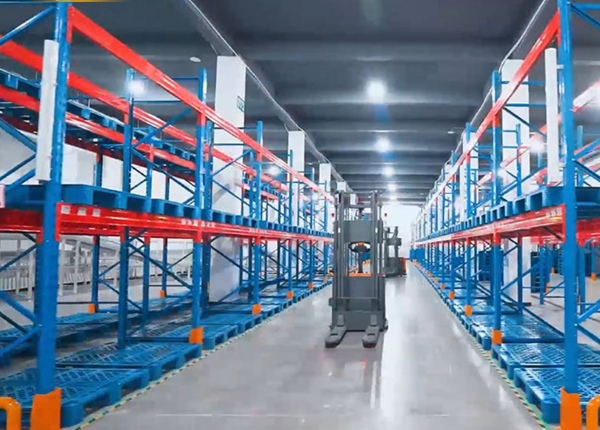
A common mistake is to focus only on Wi-Fi bandwidth. In a large AGV deployment, the more important question is often whether the fleet-management platform can process vehicle status, task requests, traffic decisions, alarms, map data, and charging requirements without creating a control bottleneck.
There is also no universal upper limit for all Chinese AGV fleet managers. The supported fleet size depends on the software architecture, server resources, communication frequency, map complexity, task volume, traffic density, and how the supplier distributes fleet-control functions.
There is no single industry-wide number.
A supplier may advertise that its fleet-management software supports a certain number of vehicles, but that figure should not be treated as a universal capacity rating. A system managing 50 AGVs performing occasional pallet movements is not facing the same workload as 50 high-speed forklifts operating continuously in a congested distribution center.
When evaluating fleet capacity, ask the supplier to define what its maximum number actually means.
Maximum registered vehicles
Maximum simultaneously connected vehicles
Maximum actively moving vehicles
Maximum concurrent transport tasks
Maximum number of maps or zones
Maximum charging stations managed
Maximum alarm and telemetry events per second
For a large project, the most useful requirement is therefore not simply “Fleet Manager must support 100 AGVs.” A better specification is to require the supplier to demonstrate the intended fleet size under representative task and traffic conditions.
Not necessarily.
An additional 20 vehicles do not automatically create a bandwidth problem. AGV control traffic can be relatively small compared with applications such as video streaming or large file transfers. However, adding vehicles increases the number of wireless clients, roaming events, telemetry messages, control packets, and simultaneous communications.
The more important issue is whether the wireless network can maintain stable latency, coverage, roaming behavior, and packet delivery while the fleet is moving through the warehouse.
A network can therefore have plenty of theoretical bandwidth while still producing an AGV control problem because of weak coverage, interference, excessive retransmissions, poor roaming configuration, overloaded access points, or network segmentation issues.
Before adding vehicles, the IT and automation teams should evaluate the complete wireless path rather than looking only at the router's advertised throughput.
| Network Area | What to Evaluate |
|---|---|
| Access points | Client capacity, channel utilization, coverage, and interference |
| Roaming | Handoff behavior while AGVs travel between coverage areas |
| Latency | Control-message response time during normal and peak operation |
| Packet loss | Dropped packets and retransmissions during fleet operation |
| VLAN/network design | Separation of AGV traffic from other warehouse workloads |
| Backhaul | Switch, uplink, and server-side capacity |
| Redundancy | Failure behavior of critical network and server components |
For warehouses using Wi-Fi technologies that support fast roaming features, the AGV supplier and IT team should agree on the required roaming behavior before deployment. The AGV's wireless adapter and configuration also need to be compatible with the enterprise wireless architecture.
Not always.
If every AGV periodically sends telemetry to the fleet server at a fixed interval, part of the network load may increase approximately with the number of vehicles. However, other workloads are more complicated.
For example, task assignments, traffic reservations, localization information, alarms, route updates, charging requests, and exception events can increase according to operational activity rather than simply vehicle count.
A fleet of 100 parked vehicles may create a very different workload from 100 vehicles simultaneously transporting pallets through the same narrow-aisle warehouse.
This is why suppliers should provide capacity information based on active fleet size and workload, not only the number of vehicle licenses.
Charging becomes a fleet-level scheduling problem as the number of AGVs increases.
A basic system may simply send an AGV to the nearest available charger when its battery reaches a defined threshold. A more sophisticated fleet manager can consider remaining battery energy, current task priority, distance to the charger, charger availability, expected workload, and the number of vehicles already waiting.
When the fleet doubles, simply doubling the number of chargers may not be the most efficient solution. The charging strategy should consider when vehicles need energy and how much operational capacity can be lost while they are charging.
For example, the software may prioritize a vehicle that has low remaining energy but is currently assigned to an important transport task, while another vehicle with sufficient energy continues working.
The exact algorithm varies by manufacturer. Buyers should therefore ask the supplier whether charging queues are:
First-come, first-served
Battery-state based
Task-priority based
Distance or location based
Dynamic according to fleet workload
Configurable by the warehouse operator
Depending on the fleet software, charging stations can potentially be distributed across different warehouse areas rather than concentrated in one location.
This can be useful for a large distribution center because sending every AGV to one charging area creates unnecessary travel and can introduce additional traffic.
A zone-based charging strategy can allow vehicles operating in different areas to use nearby charging infrastructure. However, the fleet manager needs to understand the relationship between vehicle groups, charging stations, tasks, and routes.
Ask the supplier whether charging stations can be assigned by zone, vehicle group, battery condition, or task priority, and whether the charging rules can be changed without modifying the core fleet-management software.
Potentially, but there are several different meanings of “zone,” and they should not be confused.
A fleet system may support logical zones within one centralized map. These zones can be used for traffic control, speed restrictions, charging, task priorities, vehicle permissions, or operational areas.
A more complex architecture may distribute fleet-control functions across multiple software nodes or servers. Whether this is supported depends entirely on the supplier's system architecture.
For a very large warehouse, ask whether the supplier supports:
One centralized fleet manager with multiple logical zones
Multiple fleet-management instances
Regional or sub-zone controllers
Distributed traffic management
Shared database or synchronized task information
Failover between control nodes
A single map divided into zones is generally a much simpler architecture than operating several independent fleet-management systems. Multiple independent nodes may introduce additional coordination requirements, especially where AGVs need to cross from one zone to another.
Cross-zone transportation needs a clearly defined ownership model.
For example, if Zone A controls storage aisles and Zone B controls a shipping area, the system must know which controller is responsible for the vehicle and task when the AGV crosses the boundary.
Possible architectures include centralized task management with zone-level traffic control, or a system in which one controller transfers responsibility to another. The exact method is supplier-specific.
The buyer should test cross-zone handoff during system acceptance rather than assuming that separate software nodes will automatically cooperate.
For a large deployment, the server should be treated as part of the AGV system rather than as an afterthought.
Depending on the supplier, the fleet-management platform may run on a physical server, virtual machine, industrial computer, local data-center infrastructure, or another supported deployment model.
The procurement specification should identify the required CPU, memory, storage, database, operating system, network interfaces, backup method, and redundancy options based on the supplier's tested architecture.
Do not select server hardware solely from a generic “100 AGVs” recommendation. The supplier should explain the tested workload behind its sizing recommendation.
For a major warehouse project, the most valuable capacity test is a realistic stress test rather than a simple software demonstration.
The test can gradually increase the number of connected and active vehicles while monitoring server resources, communication latency, task assignment time, traffic-control response, database performance, wireless behavior, and charging decisions.
For example, the acceptance plan could evaluate the system at several fleet-load levels rather than testing only the final fleet size.
| Test Area | Measurement |
|---|---|
| Fleet connection | Connected and active vehicle count |
| Task dispatch | Task assignment and response behavior |
| Network | Latency, packet loss, roaming, and wireless utilization |
| Server | CPU, memory, storage, database, and process utilization |
| Traffic management | Deadlock prevention, congestion, and route response |
| Charging | Queue behavior and charging availability |
| Failure recovery | Behavior after network, server, or access-point failure |
This type of testing gives the buyer a much more useful answer to the question “How many AGVs can this system handle?” than a marketing number printed in a product brochure.
For a large warehouse, it is usually more practical to design the network and server architecture with a defined expansion plan rather than building exactly to today's vehicle count.
However, future-proofing does not mean purchasing oversized hardware without a capacity model. The better approach is to define the expected fleet growth, peak concurrent vehicles, operating hours, traffic density, charging requirements, and future warehouse zones.
If the initial project uses 30 AGVs but the warehouse expects to reach 80 or 100 vehicles, that future requirement should be disclosed to the supplier before the first system architecture is finalized.
The supplier can then specify whether expansion requires additional access points, server resources, fleet-manager licenses, software nodes, traffic controllers, charging stations, or database capacity.
For a large Chinese AGV fleet, the RFQ should describe scalability as a measurable system requirement.
Required number of simultaneously connected AGVs
Expected number of simultaneously active AGVs
Expected peak transport-task volume
Fleet-manager server architecture
Wireless network requirements
Roaming requirements
Charging-station management capacity
Zone and multi-zone management capability
API and WMS/ERP communication capacity
Backup and recovery architecture
Failover requirements
Stress-test procedure and acceptance criteria
The contract should also clarify whether future fleet expansion requires new software licenses or additional engineering fees. If the supplier claims that one fleet manager can support a specific number of vehicles, request the documented system configuration and workload assumptions behind that capacity.
When a Chinese AGV fleet grows from a few vehicles to a large automated warehouse operation, several systems begin interacting at once. Wireless connectivity, fleet scheduling, server capacity, charging queues, traffic management, database performance, and warehouse layout all contribute to the final throughput.
Adding 20 more AGVs therefore does not automatically mean that the Wi-Fi network will fail. Conversely, a network with high advertised bandwidth does not guarantee reliable AGV operation.
For procurement teams, the strongest approach is to specify the expected active fleet size, peak workload, network performance, charging behavior, zone architecture, and stress-test requirements before the system is purchased.
Do not ask a Chinese AGV supplier only, “How many robots does your software support?” Ask them to demonstrate how their complete architecture performs at your planned fleet size and workload.





 Chinese
 English