


When a Chinese AGV fleet is deployed in a warehouse, the fleet-control software becomes a critical operational system. It may contain warehouse maps, routes, task configurations, vehicle information, charging rules, traffic restrictions, user permissions, alarms, historical records, and integration settings.
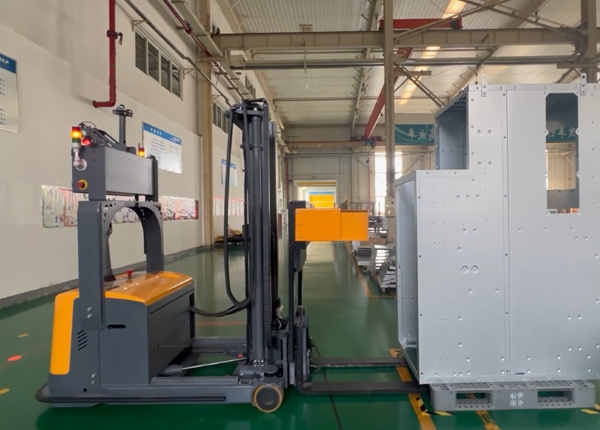
A server failure therefore does not necessarily mean that every AGV has lost everything. Different information can exist in different places: the central fleet-management server, the navigation database, the AGV's onboard controller, or the WMS/ERP system.
For an imported Chinese fleet, the most important question is not simply whether the supplier offers “backup.” The buyer should determine what is backed up, where it is stored, how often it is backed up, how it is restored, and what the AGVs can still do while the central server is unavailable.
It can, but automatic daily backup should not be assumed to be a standard feature of every Chinese AGV fleet-management system.
Some systems can use scheduled database backups, snapshots, export functions, or server-level backup tools. Others may require the customer or IT department to configure the backup process separately.
The important distinction is between a software backup function and a complete disaster-recovery strategy.
A daily database backup stored on the same physical server does not provide much protection against a failed hard drive, ransomware, filesystem corruption, or physical server damage. A more robust design normally includes a separate backup destination.
Fleet configuration
AGV registration and vehicle parameters
Warehouse navigation maps
Routes and traffic rules
Pickup and drop-off locations
Task and mission configurations
Charging parameters
Safety or restricted-area configuration where applicable
User accounts and permission settings
WMS/ERP interface configuration
PLC or external-equipment interface settings
Historical alarms and operational data where required
Do not assume that exporting the SQL database automatically captures every item required to rebuild the fleet. Some AGV systems store certain configuration files, maps, licenses, certificates, or vehicle-specific parameters outside the main database.
Ask the supplier for a backup-scope document that identifies the exact files, databases and configuration elements required for a full restoration.
The restoration process depends on the architecture of the fleet-control system, but a typical recovery sequence can look like this:
Replace or repair the failed server hardware. Confirm that the operating system and required software environment are available.
Install the required fleet-control software. Use the same supported software version or the supplier-approved recovery version.
Restore the database. Import the latest valid backup or database snapshot.
Restore map and configuration files. Confirm that warehouse maps, routes, stations and traffic rules are present.
Restore interface configuration. Reconnect WMS, ERP, PLC or other warehouse systems where applicable.
Verify AGV registration. Confirm that each vehicle is recognized by the restored fleet system.
Check map and coordinate consistency. Make sure the restored map uses the same coordinate framework expected by the vehicles.
Perform controlled communication testing. Test vehicle status, task dispatch, route assignment and fault reporting before returning to production.
Run a safety and operational validation. Verify that safety zones, restricted areas, traffic rules and critical parameters have not been unintentionally altered.
The final step is important. A database restoration that successfully opens the fleet software is not necessarily a successful operational recovery.
The warehouse should confirm that an AGV can actually receive a task, navigate to the correct location, perform the required pallet operation, report completion, and recover correctly from a simulated fault.
Not necessarily, and this is one of the most important questions to clarify before purchasing an AGV fleet.
An autonomous forklift may contain onboard navigation parameters and localization information, while the central fleet system may contain the master warehouse map, task coordinates, routes, traffic rules and operational configuration.
The exact architecture differs between manufacturers. Some systems may retain enough local information for limited vehicle-level operation or recovery. Others may rely heavily on the central server for map management, task scheduling and coordination.
Therefore, the question should not be phrased simply as, “Does the AGV remember the map?” Ask the supplier to identify which data is stored locally on the AGV and which data is stored centrally.
| Data Type | Possible Storage Location | Recovery Question |
|---|---|---|
| Warehouse map | Fleet server / AGV / both | Can the map be restored independently? |
| Vehicle identity | AGV / fleet server | Can the vehicle be re-registered? |
| Task configuration | Fleet server | Can pending tasks be recovered? |
| Traffic rules | Fleet server | Are intersections and priority rules backed up? |
| Localization parameters | AGV / configuration database | Can the original localization configuration be restored? |
| WMS interface | Fleet server / integration layer | Can external system communication be rebuilt? |
This distinction also matters if the fleet server is unavailable for several hours. The buyer should know whether vehicles can finish an active mission, stop safely, continue autonomous operation under limited conditions, or simply wait for the fleet manager to return.
There is no universal behavior. The response depends on the software architecture and safety design of the specific fleet.
Possible behaviors include completing a currently active motion under onboard control, stopping at a safe condition, waiting for communication to recover, or switching to a predefined fault state.
The fleet manager's failure should not be confused with a safety-system failure. Safety functions may be implemented locally through safety scanners, safety controllers, emergency stops and vehicle-level controls rather than depending entirely on the central scheduling server.
For procurement, ask the supplier to document the behavior for at least these scenarios:
Fleet server power loss
Database corruption
Network connection loss
Temporary Wi-Fi interruption
Server restart
AGV restart
Partial fleet-manager service failure
Recovery after communication is restored
These scenarios should ideally be demonstrated during FAT or commissioning rather than being answered only in a sales presentation.
There is no universal restoration time for Chinese AGV suppliers. The actual recovery time depends on the type of failure, availability of backups, software architecture, remote-access permissions, time-zone differences, network access, engineer availability, and whether the map itself is damaged.
A database restore from a verified backup can be relatively straightforward. Reconstructing a damaged map, however, may require engineering analysis, configuration recovery, vehicle testing, or even on-site remapping.
This is why a support contract should distinguish between technical response time and system recovery time.
| Support Metric | What It Means |
|---|---|
| Acknowledgment time | How quickly the supplier confirms the support request. |
| Remote troubleshooting start | How quickly an engineer begins technical diagnosis. |
| Backup restoration | Time required to restore a valid backup. |
| Operational recovery | Time required to verify that the fleet can safely resume production. |
| On-site recovery | Additional time if remote support cannot resolve the issue. |
For a U.S. warehouse working with a Chinese supplier, time-zone coverage should also be addressed. A support team that operates only during Chinese business hours may not provide the same practical response as a supplier offering defined emergency coverage for the customer's operating hours.
For a mission-critical warehouse, maintaining an independent backup destination is generally much stronger than relying on a single production server.
The exact backup architecture should be designed with the warehouse IT team. Depending on enterprise policy, options may include scheduled database backups, file-level backups, virtual-machine snapshots, storage replication, or another approved disaster-recovery method.
The important principle is independence. If the production server and the only backup are physically or logically dependent on the same failure point, the backup may not be useful when it is actually needed.
For a high-value AGV fleet, IT should also determine how long historical backups are retained and whether older versions can be restored. A corrupted configuration may not be discovered immediately, so keeping only the most recent backup can preserve the corrupted state.
A backup should not be considered reliable until it has been restored successfully in a controlled test.
During FAT, SAT, or a dedicated disaster-recovery test, the project team can simulate a fleet-server failure and verify the restoration procedure.
Record the production configuration and create a verified backup.
Use a test or recovery environment to restore the backup.
Verify the warehouse map and coordinate framework.
Verify AGV registration and vehicle configuration.
Verify routes, stations and traffic rules.
Verify WMS or external-system interfaces.
Confirm that safety parameters remain intact.
Dispatch controlled test missions.
Verify pallet pickup and drop-off operations.
Record the actual recovery time and any manual steps required.
The test should also identify exactly who performs each step. If the recovery procedure requires a Chinese engineer to manually rebuild configuration files, the warehouse should know that before an emergency occurs.
Data recovery requirements should be written into the technical specification instead of being left as an informal promise from the supplier.
Automatic backup frequency
Backup scope and file/database list
Customer ownership of backup files
Backup export format
Retention requirements
Recovery procedure
Maximum support response time
Remote-support requirements
On-site recovery conditions
Software version required for restoration
License recovery procedure
AGV behavior during fleet-server failure
Map recovery procedure
WMS/API configuration recovery
Disaster-recovery test before final acceptance
It is also worth specifying whether the customer can perform the recovery independently. If every restoration requires a proprietary tool, undocumented configuration file, hardware dongle, or exclusive access by the Chinese engineering team, the warehouse may have a significant operational dependency on the supplier.
Instead of asking, “Do you have automatic backups?”, ask the supplier to demonstrate the complete recovery chain:
“If our local fleet-control server fails today, what exact data can we restore, from which backup, who performs each step, how do we reconnect the AGVs, and what tests confirm that the warehouse is ready to resume operation?”
That question exposes the difference between a software product that happens to have a backup function and a fleet-management system with a genuine disaster-recovery process.
For an imported Chinese AGV fleet, the strongest architecture is one where the warehouse knows exactly where the map, vehicle configuration, routes, task data and integration settings are stored; maintains independent backups; tests restoration before production; and has a clearly documented escalation path to the Chinese technical team.
A server crash should then become a controlled recovery procedure rather than an emergency decision about whether the entire warehouse needs to be remapped.





 Chinese
 English