


Before placing a purchase order for Chinese AGVs, the quality of the site data you provide can directly affect the vehicle configuration, fleet size, warehouse layout, project price, and commissioning schedule.
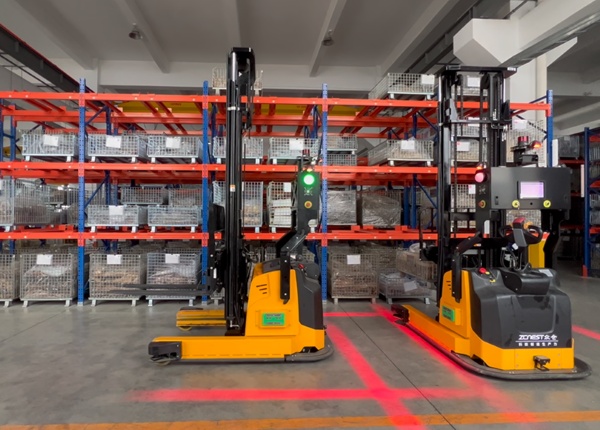
A Chinese AGV manufacturer cannot accurately size a fleet from warehouse floor area alone. The engineering team needs to understand the building structure, rack arrangement, pallet characteristics, travel distances, hourly workload, environmental conditions, traffic restrictions, and available charging or staging areas.
A well-prepared Site Data Brief gives the supplier a consistent engineering reference before the quotation is finalized. It also reduces the risk of discovering major layout or performance limitations after the AGVs have already been manufactured.
The building shell is one of the first items the AGV engineering team should review. The supplier needs to understand not only the total warehouse area, but also the physical constraints that determine where an autonomous forklift can travel and operate safely.
Your site data package should normally include:
Overall warehouse length and width
Clear ceiling height
Structural column locations
Column dimensions
Column-to-column spacing
Roof beams and low-hanging structures
Mezzanines and platforms
Fire-protection equipment and other overhead obstructions
Dock doors and loading areas
Emergency exits
Pedestrian entrances and crossings
Existing rack locations
Floor transitions, ramps and significant joints
Column spacing is particularly important when planning narrow-aisle storage. A theoretical rack layout may look efficient on an empty CAD drawing but become difficult to operate when structural columns interrupt the aisle pattern.
The supplier should therefore receive the actual structural grid rather than only the warehouse's total dimensions.
For high-bay applications, clear height is more important than the nominal building height.
An AGV with an 11 m lifting capability does not necessarily mean that an 11 m rack can be installed in every warehouse. The engineering calculation must consider the actual roof clearance, sprinkler arrangement, lighting, structural members, rack beam elevations, pallet height and required clearance above the load.
When sending building data to the Chinese factory, specify both the building clear height and any areas where the usable height is lower.
Fleet size should be based on workload rather than simply the number of AGVs that fit inside the warehouse.
The Chinese engineering team needs to understand how many pallet movements occur during normal and peak operating periods, how far those pallets travel, and how the workload changes throughout the day.
A useful site-data sheet can record the number of completed pallet movements for every hour of the operating day.
| Time Period | Inbound Moves | Put-Away Moves | Retrieval Moves | Outbound Moves |
|---|---|---|---|---|
| 08:00–09:00 | Record actual | Record actual | Record actual | Record actual |
| 09:00–10:00 | Record actual | Record actual | Record actual | Record actual |
| 10:00–11:00 | Record actual | Record actual | Record actual | Record actual |
The table should be extended across the complete operating period and, ideally, collected over multiple representative days. A single unusually busy or quiet day may not represent the normal workload.
Two warehouses can both report 100 pallet movements per hour while requiring very different AGV fleets.
For each major workflow, record:
Pickup location
Drop-off location
Average travel distance
Peak travel distance
Load weight
Pallet dimensions
Lift height
Pickup and drop-off dwell time
Waiting time at staging areas
Required delivery time
Number of simultaneous tasks
This information allows the supplier to build a more realistic fleet-sizing model. Vehicle count should be based on the complete cycle, including travel, lifting, pallet handling, waiting, charging and traffic effects.
Ambient temperature and relative humidity should be included in the Site Data Brief because environmental conditions can affect batteries, electronics, hydraulic systems, tires, sensors and charging behavior.
Do not provide only the average warehouse temperature. The supplier should know the normal operating range and the expected extremes.
For example, record:
Typical daytime temperature
Typical nighttime temperature
Lowest expected operating temperature
Highest expected operating temperature
Typical relative humidity
Highest expected relative humidity
Seasonal variations
Areas exposed to outdoor air
Cold-storage or refrigerated zones
Areas with condensation risk
A warehouse that normally operates at 20–25°C is very different from an outdoor loading area that can experience freezing temperatures. The supplier should evaluate the actual operating envelope rather than simply confirming that the AGV is an “industrial model.”
Battery operating temperature and battery charging temperature should not be treated as the same specification.
If the warehouse experiences very low temperatures, ask the manufacturer for separate specifications covering vehicle operation, battery charging, battery storage and transportation.
This is particularly important for lithium battery systems because charging behavior and allowable charging conditions may be more restrictive than normal vehicle operation.
Yes, many AGV engineering teams can use warehouse CAD drawings as an important planning reference. However, a CAD drawing should be treated as engineering layout information, not automatically as the final navigation map used by the AGVs.
Depending on the supplier's software architecture, the CAD file may be used to understand the warehouse geometry, establish coordinates, plan racks and aisles, identify obstacles, or prepare the project layout. The actual AGV navigation map may later be generated or configured using the vehicle's navigation technology.
For a Laser SLAM or 3D SLAM project, the physical environment remains important because the robot ultimately has to localize itself against real-world features.
Insufficient aisle width
Columns obstructing planned travel paths
Inadequate turning areas
Dead-end routes
Insufficient cross aisles
Conflicts between staging and AGV traffic
Pedestrian crossing points
Dock-area congestion
Charging-station access problems
Rack-end clearance issues
Potential traffic intersections
Insufficient space for pallet handoff
The engineer can also compare alternative rack orientations. For example, moving a rack block by a relatively small distance may create a better AGV cross-aisle or eliminate a difficult turning maneuver.
This is one reason it is better to involve the AGV engineering team before the rack layout is finalized rather than asking them to fit the robots into a completed warehouse design.
If available, provide the most current engineering drawings rather than an old warehouse layout.
Useful files can include:
DWG or DXF architectural drawings
Rack layout drawings
Structural column plans
Building elevation drawings
Floor plans
Mezzanine drawings
Dock and door layouts
Fire-protection layouts where relevant
Existing equipment layouts
Pedestrian routes
Also identify the drawing's scale, units, coordinate reference, revision number and date. An incorrect scale or outdated rack layout can produce an apparently accurate simulation based on incorrect information.
Pallet geometry is one of the most important inputs for a high-lift AGV project.
The supplier should know the minimum and maximum pallet dimensions, not just the name of the pallet type.
Pallet length
Pallet width
Pallet height with load
Empty pallet weight
Maximum loaded pallet weight
Load center
Fork-entry direction
Bottom-board or runner configuration
Openings available for fork entry
Percentage of non-standard pallets
If several pallet types are used, provide representative samples or detailed photographs and drawings. A vehicle that works well with one pallet profile may require different fork positioning or handling parameters for another.
Floor condition can directly affect high-lift AGV performance, particularly when the vehicle must position a load accurately at high rack levels.
The Site Data Brief should identify:
Concrete floor type
Known floor flatness measurements
Significant slopes
Expansion joints
Floor transitions
Metal plates or thresholds
Cracks or damaged areas
Wet or frequently contaminated areas
Areas with polished or low-traction surfaces
If accurate floor measurements are unavailable, state that clearly rather than providing an estimated number. The AGV supplier can then identify whether a detailed floor survey is required before final engineering approval.
A practical Site Data Brief can be divided into eight sections.
| Section | Key Information |
|---|---|
| 1. Building | Dimensions, columns, clear height, roof obstructions |
| 2. Racking | Rack dimensions, levels, beam heights and clearances |
| 3. Pallets | Dimensions, weight, load center and fork-entry geometry |
| 4. Workload | Hourly movements, peak periods, travel distances and dwell time |
| 5. Environment | Temperature, humidity, dust, moisture and special conditions |
| 6. Floor | Flatness, joints, ramps, transitions and traction conditions |
| 7. Traffic | Pedestrians, manual forklifts, crossings and restricted areas |
| 8. CAD | Current drawings, revisions, coordinates and proposed layouts |
The supplier should not simply reply with an AGV model and unit price. For a serious warehouse automation project, request an engineering response showing how the site data was translated into the proposed system.
Useful deliverables include:
Recommended AGV model
Recommended fleet quantity
Validated aisle width
Maximum required lift height
Rated payload under the proposed operating conditions
Proposed rack configuration
Estimated pallet positions
Proposed AGV routes
Pickup and drop-off locations
Charging strategy
Traffic-management concept
Identified layout bottlenecks
Site modifications required before installation
Assumptions used for fleet-sizing calculations
The assumptions are particularly important. If the supplier sizes the fleet using an assumed travel speed, assumed handling time, assumed pallet weight, or assumed hourly throughput, those assumptions should be visible in the quotation and technical proposal.
Otherwise, two suppliers may quote different fleet sizes simply because they used different assumptions rather than because one AGV is inherently more efficient.
Before the purchase order is released, compare the final supplier proposal against the actual Site Data Brief.
Are the final pallet dimensions correct?
Is the maximum pallet weight correct?
Is the required lift height confirmed?
Is the proposed aisle width compatible with the actual rack and pallet geometry?
Has the supplier reviewed the current CAD revision?
Are building columns included in the simulation or layout review?
Are peak hourly movements reflected in the fleet calculation?
Are charging requirements based on the actual workload?
Are temperature and humidity limits documented?
Are floor conditions included in the engineering assumptions?
Are pickup and drop-off locations defined?
Are manual forklift and pedestrian interactions considered?
Are site modifications clearly identified?
The final purchase order should reference the approved technical specification and site assumptions. If the warehouse layout, pallet dimensions, throughput or operating environment changes later, the supplier should be required to review whether the AGV configuration or fleet size needs to change.
A good Site Data Brief turns an AGV purchase from a simple equipment quotation into an engineering project with measurable assumptions. The Chinese factory can then size the fleet against real workload, evaluate the building geometry, identify path bottlenecks from the CAD layout, and confirm whether the proposed AGV can operate within the warehouse's actual environmental and physical conditions.
The goal is not to provide the factory with the largest possible amount of data. It is to provide the right data before the vehicle configuration, fleet quantity and warehouse layout become contractual commitments.





 Chinese
 English