


Battery management is one of the less visible parts of an autonomous forklift, but it has a direct effect on fleet availability, charging time, battery life, and maintenance cost. For a warehouse importing AGVs from China, the important question is not simply whether the vehicle uses a lithium battery or has a BMS. The real question is how much battery information the BMS measures, what the fleet software can access, and how the charging system reacts when individual cells begin to drift.
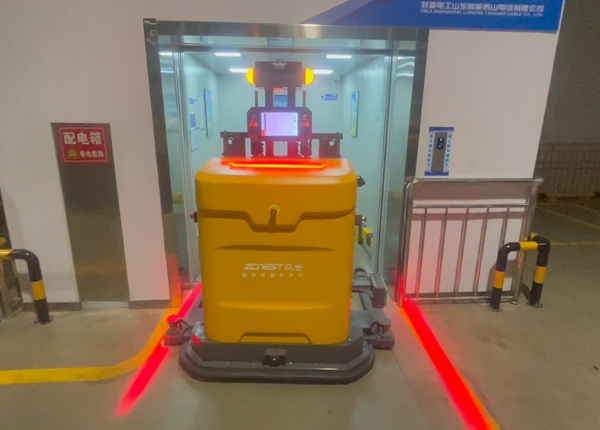
This becomes particularly important when automated forklifts use high-current charging during multi-shift warehouse operations. A properly engineered system should monitor battery conditions, control charging within the battery manufacturer's limits, and prevent abnormal cell conditions from being ignored simply because the overall battery voltage appears normal.
Usually, the fleet manager and the battery management system are not the same device. This distinction is important when evaluating a Chinese AGV.
The BMS is normally responsible for monitoring the battery itself. Depending on the battery architecture, it may measure individual cell voltages, pack voltage, current, temperature, SOC, and other operating parameters. The fleet management system may receive selected battery information from the BMS through the vehicle controller or another communication interface.
Therefore, a fleet dashboard showing "Battery: 78%" does not prove that the fleet manager has access to individual cell voltages.
For a high-current charging application, a buyer should distinguish at least three levels of monitoring:
Pack-level monitoring: total battery voltage, charging current, SOC and battery temperature.
BMS-level monitoring: individual cell voltage, temperature channels, balancing status, protection events and battery fault codes, depending on the BMS design.
Fleet-level monitoring: information exposed to the central fleet management software, such as battery percentage, charging status, alarms and vehicle availability.
A system can therefore have cell-level BMS measurement while exposing only simplified battery information to the warehouse operator.
For procurement, this distinction should be written directly into the technical specification. If cell-level voltage visibility is required, specify whether the buyer needs real-time display, historical logging, alarm thresholds, downloadable data, or API access.
Lithium battery cells connected in series do not always age at exactly the same rate. Differences in internal resistance, temperature, capacity, and aging can cause individual cell voltages to diverge.
During charging, the highest-voltage cell can reach its protection threshold before the rest of the pack is fully charged. The BMS therefore needs to monitor the cells rather than relying only on total pack voltage.
Depending on the battery design, balancing may be performed using passive or active balancing techniques. The exact balancing method, balancing current, trigger conditions, and operating strategy are battery-specific and should not be assumed simply because the AGV is equipped with a lithium battery.
Possibly, but it is not a standard capability of every Chinese AGV fleet system.
Many fleet management platforms provide a browser-based interface for vehicle status, task information, alarms, battery percentage, charging status and historical operational data. However, that does not automatically mean the interface exposes every individual battery cell.
If your IT or maintenance team wants a live cell-voltage chart, the complete data path needs to support it:
The battery BMS must measure the required cell-level parameters.
The BMS must communicate those parameters to the vehicle controller or gateway.
The vehicle software must make the information available to the fleet server.
The fleet software must store or display the required data.
The user must have sufficient permissions to access the information.
A manufacturer may have detailed BMS diagnostic software available to its engineers while exposing only basic battery information in the normal fleet dashboard.
For a warehouse with a local server, this is worth addressing before the purchase order. Ask the supplier for a sample screenshot or demonstration of the actual battery diagnostic interface rather than accepting a statement such as "BMS supported."
| Parameter | Why It Matters |
|---|---|
| Pack voltage | Shows overall electrical condition and charging state. |
| Charging/discharging current | Helps identify charging behavior and abnormal current conditions. |
| Cell voltage | Helps identify cell imbalance and abnormal individual cells. |
| Battery temperature | Important during high-current charging and abnormal operating conditions. |
| SOC | Used by fleet scheduling and charging decisions. |
| SOH | Useful for long-term battery degradation analysis when supported by the BMS. |
| Balancing status | Shows whether the BMS is actively performing its balancing function. |
| Protection/fault records | Helps maintenance teams diagnose over-voltage, under-voltage, temperature and other battery events. |
Not every parameter needs to appear on the operator's dashboard. For a large fleet, it can be more practical to show basic battery information to operators and reserve detailed cell diagnostics for maintenance or engineering users.
There is no single BMS brand used across Chinese automated forklifts. Battery suppliers and AGV manufacturers may use different BMS architectures depending on battery capacity, voltage platform, vehicle design, charging method and project requirements.
More importantly, specifying only a BMS brand does not tell the buyer enough about the actual battery-management capability.
For an industrial AGV project, the RFQ should instead specify the required technical functions. These may include:
Cell-level voltage monitoring
Temperature monitoring
Over-voltage and under-voltage protection
Over-current protection
Over-temperature protection
Short-circuit protection
Cell balancing
SOC calculation
SOH estimation, if required
CAN or other vehicle communication interface
Battery fault-code reporting
Charging-current control or charger communication
Historical battery data access
If a particular BMS manufacturer or component brand is mandatory for your enterprise standard, it can be included in the purchase specification. The supplier should then confirm the exact model, communication protocol, voltage range, current rating, certification documentation and integration responsibility.
This approach is generally more useful than simply requesting a "famous BMS brand." A well-integrated battery system with documented interfaces can be more valuable than a branded component whose data cannot be accessed or whose configuration is not suitable for the AGV.
Long warehouse shutdowns require a different battery strategy from normal daily operation. Leaving an AGV connected to a charger for several weeks without a defined storage procedure is not an appropriate substitute for battery management.
The exact procedure depends on the battery chemistry, BMS, charger and manufacturer's storage recommendations. For lithium batteries, the key variables include state of charge, storage temperature, self-discharge, BMS quiescent consumption and the permitted storage period.
A properly designed AGV charging system may support different strategies during extended shutdowns, such as:
Stopping normal automatic charging after reaching a defined SOC.
Maintaining the battery within a manufacturer-defined storage SOC range.
Disconnecting or placing charging equipment into a controlled standby condition.
Monitoring battery voltage and temperature during extended idle periods.
Generating a low-battery warning before the battery reaches an undesirable storage condition.
Providing a defined restart and inspection procedure before returning the AGV to service.
The correct strategy should come from the battery manufacturer's storage specification rather than from a generic AGV rule. Different battery packs can have different recommended storage conditions even when they are installed in similar vehicles.
A holiday shutdown procedure should also define what happens before the AGVs return to normal operation.
Maintenance personnel may need to inspect battery status, charger condition, connector condition, vehicle fault records and battery temperature before releasing the fleet. If the system has detailed BMS diagnostics, comparing cell voltages after a long idle period can provide additional information about abnormal cell drift.
For a large fleet, the fleet manager can also be configured to prevent vehicles with abnormal battery conditions from automatically returning to production tasks until the issue has been reviewed.
Battery performance should be treated as a contractual technical requirement rather than a brochure specification. For an imported Chinese autonomous forklift fleet, the following items are worth defining before production begins.
| Requirement | What to Confirm |
|---|---|
| Battery chemistry | Exact chemistry and battery-pack configuration. |
| BMS | Manufacturer, model and monitoring functions. |
| Cell monitoring | Whether individual cell voltages and temperatures are measured. |
| Balancing | Balancing method and operating conditions. |
| Fleet visibility | Which battery parameters are visible through the local fleet interface. |
| Data export | CSV, database, API or other available methods for battery data extraction. |
| Fast charging | Maximum charging current and battery/charger control strategy. |
| Holiday storage | Required SOC, temperature and charger procedure for extended shutdown. |
| Warranty | Battery warranty conditions, cycle limits and degradation criteria. |
During FAT, the buyer can go one step further by requesting a demonstration of the actual BMS and charging behavior. This can include reviewing battery parameters through the maintenance interface, verifying charging current, checking alarm behavior, confirming communication between the BMS and vehicle controller, and documenting the battery information that will be available after installation.
For an imported AGV fleet, the most useful battery specification is therefore not simply "fast charging lithium battery." It is a defined chain from cell monitoring → BMS protection → charger control → vehicle controller → fleet software → maintenance data. That chain determines how easily the warehouse team can identify battery problems before they become vehicle downtime.





 Chinese
 English