


Laser SLAM is attractive for warehouse automation because it can allow an autonomous forklift to navigate using environmental features rather than requiring reflective targets throughout every aisle. For a warehouse evaluating AGVs built in China, however, "no reflectors required" should not be interpreted as "the warehouse can have any environment without affecting navigation."
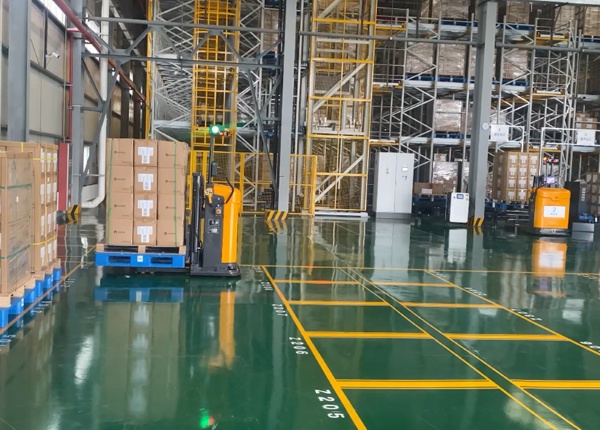
A natural-feature Laser SLAM system still needs sufficiently stable geometric information to localize the vehicle. Walls, columns, rack structures, end-of-aisle geometry, doors, fixed equipment, and other permanent features can contribute to localization. Long, repetitive aisles with almost identical geometry are a more demanding environment because the vehicle has fewer immediately distinguishable features.
The practical question for an imported Chinese AGV is therefore not simply whether reflective targets are required. It is whether the supplier has validated the navigation system against the actual rack layout, aisle geometry, floor conditions, temporary obstacles, and planned warehouse changes.
Two visually similar aisles do not necessarily create a navigation problem, but a warehouse containing long stretches of nearly identical geometry presents a more difficult localization environment.
A Laser SLAM system generally compares laser observations with its stored map and estimates the vehicle's position from the relationship between observed environmental geometry and the map. The exact localization and matching algorithms are supplier-specific.
In a warehouse, potentially useful permanent features can include:
Building walls and corners.
Structural columns.
Rack-end geometry.
Cross-aisles and intersections.
Doors and openings.
Fixed safety barriers.
Permanent equipment.
Changes in aisle geometry.
Other stable objects that consistently appear in the laser scan.
This means that the AGV does not necessarily need a unique feature beside every individual rack location. The overall map contains a larger geometric context that helps determine where the vehicle is.
However, the risk increases when two aisles remain extremely similar for a long distance and contain few stable cross-features. In such a situation, the system may have less information with which to distinguish one location from another.
This is why a proper site test should include the longest and most repetitive aisles, rather than demonstrating navigation only in an open area of the warehouse.
Aisle intersections and end-of-aisle areas can provide useful changes in geometry. When an AGV leaves a long repetitive rack corridor and encounters a cross-aisle, column, wall, or other permanent structure, the laser scan contains more information for localization.
For this reason, warehouse layout design and SLAM performance should be considered together. A technically capable AGV can still require additional engineering if the proposed warehouse contains unusually repetitive geometry.
Temporary objects can affect Laser SLAM, but the effect depends on how the navigation system uses the map and how large, numerous, and persistent the objects are.
A warehouse may contain cardboard boxes, pallets, carts, temporary staging material, parked forklifts, wrapped loads, and people. A production-ready AGV system should not require every temporary object to remain permanently unchanged.
Modern SLAM-based warehouse systems generally distinguish, to some extent, between stable environmental structure used for localization and dynamic obstacles that should be handled as temporary objects. The exact implementation differs between suppliers.
A cardboard box placed temporarily in an aisle therefore does not necessarily require the entire natural map to be rebuilt. The vehicle may simply detect it as an obstacle and either slow down, stop, wait, or use an available route around it, depending on the configured traffic and obstacle-handling logic.
The situation becomes more complicated when temporary objects are repeatedly placed in locations that were originally used as stable navigation references.
For example, if a warehouse continuously stores large stacks of boxes along a wall, the laser scan may see a substantially different environment from the one used during mapping. Likewise, shrink-wrapped inventory or tall temporary staging can obscure fixed structures.
The practical rule is therefore to keep critical localization features permanently visible whenever possible, while allowing normal temporary warehouse traffic in the operational space.
During FAT and SAT, the buyer should deliberately test realistic temporary obstacles. A good test is not an empty warehouse with perfect housekeeping. It is a representative operating environment containing pallets, people, parked equipment, temporary staging, and normal warehouse activity.
There is no universal minimum number of walls, columns, or fixed objects per square meter that guarantees reliable Laser SLAM navigation.
A supplier that provides a single number without considering the actual warehouse geometry is oversimplifying the problem.
Navigation performance depends on factors such as:
Laser scanner characteristics and field of view.
Scanner mounting height and orientation.
Rack geometry.
Distance between stable features.
Aisle length and width.
Cross-aisle arrangement.
Building columns and walls.
Open areas and large featureless spaces.
Reflective, transparent, or difficult-to-detect surfaces.
Dynamic obstacles and temporary storage.
Floor conditions and vehicle vibration.
Vehicle speed and operating profile.
In a conventional high-bay warehouse, the rack structure itself can provide substantial geometric information. However, the supplier should verify this rather than assuming that every rack system will provide the same SLAM quality.
A particularly important area is the transition between open spaces and repetitive rack aisles. The AGV should be tested when entering and leaving aisles, turning at intersections, passing columns, and approaching staging areas.
Before placing an order, provide the Chinese AGV manufacturer with the warehouse layout and identify the permanent structures that will remain after deployment.
The supplier should then identify areas where natural-feature localization may be less robust and recommend appropriate engineering measures. Depending on the system, these could include changes to route design, additional stable reference features, modified rack-end geometry, controlled navigation zones, or another navigation technology.
The correct objective is not to maximize the number of permanent objects. It is to ensure that the navigation system has enough reliable environmental information throughout the actual operating routes.
Removing a rack row is a more significant change than temporarily moving a pallet because it changes the permanent geometry of the warehouse.
The correct procedure depends on the Chinese AGV software architecture. Some systems allow trained administrators to modify map elements or operational routes through the fleet interface. Others require the manufacturer's engineering software or remote/on-site engineering support.
A typical controlled process can look like this:
Record the existing configuration: back up the current map and route configuration before changing the warehouse.
Update the physical layout: remove the rack and confirm the actual floor area is ready for operation.
Inspect the new geometry: verify that the removal has not created unexpected obstacles, floor changes, or pedestrian conflicts.
Update the navigation map: use the supplier-approved map editing or remapping procedure.
Review routes: remove obsolete paths and create or adjust routes through the newly available space.
Review operational zones: update pickup, drop-off, waiting, charging, restricted, or other configured zones if affected.
Validate localization: confirm the AGV can repeatedly localize and travel through the modified area.
Run functional tests: test representative pallet movements, turns, stops, and interactions with surrounding routes.
Release the new configuration: keep the previous approved configuration as a rollback option.
Importantly, removing one rack row does not automatically mean the entire warehouse must always be remapped. If the affected area is limited and the existing map architecture supports controlled editing, a partial update may be sufficient. In other systems, the supplier may recommend a new mapping run or additional localization validation.
The decision should be based on how the physical change affects the map and localization system rather than on the size of the removed rack itself.
This should be defined before purchasing the system.
For an overseas warehouse, relying on the Chinese manufacturer for every minor layout change can create unnecessary downtime. On the other hand, giving untrained users unrestricted access to navigation and safety parameters can introduce operational and safety risks.
A better approach is to define different permission levels:
| Function | Recommended Access |
|---|---|
| View current map | Warehouse administrator / IT |
| View routes and zones | Trained warehouse administrator |
| Create ordinary operational routes | Trained authorized user, if supported |
| Modify localization configuration | Qualified AGV engineer |
| Modify safety parameters | Controlled engineering procedure |
| Change core navigation algorithm | Manufacturer engineering team |
The exact permissions depend on the supplier's software. Therefore, during procurement, ask the manufacturer to demonstrate the actual local web or engineering interface and identify which functions are available to customer administrators.
A brochure statement such as "no reflector required" is not enough for a high-value warehouse automation project. The navigation technology should be evaluated against the actual warehouse conditions.
The pre-purchase validation should ideally include:
Longest repetitive rack aisle.
Narrowest operating aisle.
Open warehouse areas.
Cross-aisle intersections.
Columns and walls with irregular spacing.
Normal temporary pallet staging.
Pedestrian activity.
Parked manual forklifts or carts.
Low-visibility or difficult-to-detect surfaces where applicable.
Entry and exit from high-bay rack areas.
Representative pallet loads.
Normal and abnormal obstacle scenarios.
The buyer should also ask the supplier to explain what happens if localization confidence falls below the permitted operating threshold. Does the AGV slow down, stop, request assistance, attempt recovery, or use another configured behavior? The answer should be documented rather than left to assumptions.
For an imported Chinese Laser SLAM fleet, the strongest acceptance criteria are therefore based on repeatable navigation performance in the real warehouse, not simply on whether the system requires reflective targets.
Natural-feature SLAM can be highly suitable for multi-aisle warehouse automation, including high-bay and narrow-aisle applications. Its reliability ultimately depends on the relationship between the vehicle's sensing system, the permanent geometry of the building and racks, dynamic warehouse conditions, and the quality of the commissioning and map-management process.





 Chinese
 English