


Warped wooden pallets are one of the less obvious causes of failed automated forklift picks. A pallet may look acceptable to a human operator while having a twisted deck board, uneven runners, a damaged fork-entry opening, or a missing section underneath the load.
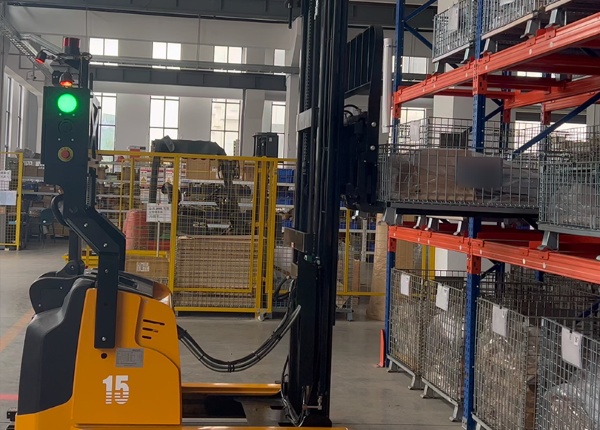
For a Chinese AMR forklift, the problem is not simply whether the pallet exists. The vehicle must determine whether the pallet is positioned correctly, whether the available fork-entry path is usable, and whether the pallet can be picked without creating an unsafe or unstable condition.
The exact sensor combination varies by manufacturer and vehicle configuration. A typical system may combine navigation LiDAR or 3D sensors, pallet or fork-position sensors, wheel and steering feedback, lift-position feedback, and load-related signals. The control software then applies predefined operating rules before allowing the pick cycle to continue.
A good autonomous forklift does not treat every pallet as a perfect rectangular object. In a real warehouse, wooden pallets can have broken boards, uneven runners, protruding nails, warped deck boards, damaged corners, or partial fork-entry openings.
The picking process can therefore be divided into several stages:
Navigate to the pallet pickup location.
Detect the pallet and its surrounding geometry.
Estimate the required approach and alignment.
Move the forks toward the entry position.
Verify that the fork-entry condition remains acceptable.
Insert the forks and perform the lift operation.
Verify the load state before transporting the pallet.
If the vehicle cannot satisfy the configured conditions at one of these stages, the software may slow down, reposition the vehicle, retry the approach, or stop the task and generate an exception. The exact behavior is supplier-specific and should be demonstrated during acceptance testing.
There is usually not one dedicated “twisted pallet angle sensor.” The alignment decision is normally produced by combining several sources of information.
Navigation LiDAR can provide the vehicle with its position relative to the warehouse map and surrounding structures. Depending on the system architecture, it may also contribute to detecting pallet geometry or the pickup environment.
However, navigation LiDAR should not automatically be considered a dedicated pallet inspection sensor. Its suitability for pallet alignment depends on scanner placement, resolution, field of view, pallet geometry, and the manufacturer's software.
A 3D camera or depth sensor can provide additional information about the height and shape of the pallet area. This can be useful when the top surface or fork-entry geometry cannot be adequately represented by a two-dimensional scan.
For example, a depth sensor may help identify an uneven pallet surface or distinguish the pallet from nearby objects. Its actual performance depends heavily on lighting, surface reflectivity, sensor mounting, and software algorithms.
The AMR also knows information about its own movement. Steering angle, wheel position, travel distance, fork height, and other vehicle feedback can be used to determine whether the commanded approach has been achieved.
This is important because detecting a pallet and actually inserting the forks into it are two different problems.
It can, but this should not be assumed for every Chinese AMR forklift.
Whether a missing runner is detected depends on the vehicle's sensor configuration, pallet-recognition method, fork-entry strategy, and control logic. Some systems may detect an abnormal geometry before fork insertion. Others may only detect the problem after the expected fork-entry condition is not achieved.
This distinction matters when purchasing an AMR. A supplier saying that the vehicle “supports pallet detection” does not necessarily mean it can identify every missing wooden runner.
For example, if one runner is missing but the remaining pallet geometry still allows the forks to enter normally, the system may not classify the pallet as unpickable. If the missing structure creates an abnormal opening, changes the expected geometry, or prevents stable fork insertion, the system may stop the operation.
The safest procurement approach is therefore to define the abnormal pallet conditions that the AMR must detect rather than simply asking whether “damaged pallet detection” is supported.
When an automated pick cannot be completed, the fleet-management software may record an exception associated with the vehicle, task, location, and fault condition.
Depending on the supplier's software architecture, the warehouse manager may see information such as:
Vehicle identification
Task or mission number
Pickup location
Current vehicle state
Pick or alignment failure
Sensor or positioning alarm
Number of retry attempts
Time of the exception
Required manual intervention
Some fleet systems can also expose historical task records and fault statistics. This allows the warehouse team to determine whether failed picks are isolated incidents or whether a particular pallet type, storage location, or operating area is producing repeated exceptions.
For example, if the same pickup location repeatedly generates alignment failures, the problem may not be the AMR itself. The pallet position, rack geometry, floor condition, pallet quality, or pickup-point configuration may need to be investigated.
In many systems, some alignment and operating parameters can be configured, but the extent of customer access varies significantly between manufacturers.
A configurable parameter might relate to approach distance, stopping position, pallet detection range, retry behavior, fork-entry conditions, or task-specific positioning rules. However, safety-critical limits and core navigation parameters should normally be protected from unrestricted warehouse-user modification.
This is particularly important with damaged wooden pallets. Increasing the tolerance may reduce unnecessary pick failures, but excessive tolerance can also allow the vehicle to attempt a pick that should have been rejected.
The correct approach is to establish an acceptable operating window using representative pallets, rather than simply increasing the tolerance until the AMR stops reporting errors.
A common mistake during AGV procurement is to compare sensor specifications and assume that a higher-resolution sensor automatically produces better pallet handling.
Actual fork-entry performance can also be affected by:
Vehicle localization accuracy
Steering and mechanical backlash
Fork geometry and fork spacing
Fork deflection under load
Pallet dimensional variation
Warped or broken pallet runners
Floor flatness and joints
Load center and payload
Rack and pickup-location tolerances
Sensor mounting position
Lighting and reflective surfaces
Therefore, an RFQ should not only ask for LiDAR resolution or camera specifications. It should ask the supplier to demonstrate actual pallet-pick performance with the pallets that will be used in the warehouse.
Factory Acceptance Testing should include more than a perfect new pallet. If the warehouse regularly uses old wooden pallets, representative damaged pallets should be included in the test protocol.
A practical FAT pallet set could include:
Normal wooden pallets
Slightly warped pallets
Uneven deck boards
Damaged corners
Different runner conditions
Pallets with missing or damaged boards
Different pallet dimensions used by the warehouse
Representative maximum payloads
The objective is not to prove that the AMR can pick every damaged pallet. The objective is to establish which pallet conditions are acceptable and which conditions must result in a controlled rejection or manual exception.
If pallet quality is a major concern, the purchase specification should describe the required behavior instead of relying on a general statement such as “AI pallet recognition.”
Ask the Chinese AMR supplier to define:
Which sensors are used for pallet detection and fork alignment
Whether pallet geometry is detected in 2D, 3D, or through another method
What pallet dimensions and runner configurations are supported
Which damaged-pallet conditions can be detected
What happens when fork entry cannot be verified
Whether the vehicle retries, repositions, or aborts the mission
Which alignment parameters are configurable
Which parameters are restricted to supplier engineers
What fault information is recorded by the fleet manager
Whether historical failed-pick data can be exported
How abnormal pallets are handled after a failed task
How these functions will be tested during FAT and SAT
For warehouses using mixed-quality wooden pallets, the best AMR strategy is not to make the vehicle accept increasingly poor pallets. It is to establish a defined pallet-quality window and make the automation system behave predictably outside that window.
A robust system should combine vehicle localization, pallet sensing, fork positioning, controlled motion, and exception handling. The warehouse should then use FAT and SAT to determine which pallet conditions can be handled automatically and which require manual inspection.
This approach also makes software tuning safer. Instead of asking the supplier to “increase the tolerance,” the buyer can specify a measurable operating requirement: acceptable pallet dimensions, permitted deformation, required pick success rate under representative conditions, and the required response when the pallet falls outside those conditions.











 Chinese
 English




