


A private 5G network can provide an attractive wireless architecture for a large AGV fleet, particularly when a warehouse wants predictable coverage, centralized network management, and stronger separation between robot traffic and ordinary corporate devices.
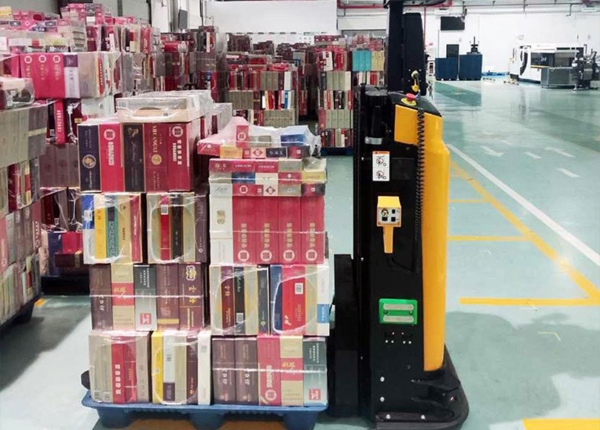
However, a 5G connection should not automatically be treated as the safety system for an autonomous forklift. The correct architecture separates ordinary fleet communication from safety-critical functions. An AGV should have a defined local response when communication is delayed, interrupted, or lost.
NIST's 2026 guidance on private and commercial 5G security specifically recommends architectural separation of data-plane, signaling, and operations-and-maintenance traffic. NIST also identifies private 5G as a technology with potential for industrial applications where reliability and latency are important.
Some Chinese AGV manufacturers can integrate cellular communication hardware, but this should never be assumed from the phrase “5G compatible.”
The buyer needs to specify the complete communication architecture, including the 5G modem, supported frequency bands, SIM or eSIM configuration, antenna system, operating system, network interface, private-network authentication method, and fleet-management software.
The relevant question is therefore not simply:
“Does the AGV have a 5G module?”
Instead, ask whether the exact vehicle can connect to the private 5G infrastructure that your enterprise plans to deploy.
Important compatibility items include:
5G frequency bands supported by the AGV modem
Standalone or non-standalone 5G architecture
SIM/eSIM requirements
Private-network authentication
IP addressing method
VLAN or VRF integration
APN or enterprise data-network configuration
Firewall requirements
Fleet-server communication ports
Roaming behavior between private-network cells
Local operation when the external WAN is unavailable
For an imported fleet, the modem's regional band support is especially important. A 5G modem that works with a Chinese carrier does not automatically support the spectrum configuration used by a private network in the United States, Europe, or another destination market.
Not by itself.
5G includes technologies intended to support high reliability and low-latency industrial communication. NIST's industrial private-5G research specifically identifies URLLC as a technology intended for industrial control and mission-critical applications.
But the word “low latency” describes network performance, not the complete safety response of an AGV.
The complete control loop may include:
Operator command
Remote-control application
Enterprise network
5G core
5G radio network
AGV modem
Vehicle computer
Safety or motion controller
Motor and brake response
Even if the radio portion is very fast, processing, queuing, application software, vehicle control, and mechanical braking can add additional delay.
For this reason, an RFQ should specify measured end-to-end control performance where remote operation is required rather than advertising a theoretical 5G latency number.
Both technologies can provide wireless connectivity for an AGV fleet. The choice should be based on the site's coverage, mobility, device density, network architecture, operational requirements, and IT capabilities rather than assuming that 5G is automatically better.
Private 5G can provide cellular mobility management, controlled spectrum use in appropriate deployments, centralized subscriber management, and dedicated enterprise network architecture. Wi-Fi can be simpler and less expensive when the warehouse already has a mature industrial wireless network.
For an AGV buyer, the important comparison is operational rather than theoretical:
| Requirement | What to Measure |
|---|---|
| Coverage | Signal quality throughout travel routes |
| Mobility | Connection continuity during movement |
| Latency | Measured end-to-end application latency |
| Reliability | Packet loss, jitter and reconnection behavior |
| Security | Authentication, segmentation and firewall controls |
| Scalability | Performance with the full planned fleet |
Network slicing allows different traffic or services to be logically separated within a 5G architecture. In an enterprise deployment, a slice can be designed for particular service requirements rather than allowing every application to compete identically for network resources.
3GPP has continued to develop network-slicing capabilities across successive releases, including enhancements related to slice continuity and resource handling.
For an AGV warehouse, a network architecture might conceptually separate:
AGV fleet traffic
Warehouse-management traffic
Employee devices
Video surveillance
Maintenance traffic
Operations-and-maintenance traffic
This can reduce the risk that ordinary corporate traffic directly competes with robot communications. However, slicing is not a magic “AGV priority button.” Its effectiveness depends on how the 5G RAN, core, transport network, policies, and applications are actually configured.
NIST specifically recommends separating data-plane, signaling, and operations-and-maintenance traffic as part of a secure 5G network architecture.
Depending on the private-network and carrier architecture, the enterprise may be able to use APN or equivalent data-network configuration to control how AGV devices access enterprise resources.
The exact mechanism depends on whether the deployment uses a standalone private 5G network, a carrier-managed private network, or a hybrid architecture.
The objective should be to create a clearly defined communication path:
AGV → 5G Access → Enterprise Data Network → Firewall / Security Controls → Fleet Server
The AGV should not automatically have unrestricted access to the corporate LAN simply because it has a 5G SIM.
Your IT team should define:
AGV IP addressing
Permitted destination addresses
Required TCP/UDP ports
Fleet-server addresses
DNS requirements
NTP/time synchronization requirements
Remote-maintenance destinations
Internet access requirements
Firewall rules
Logging requirements
If the fleet can operate entirely against a local server, the buyer should determine whether Internet access is actually required for normal AGV operation. Cloud monitoring, remote diagnostics, software updates, license verification, or vendor support may require external connectivity, but these functions should be identified separately.
This should be addressed through network architecture and testing rather than through the country of origin of the equipment.
A Chinese AGV does not inherently need to send operational data to a server in China. Conversely, the fact that the fleet is connected to a private 5G network does not automatically mean that no data can leave the facility.
The IT team should request a communication-flow diagram showing:
AGV-to-fleet-manager communication
AGV-to-local-server communication
Fleet-server-to-WMS communication
Remote-maintenance connections
Cloud monitoring connections
Software-update destinations
License or authentication services
Any external telemetry transmission
NIST's 2026 5G security guidance emphasizes architectural separation of network traffic and operational-management functions, which is directly relevant when designing a private network for industrial robots.
A single lost packet should not automatically be interpreted as a dangerous failure. Wireless networks experience packet loss, retransmission, jitter, and temporary interruptions.
The important question is how the AGV control architecture responds to communication degradation.
For ordinary fleet communication, the vehicle may tolerate a short interruption using buffering, retransmission, local task state, or a temporary communication timeout.
For a safety-critical command, the architecture should define a deterministic safe response if the required communication cannot be maintained.
Possible responses may include:
Controlled deceleration
Safe stop
Brake application
Task suspension
Local obstacle-protection behavior
Communication-loss alarm
Fleet-manager notification
Manual intervention requirement
The correct response depends on the vehicle's safety architecture and risk assessment. The supplier should not simply state that “5G is reliable enough.” The buyer should request the actual timeout and fail-safe behavior.
For a safety-critical emergency-stop function, relying solely on an ordinary 5G data connection is generally the wrong architecture.
An autonomous forklift should have appropriate local safety functions, such as physical emergency-stop devices and protective sensing, with safety-related control logic designed for the required safety performance.
A remote 5G command can provide an additional operational control mechanism, but the supplier should clearly distinguish:
Normal remote-control commands
Fleet-management commands
Safety-related commands
Emergency-stop functions
Communication-loss behavior
If a supplier claims that a 5G-based remote emergency-stop function is safety-rated, request the relevant safety architecture, certification or assessment evidence, response-time specification, communication-loss behavior, and validation records for the complete function.
A private 5G network should be tested under abnormal conditions before the AGVs are released for production.
The FAT or SAT test plan can include:
Normal 5G operation at different warehouse locations.
Temporary packet loss.
Increased latency.
Increased jitter.
Temporary radio coverage degradation.
5G cell handover during AGV movement.
Loss of the 5G connection.
Fleet-server connection loss.
Recovery after the network becomes available again.
Confirmation that the AGV does not unexpectedly restart a suspended task.
The test should record the network condition and the vehicle's response. “The AGV stopped” is not enough. The test should identify whether it stopped because of a communication timeout, a safety function, an application-level timeout, or another mechanism.
Before approving a 5G-based AGV architecture, ask the supplier to provide a communication specification covering the exact vehicle and fleet software.
5G modem manufacturer and exact model
Supported frequency bands
5G standalone support
SIM/eSIM requirements
Private-network compatibility
Required APN or data-network configuration
IP addressing method
Required ports and protocols
Fleet-server architecture
Local-server operation
External Internet dependencies
Remote-maintenance architecture
Network-loss timeout
Communication-loss behavior
Task recovery after reconnection
5G handover behavior
FAT/SAT network test requirements
The IT team should treat the AGV fleet as an industrial OT system rather than simply another group of wireless clients.
A practical security test should include:
Asset inventory for every 5G modem and AGV
Network segmentation
Firewall rule review
Allowed destination verification
Port and protocol verification
Remote-access testing
Authentication review
Logging and monitoring
Firmware and software update process
External-cloud connection verification
Network-loss recovery testing
Fleet-server backup and recovery testing
NIST's current 5G security work emphasizes that the security capabilities defined by 5G standards still need to be correctly configured and implemented by network operators. In other words, having 5G technology does not automatically create a secure enterprise network.
For a large warehouse, a strong architecture separates four functions.
Vehicle safety: local safety sensors, emergency stop, braking, protective fields, and safety-related control logic.
Vehicle control: local motion control and defined behavior when communication is degraded.
Fleet communication: 5G connectivity between AGVs, fleet software, WMS/WCS, and other authorized systems.
Enterprise security: private APN or equivalent network controls, segmentation, firewalling, authentication, logging, and controlled remote access.
This prevents a common architectural mistake: assuming that a highly reliable wireless network can replace local AGV safety functions.
Private 5G can be a powerful communications layer for an imported Chinese AGV fleet, particularly where the warehouse requires controlled wireless access, predictable mobility, and integration with enterprise IT/OT infrastructure. But the buyer should evaluate the complete system rather than the 5G modem alone.
The strongest procurement requirement is therefore not simply “AGV must support 5G.” It is: the supplier must document the 5G architecture, network dependencies, security boundaries, communication-loss behavior, and FAT/SAT performance for the exact AGV fleet being supplied.







 Chinese
 English