


Flexible assembly operations may require materials to be delivered to different locations during the same production shift. A workstation can be moved, a temporary assembly dock can be opened, or a production order can change the required delivery point.
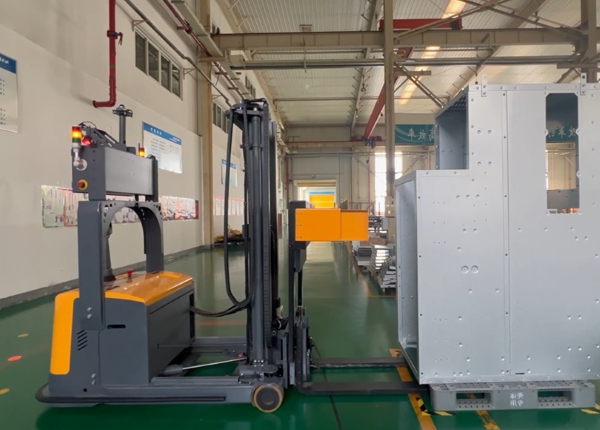
For a Chinese AMR deployment, this creates a more complex requirement than simply moving pallets between fixed stations. The system must identify the current destination, confirm that the destination is available, plan a safe route, position the vehicle correctly, and notify the workstation operator when the delivery is ready.
A practical solution normally involves several coordinated layers: the MES or production system, WMS or material-management system, fleet manager, navigation software, vehicle sensors, and the local workstation interface.
The most important procurement question is whether the supplier can support controlled changes to delivery points without requiring an engineer to manually rebuild the entire warehouse map every time a workstation moves.
A dynamic drop-off point should normally be represented as a controlled destination in the fleet system rather than as an arbitrary coordinate entered by an operator.
Depending on the supplier's software architecture, a destination may be defined through a station ID, a docking point, a task location, a coordinate, a map feature, or a preconfigured set of approved positions.
When the target location changes, the general workflow may be:
The production or material-management system identifies the required delivery point.
The destination is checked against the approved station list or operating area.
The fleet manager receives the updated task destination.
The routing system calculates a path from the AMR's current position to the new destination.
The system checks traffic restrictions, blocked paths, vehicle access rules and other active missions.
The AMR travels to the approved approach point.
The vehicle performs the final positioning and material handoff.
The fleet system reports task completion or an exception.
If the new destination is already included in the approved map and station configuration, the change may be handled through software. If the destination is outside the mapped or validated operating area, additional mapping, route configuration, safety review or engineering work may be necessary.
This distinction should be clarified before purchase. A system that supports changing between preconfigured stations is not necessarily a system that can safely accept any new physical coordinate in real time.
The fleet manager should have a defined response when a dynamic destination is occupied, offline, blocked or not ready to receive materials.
Possible responses include waiting at a safe holding point, selecting another approved approach route, sending the material to a temporary buffer, returning the task to a queue, or generating an operator alert.
The correct response depends on the production process. For example, a high-priority assembly order may require the AMR to wait, while a lower-priority replenishment task may be temporarily reassigned.
The buyer should require the supplier to demonstrate how the system handles a destination that becomes unavailable after the AMR has already started its mission.
In principle, an AMR fleet system can receive material-delivery tasks from an MES or another production-management platform. However, the exact integration method depends on the supplier's software interface and the customer's production architecture.
The MES may know which production order is active, which workstation requires material, and when a delivery is needed. The fleet manager then translates that production requirement into an executable AMR mission.
A typical workflow may look like this:
| System | Responsibility |
|---|---|
| MES | Identifies the production order, workstation and material requirement |
| WMS or Material System | Confirms material identity, quantity, pallet or container and inventory status |
| Integration Layer | Translates business data into a valid transport request |
| Fleet Manager / RCS | Assigns the AMR, checks routes and manages the mission |
| AMR | Navigates to the approved destination and performs material handling |
| Workstation Interface | Confirms readiness, receipt, completion or an exception |
The MES does not necessarily need to control the AMR's motors, navigation or safety functions. In many architectures, the MES supplies production requirements while the fleet manager controls vehicle dispatch and movement.
Depending on the system, the interface may use REST APIs, TCP/IP messages, database exchange, message queues, industrial Ethernet, PLC signals, digital I/O, or another documented integration method.
The buyer should not accept “MES integration available” as a complete technical answer. The supplier should identify:
Supported interface protocols.
Task creation and cancellation methods.
Station and destination ID structure.
Required task fields.
Acknowledgement and completion messages.
Timeout and retry behavior.
Duplicate-task prevention.
Fault and exception codes.
Authentication and access permissions.
Responsibility for maintaining the integration interface.
If a workstation can move between several approved locations, the integration layer may select a station ID from a controlled list. This is generally easier to validate than allowing the MES to send unrestricted physical coordinates.
Accurate delivery to a temporary workstation requires more than a navigation map. The vehicle must reach the correct area and then align with the actual handoff interface.
Depending on the AMR design, positioning and docking may use a combination of:
Laser LiDAR or Laser SLAM: supports localization and navigation using environmental features.
Reflectors or coded markers: can provide a more defined reference where the system is designed to use them.
2D or 3D cameras: can help identify docking features, pallets, containers or workstation references.
Depth sensors: can provide geometric information for final approach or object alignment.
Proximity sensors: can confirm that the vehicle or load has reached a defined physical position.
Wheel encoders and steering feedback: support vehicle motion estimation and control.
Mechanical guides or docking fixtures: can improve repeatability when the workstation design permits them.
External positioning references: may be used when the application requires a defined reference independent of the surrounding environment.
The exact sensor combination is application-specific. A navigation LiDAR that keeps the AMR localized does not automatically guarantee accurate pallet transfer into a mobile assembly dock.
No. The phrase “millimeter-level accuracy” should be examined carefully before it is included in a purchase specification.
The buyer should distinguish between:
| Accuracy Type | Meaning |
|---|---|
| Localization Accuracy | How accurately the vehicle estimates its position in the navigation environment |
| Stopping Accuracy | How consistently the vehicle stops at a commanded position |
| Docking Accuracy | How accurately the vehicle aligns with the workstation or transfer interface |
| Load Position Accuracy | How accurately the pallet, container or material is placed |
| Repeatability | How consistently the same position is achieved across repeated cycles |
Final handover performance can also be affected by wheel wear, floor conditions, vehicle load, pallet or container tolerances, mechanical backlash, fork deflection, workstation movement, sensor mounting, lighting, reflective surfaces and the design of the transfer interface.
For a mobile assembly dock, the dock itself may move or settle. A highly accurate AMR cannot compensate for an unstable or poorly defined receiving interface.
The better requirement is to define a measurable handover tolerance under representative payload, floor, workstation and environmental conditions, then verify it during FAT and SAT.
Arrival and completion should be treated as separate events. An AMR reaching a coordinate does not necessarily mean that the material has been safely transferred or accepted by the workstation.
A complete workflow may include the following states:
The AMR is assigned a delivery task.
The vehicle approaches the destination.
The vehicle reaches the defined arrival or docking area.
The workstation confirms that it is ready.
The AMR performs the material handoff.
The workstation or sensor system confirms receipt.
The fleet manager marks the task complete.
The MES or WMS receives the completion message.
Depending on the workstation, the notification may be provided through a dashboard, operator tablet, industrial display, stack light, buzzer, local HMI, email, message interface, PLC signal, or a software event.
The appropriate method depends on the production environment. A noisy assembly area may require a visual signal in addition to an audible alert. A safety-critical handoff may require a formal ready/complete interlock rather than a simple notification.
| Status | Required Meaning |
|---|---|
| Arrived | The AMR reached the defined approach or docking position |
| Workstation Ready | The receiving station is ready to accept the material |
| Handover Started | The transfer operation has begun |
| Handover Confirmed | The material has reached the required receiving condition |
| Task Complete | The fleet and production systems have accepted the completed mission |
| Exception | The task cannot continue or requires operator intervention |
Defining these statuses prevents a common integration problem: the fleet system reports “arrived,” while the workstation operator assumes that the material has already been delivered.
A standard AMR demonstration may show one vehicle traveling to one fixed station. That does not adequately test a flexible assembly application.
The buyer should request test scenarios such as:
Change the delivery destination before the task starts.
Change the destination while the AMR is traveling.
Make the selected workstation unavailable.
Assign two AMRs to different temporary stations.
Move a workstation within its approved operating area.
Block the shortest route to the new destination.
Confirm that rerouting does not enter prohibited areas.
Test the docking tolerance with representative payloads.
Interrupt the handover and verify recovery behavior.
Verify arrival, ready, handover and completion messages.
Test the system when MES, WMS, PLC or network communication is interrupted.
The acceptance record should include the software version, map or station configuration, payload, destination, measured docking result, response time where relevant, fault behavior, and whether the test passed the agreed criteria.
Dynamic drop-off functionality should be written as a measurable system requirement rather than a general promise that the AMR supports flexible production.
Definition of approved dynamic stations.
Rules for adding, moving, activating and disabling stations.
Whether station changes require supplier engineering support.
MES, WMS, RCS and PLC interface responsibilities.
Task creation, cancellation, acknowledgement and completion messages.
Dynamic routing and blocked-destination behavior.
Workstation readiness and handover confirmation.
Docking and load-placement tolerances.
Permitted payloads, floor conditions and workstation movement range.
Operator alerts and exception handling.
FAT and SAT scenarios.
Software change control, version records and support responsibilities.
The contract should also clarify whether the customer can change station locations independently or whether every change must be approved by the supplier. This affects the operating cost and flexibility of the system after deployment.
For most flexible assembly applications, the most reliable approach is to combine a controlled library of approved drop-off points with software-driven task assignment and a clearly defined physical handover interface.
The MES can determine where material is required. The integration layer can select an approved station. The fleet manager can assign the mission and calculate a valid route. The AMR can use its navigation and docking sensors to approach the station. The workstation can then confirm readiness and receipt through a defined signal or software message.
This architecture is generally easier to test and maintain than allowing every system to modify vehicle destinations without control.
For flexible assembly logistics, dynamic delivery should mean controlled flexibility—not unrestricted movement to any coordinate. Before selecting a Chinese AMR supplier, verify how approved drop-off points are managed, how MES tasks are converted into fleet missions, how the vehicle performs final docking, and how the workstation confirms successful handover. The most valuable acceptance criterion is not a generic accuracy claim, but repeatable delivery performance at the actual mobile or temporary assembly interface.
SEO Title: Chinese AMRs for Dynamic Drop-off Points in Assembly Lines
Meta Description: Learn how Chinese AMRs manage changing delivery points, MES integration, dynamic routing, docking sensors, and arrival confirmation for flexible assembly logistics.





 Chinese
 English