


An autonomous forklift does not simply replace a manual forklift and immediately start working. The warehouse environment becomes part of the automation system. A successful installation requires the vehicle, racks, pallets, floor, traffic routes, network, charging area, and operating rules to work together.
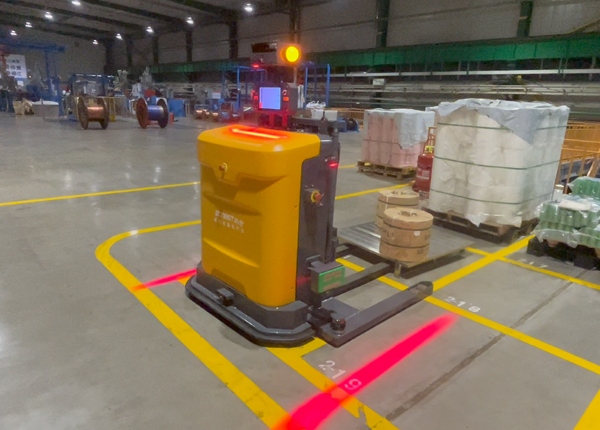
Before selecting an unmanned forklift, provide the supplier with the warehouse layout and identify aisles, racks, columns, doors, staging areas, pedestrian routes, docks, elevators, and charging locations.
The vehicle's turning capability, fork dimensions, load center, lift height, and navigation technology should then be checked against the actual warehouse geometry.
Aisle width should not be selected from a generic AGV specification sheet alone.
The actual requirement depends on pallet dimensions, rack configuration, vehicle steering, load center, turning behavior, safety clearance, and required placement accuracy.
For a VNA application, even a small difference in required aisle width can affect the number of rack positions available in the building, so the supplier should validate the proposed aisle dimension using the actual pallet and rack configuration.
Autonomous forklifts depend on predictable floor conditions for traction, localization, braking, and accurate pallet handling.
The site survey should identify slopes, joints, cracks, potholes, thresholds, metal transition plates, wet areas, polished surfaces, and other changes in floor condition.
There is no single floor specification that applies to every unmanned forklift. Requirements should be confirmed against the selected vehicle, speed, lift height, payload, rack configuration, and accuracy requirements.
Pallet geometry can have a direct effect on autonomous fork entry.
The supplier should know pallet dimensions, runner configuration, total height, maximum weight, load center, fork-entry direction, and the percentage of non-standard pallets.
Damaged or heavily warped pallets should also be included in testing if they occur regularly in production.
Existing warehouses often have forklift traffic, pedestrian walkways, manual pallet jacks, visitors, maintenance workers, and temporary staging areas.
The automation project should define pedestrian crossing points, restricted areas, AGV travel corridors, slow-speed areas, waiting zones, and exception-handling locations.
The final safety concept should be based on the actual site risk assessment rather than assuming that software traffic rules alone provide physical protection.
Charging areas need sufficient electrical capacity, physical space, ventilation or environmental controls where required, network coverage where applicable, and safe access for maintenance.
The electrical installation should be reviewed against the exact charger and local electrical requirements.
An autonomous fleet normally depends on reliable communication between vehicles and fleet-management infrastructure.
Before deployment, check wireless coverage throughout aisles, rack areas, charging stations, staging areas, docks, and other locations where vehicles operate.
Coverage alone is not enough. Roaming behavior, interference, packet loss, latency, AP capacity, and network segmentation should also be considered.
For high-bay warehouses, the rack system must be checked together with the AGV.
Important information includes rack beam levels, clearances, pallet positions, rack upright locations, building clear height, fire-protection requirements, and load limitations.
A vehicle capable of lifting to a certain height does not automatically mean that the existing rack can safely use that height.
Autonomous forklifts perform more consistently when pickup and drop-off conditions are clearly defined.
Marking staging areas, pallet orientation, approach direction, exception areas, and manual intervention zones can reduce unnecessary variation.
The supplier should return a site-modification list before the project becomes contractual.
Floor repairs
Rack modifications
Traffic barriers
Charging infrastructure
Network improvements
Pedestrian controls
Staging-area changes
Elevator or door interfaces
Electrical installation
This gives the buyer a much clearer understanding of the real deployment scope than purchasing the vehicle first and discovering infrastructure problems during commissioning.





 Chinese
 English