


For an overseas buyer, shipment should not be treated as the point at which documentation begins. Before a Chinese unmanned forklift leaves the factory, the buyer should already have enough technical, commercial, installation, and compliance information to prepare the receiving site.
This is especially important for high-bay warehouses, narrow-aisle applications, WMS integration, and projects where local technicians will participate in installation or maintenance.
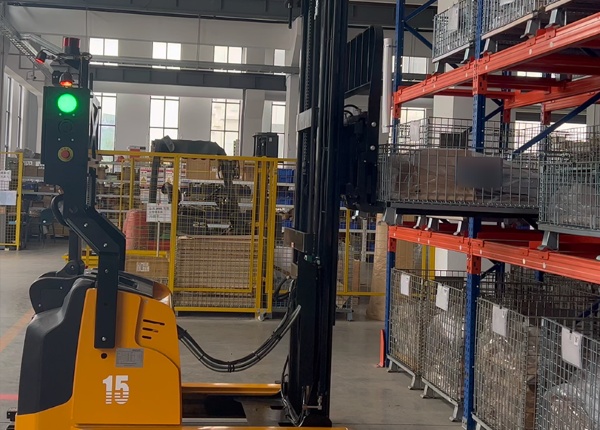
The supplier should provide the final specification for the exact vehicle configuration being shipped.
Model number
Rated payload
Load center
Maximum lift height
Fork dimensions
Overall dimensions
Turning requirements
Travel speed
Battery specification
Charger specification
The final document should correspond to the actual purchased configuration rather than a generic catalog model.
Mechanical drawings are useful for checking warehouse clearances, rack interfaces, maintenance access, and transportation requirements.
Depending on the project, the buyer may request overall dimensions, fork dimensions, lifting envelope, maintenance access, mounting points, and major component locations.
The receiving facility may need electrical information before the equipment arrives.
Request the vehicle electrical specifications, charger requirements, power consumption information where applicable, wiring diagrams, protection requirements, connector information, and emergency-stop architecture relevant to the installation.
For the charger, the exact voltage, phase, current, connection method, and applicable certification or listing documentation should be identified rather than relying on a generic “industrial charger” description.
For lithium battery systems, request the battery model, chemistry, nominal capacity, operating conditions, charging conditions, BMS information, and applicable transport documentation.
If the battery is being shipped internationally, the buyer and logistics provider should confirm the required dangerous-goods and transport documentation for the exact battery configuration.
An autonomous forklift project can require network preparation before installation.
Ask the supplier to provide:
Network architecture
Required IP configuration
Required ports and protocols
Server requirements
Wireless requirements
Fleet-management architecture
API documentation
WMS interface information
This allows the customer's IT team to review the system before the equipment arrives.
The supplier should provide documentation describing the vehicle's safety functions and applicable technical documentation for the purchased configuration.
Depending on the project, this can include safety scanner information, emergency-stop architecture, warning devices, protective functions, safety-related control documentation, risk-assessment information, manuals, and applicable declarations or test records.
A CE document, where provided, should not automatically be treated as proof that every U.S. site requirement has been satisfied. The buyer should review the exact equipment and local requirements separately.
Before shipment, the supplier should provide the agreed factory acceptance test records.
The FAT package can document vehicle movement, pallet handling, lifting, navigation, safety functions, software communication, charging, alarms, and other project-specific acceptance requirements.
The exact test items should come from the agreed purchase specification rather than a generic checklist created after manufacturing is complete.
The buyer should receive the final packing information before shipment.
Number of packages
Package dimensions
Gross weight
Net weight
Package identification
Loading instructions
Lifting points where applicable
Center-of-gravity information where applicable
These details allow the warehouse and logistics team to prepare unloading equipment before the shipment arrives.
The receiving site should know what must be completed before the Chinese engineers arrive.
The supplier should identify requirements for floor conditions, charging, network connectivity, staging areas, rack clearance, pallet preparation, safety barriers, and other site conditions.
The buyer should receive maintenance information before commissioning is complete.
Useful documentation includes maintenance intervals, inspection procedures, lubrication requirements where applicable, wear-part identification, fault-code information, replacement procedures, and recommended spare parts.
| Document | Purpose |
|---|---|
| Final technical specification | Confirm purchased configuration |
| Mechanical drawings | Check site and maintenance clearance |
| Electrical documents | Prepare installation |
| Network architecture | Prepare IT infrastructure |
| Safety documentation | Support site safety review |
| FAT records | Verify factory acceptance |
| Packing list | Prepare transportation and unloading |
| Maintenance manual | Prepare local service |
The final pre-shipment document package should become part of the project handover record. This gives the overseas buyer a technical baseline for commissioning, maintenance, future modifications, and warranty support.











 Chinese
 English




