


Comparing Chinese unmanned forklift suppliers only by price can make the purchasing decision difficult. Different suppliers may use different vehicle configurations, software architectures, service models, and project scopes in their quotations.
For an overseas warehouse buyer, the better approach is to compare suppliers using the same technical and commercial requirements.
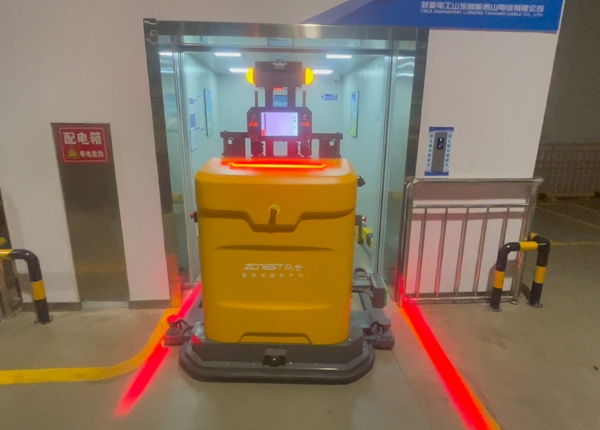
Before requesting quotations, prepare a common specification for every supplier.
Payload
Lift height
Load center
Fork dimensions
Pallet dimensions
Minimum aisle width
Travel distance
Required throughput
Floor conditions
Operating temperature
Navigation requirements
Charging requirements
WMS or ERP interface
If every supplier receives the same information, their proposals become much easier to compare.
Two forklifts with the same rated capacity may have very different operating characteristics.
Check vehicle dimensions, turning characteristics, mast configuration, fork adjustment, lift speed, travel speed, battery capacity, charging method, and safety hardware.
For narrow-aisle applications, do not accept a generic aisle-width statement. Ask the supplier to validate the vehicle against the actual pallet, rack, load center, and operating route.
Chinese AGVs can use different navigation technologies, including Laser SLAM, 3D SLAM, reflector-based positioning, magnetic navigation, QR codes, or combinations of technologies.
The important question is not which technology sounds more advanced. The buyer should understand how the proposed system performs in the actual warehouse environment.
Ask suppliers to explain localization requirements, temporary obstacles, rack changes, open areas, repetitive aisles, and map-update procedures.
The fleet-management layer should be evaluated separately from the vehicle.
Compare task dispatching, traffic management, charging management, alarm handling, user permissions, reports, historical data, API availability, and integration with the existing WMS.
Also ask whether additional vehicles can be added later without replacing the fleet-management architecture.
A supplier should be able to explain how the proposed vehicle will be tested against the buyer's actual operating requirements.
For example, test cases can cover loaded travel, empty travel, pallet pickup, rack placement, high-level lifting, obstacle detection, charging, communication loss, and abnormal pallet conditions.
The same acceptance criteria should be applied to every supplier wherever practical.
For an overseas buyer, service capability can be as important as the vehicle itself.
Ask how technical support is provided after commissioning, how remote diagnostics work, what spare parts are available, how software issues are handled, and when an engineer can be dispatched if remote troubleshooting is insufficient.
Do not treat “24/7 support” as a complete service specification. Ask for response times, escalation procedures, communication channels, and responsibilities.
| Category | Supplier A | Supplier B | Supplier C |
|---|---|---|---|
| Payload | Specified | Specified | Specified |
| Lift Height | Specified | Specified | Specified |
| Aisle Requirement | Specified | Specified | Specified |
| WMS Integration | Scope | Scope | Scope |
| Commissioning | Included / Excluded | Included / Excluded | Included / Excluded |
| Warranty | Specified | Specified | Specified |
One of the most useful parts of a supplier comparison is identifying what has not been specified.
If one quotation provides detailed software, integration, testing, and commissioning information while another provides only a vehicle price, the two quotations are not yet directly comparable.
Ask the supplier to mark every item as included, optional, excluded, or to be confirmed.
This creates a much clearer purchasing basis before technical negotiations and contract discussions begin.





 Chinese
 English