


An unmanned forklift purchase should not be based only on a product brochure or a quotation. Before placing a purchase order, the buyer and supplier should agree on a technical specification that defines what the vehicle and system are expected to do.
This document becomes especially important when the forklift is customized for a specific warehouse.
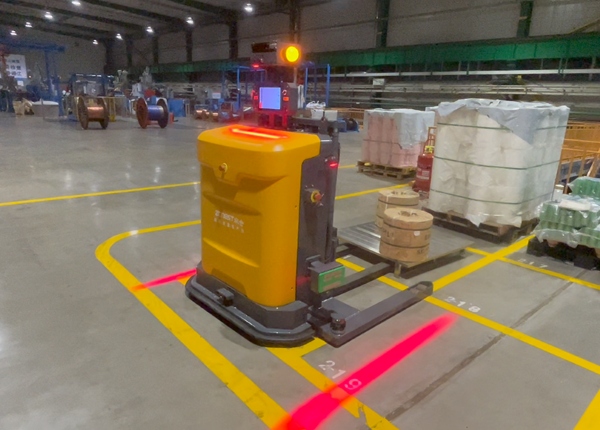
Start with the basic vehicle configuration.
Payload and load center
Fork length and width
Minimum and maximum lift height
Vehicle dimensions
Travel speed
Lift speed
Turning characteristics
Battery capacity
Charging method
For high-bay warehouses, specify the actual storage height rather than only the nominal building height. The usable requirement depends on rack beam height, pallet dimensions, load height, clearances, and the vehicle's lifting geometry.
The pallet should be treated as part of the technical specification.
Document pallet length, width, height, weight range, fork-entry direction, runner configuration, load center, and acceptable pallet condition.
If multiple pallet types will be handled, list them separately rather than describing them simply as “standard pallets.”
The technical specification should define where the vehicle will operate.
Minimum aisle width
Rack configuration
Pickup and drop-off locations
Travel routes
Cross aisles
Pedestrian areas
Manual forklift interaction
Dock or staging areas
Floor transitions
Charging area
This prevents a situation where the purchased vehicle meets the brochure specification but cannot operate efficiently in the actual warehouse.
Specify the navigation technology and the expected operating environment.
The specification should also identify safety scanners, emergency-stop functions, obstacle detection, pedestrian detection, warning devices, and expected responses to communication or sensor faults.
For safety-related functions, define the required behavior and testing method rather than relying only on marketing terminology.
The technical specification should identify the software architecture as well as the vehicle.
Specify fleet management, task dispatching, traffic control, charging management, user permissions, alarms, data storage, reports, and external system interfaces.
If the AGVs will communicate with an existing WMS or ERP, identify the required interface, message flow, responsibility for development, testing method, and expected failure behavior.
Avoid vague requirements such as “high efficiency.” Define measurable operating conditions.
For example, describe required pallet movements per hour, representative travel distance, lift height, payload, charging conditions, operating shifts, and peak workload.
The supplier can then use these parameters to propose vehicle quantity and fleet configuration.
Before the purchase order, specify which documents must be delivered.
User manuals
Electrical drawings
Mechanical drawings where applicable
Software documentation
Maintenance documentation
Spare-parts list
Battery and charger documentation
Test records
Configuration records
Training materials
The final approved technical specification should be identified in the purchase order or contract.
If the supplier proposes a component change, software modification, or engineering change after the PO, the change procedure should define how it is reviewed and approved.
This is particularly important for customized AGVs because a seemingly small change in forks, sensors, controller hardware, battery, mast, or software can affect testing and integration.
A clear technical specification gives both sides the same reference point before manufacturing begins.





 Chinese
 English