


High-bay warehouses often focus heavily on rack capacity and aisle width, but staging areas can determine whether an AGV fleet actually operates efficiently.
If pallets arrive faster than AGVs can transport them, or if completed pallets have nowhere to wait, congestion can develop outside the rack aisles.
A staging area provides controlled space between warehouse processes and automated transport.
Looking for an AGV/AMR Forklift? 01 — Custom-Built for Your Warehouse — No One-Size-Fits-All 02 — Automation Built Around Your Workflow 03 — Direct from the Manufacturer — Engineer-to-Engineer Support |
An AGV staging area is a predefined location where pallets wait before or after an automated transport task.
Typical staging functions include:
Inbound pallet staging
Outbound pallet staging
AGV pickup staging
AGV drop-off staging
Exception pallet staging
Empty-pallet staging
These areas should not simply be treated as unused floor space. They should be designed around the expected pallet flow.
High-bay storage systems are designed to use vertical space efficiently, but the floor-level interface between receiving, storage, picking, and shipping remains critical.
If pallets are left randomly around these interfaces, AGVs may encounter blocked routes or inconsistent pickup positions.
A dedicated staging design can separate:
Pallet waiting
AGV travel
Manual forklift movement
Exception handling
Shipping and receiving operations
Do not calculate staging capacity only from the number of AGVs.
Consider the actual pallet flow.
Important inputs include:
Inbound pallets per hour
Outbound pallets per hour
Average AGV transport time
Peak arrival patterns
Manual handling time
WMS task release behavior
Number of pickup and drop-off locations
Available floor space
A staging area that is too small can cause upstream processes to stop. One that is excessively large can consume floor space without improving throughput.
Where manual forklifts and AGVs share a warehouse, staging areas should be designed to minimize unnecessary crossing movements.
For example, a manual forklift may deliver a pallet to a designated staging position and leave through a separate route. The AGV can then approach the pallet from its own travel path.
This is particularly useful near high-bay rack aisles, where unnecessary manual traffic can interfere with automated storage operations.
Fixed locations are usually easier to control when pallet dimensions and workflows are standardized.
However, dynamic staging may be useful where demand varies.
The choice depends on:
Pallet standardization
Available floor area
WMS functionality
AGV navigation method
Traffic volume
Number of simultaneous tasks
The important requirement is that the system knows where a pallet is expected to be and how the AGV can safely access it.
Staging areas should not become parking areas for AGVs.
If multiple AGVs frequently wait near the same pickup point, the issue may be caused by insufficient handoff capacity, poor task release timing, or limited downstream capacity.
Useful design measures include:
Separate pickup and drop-off positions
Defined waiting positions
Alternative staging positions
Task release based on downstream availability
Traffic rules around the staging area
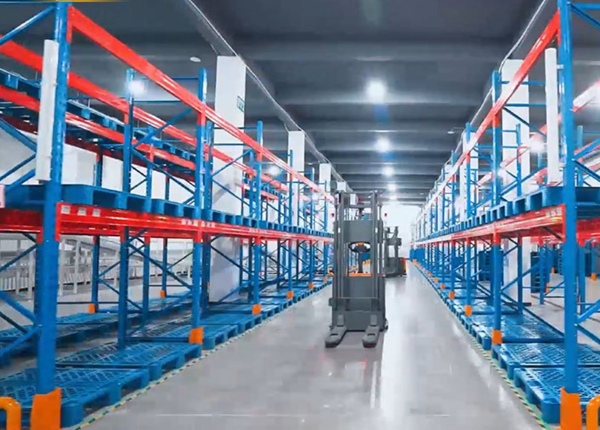
When AGVs serve high-bay racks, staging locations should be positioned so that pallets can enter and leave storage flows without unnecessary cross-traffic.
The design should consider the complete route from:
Receiving → staging → AGV pickup → rack aisle → storage position
and the reverse flow:
Storage position → rack aisle → AGV drop-off → staging → shipping
Optimizing only one section of this route can simply move the bottleneck to another location.
AGV travel lanes
Pickup positions
Drop-off positions
Manual forklift routes
Pedestrian areas
Emergency access
Temporary staging
Exception pallet area
Charging locations
Rack interfaces
The final layout should be reviewed with the AGV supplier before equipment placement is finalized.
Peak inbound flow
Peak outbound flow
Multiple simultaneous pallet arrivals
Full staging condition
Blocked staging position
Manual forklift interference
AGV waiting behavior
Exception pallet handling
Recovery after a task is cancelled
A staging area should be tested under realistic peak conditions rather than only during an empty-warehouse demonstration.












 Chinese
 English





