


Warehouse Workflow Automation Guide
Automating pallet putaway and retrieval involves more than sending an AGV from one point to another. The warehouse must define how pallets enter the automated area, how storage locations are assigned, how retrieval requests are prioritized, and how exceptions are resolved without losing inventory accuracy.
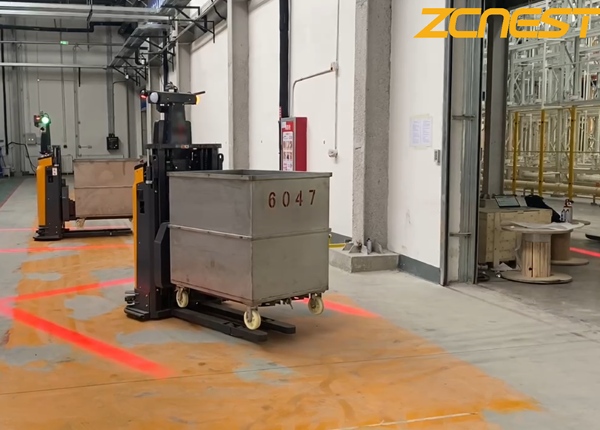
Before configuring routes or selecting vehicle quantities, identify where the AGV receives pallets and where it delivers them. Typical handover points include receiving stations, conveyors, production-independent staging areas, rack aisles, outbound staging zones, and manual forklift transfer points.
Each handover point needs a clear operating rule. The system should know when a pallet is physically ready, when a vehicle may approach, and when the receiving equipment has completed the transfer.
Define the physical position and permitted orientation of each pallet.
Specify how pallet presence is detected or confirmed.
Establish whether a conveyor, operator, or AGV controls the handover signal.
Determine where vehicles wait when a station is occupied.
Provide a safe recovery process for damaged or incorrectly positioned pallets.
Unclear handover rules often create queues and failed tasks even when the vehicle itself operates correctly.
LAYER 01
The upstream system confirms that the pallet is available, correctly identified, and positioned at the agreed pickup point. Damaged pallets or missing identification should enter an exception process instead of an automatic storage cycle.
LAYER 02
The WMS or designated inventory system determines the target storage location. Fleet control assigns the vehicle and manages route execution, traffic, and task status according to the agreed system architecture.
LAYER 03
After placement or retrieval, the system records the result and updates the appropriate task and inventory status. Failed movements must remain visible until the discrepancy is resolved.
Storage assignment should reflect warehouse policy rather than simply selecting the nearest empty rack. Depending on the operation, rules may consider product compatibility, batch or lot requirements, turnover rate, available capacity, storage restrictions, and the next expected retrieval.
Which system owns the inventory location record?
Are storage locations assigned before the AGV receives a task?
Can a location be reserved while another task is in progress?
How are urgent retrievals prioritized against routine putaway tasks?
Can the system prevent incompatible products or pallets from sharing restricted areas?
Avoid allowing multiple systems to independently change inventory locations without a defined reconciliation mechanism. Otherwise, the physical pallet location and the WMS record can diverge.
Normal movements are only part of the workflow. A production-ready system must also handle conditions that interrupt automatic execution.
Target location occupied: Decide whether to assign an alternative location, wait, or request operator intervention.
Pallet pickup failure: Record the failed attempt and prevent the system from falsely confirming the movement.
Missing or unreadable pallet ID: Route the pallet for identification instead of making an unverified inventory update.
Blocked route: Define whether the fleet system can reroute, wait, or escalate the obstruction.
Communication interruption: Establish safe vehicle behavior, task recovery, and status reconciliation after reconnection.
For each exception, assign responsibility to a specific role or system. An alarm without a recovery owner may stop the workflow longer than the original fault requires.
Track completed putaway and retrieval tasks, failed pickups, location conflicts, average cycle time, waiting time, manual interventions, and inventory discrepancies. Separate vehicle-related delays from upstream readiness problems and downstream congestion so the team can identify the real bottleneck.












 Chinese
 English





