


Warehouse Automation Cost Analysis
Electricity consumption per pallet move helps warehouse operators compare operating costs, estimate charging requirements, and evaluate automation performance. A useful calculation must define a completed move, measure energy over a representative operating period, and account for load, travel distance, lifting, waiting, and charging behavior.
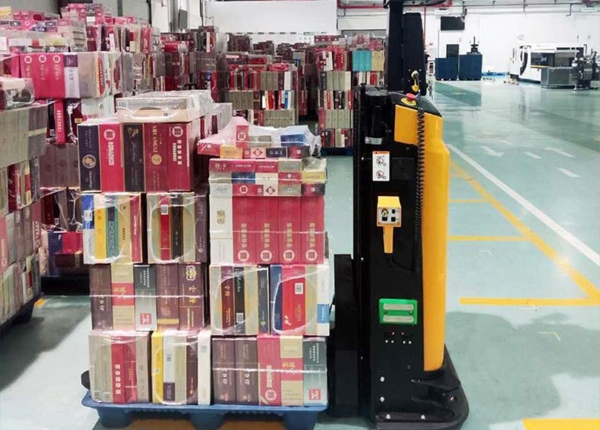
Before measuring energy consumption, define the unit of work. A move might mean transferring one pallet from a receiving station to a rack location, retrieving one pallet from storage, or transporting a pallet between two warehouse zones.
These activities can consume different amounts of energy. A high-bay putaway cycle involving lifting, precise positioning, and a long return route should not automatically be compared with a short, level-floor pallet transfer.
Define the starting point and destination.
Specify whether the cycle includes empty return travel.
Record whether lifting and lowering are part of the task.
Clarify whether waiting, standby, and charging losses are included.
Count completed moves, not merely dispatched or attempted tasks.
Energy consumption per completed pallet move is calculated by dividing the measured energy used during the defined operating period by the number of completed moves during that same period.
Energy per move (kWh) = Total energy consumed (kWh) ÷ Completed pallet moves
EXAMPLE CALCULATION
If the measured energy consumption is 24 kWh and the AGV completes 300 defined pallet moves during the same period, the average is 0.08 kWh per move. This is an illustrative calculation, not a performance specification for any particular AGV model.
The result is only meaningful when the energy measurement boundary and the definition of a completed move are consistent.
Energy measured at the battery and energy measured at the charging power supply are not necessarily equal. Charging losses, battery-management behavior, and auxiliary equipment can create differences between the two readings.
Battery data can help assess the energy used by the vehicle during operation. However, the available data, accuracy, sampling frequency, and treatment of battery charging or regeneration depend on the system.
A suitable energy meter at the charging supply can capture electricity drawn from the facility, potentially including charging losses. If several vehicles share charging equipment, the measurement method must separate or allocate consumption consistently.
For operating-cost analysis, facility-side electricity is often useful because it reflects the electricity purchased. For vehicle-efficiency comparisons, battery-side data may also be informative. State clearly which boundary is being used.
Travel distance: Longer routes generally require more traction energy, especially when empty return travel is included.
Load weight: Payload affects traction demand and may influence acceleration, deceleration, and travel settings.
Lifting activity: Lift height, load weight, and the number of lifting cycles influence energy use.
Waiting and standby: Long queues and idle periods may increase auxiliary consumption without increasing completed moves.
Traffic and route efficiency: Detours, repeated stopping, and congestion can reduce productive output.
Operating environment: Floor condition, temperature, gradients, and charging behavior can affect results.
When comparing two layouts or AGV models, keep the workload as similar as possible. Otherwise, a difference in measured consumption may reflect different task conditions rather than a genuine efficiency improvement.
Once energy consumption per move is known, multiply it by the applicable electricity rate to estimate the direct electricity cost of that move.
Illustrative example: 0.08 kWh per move × $0.15 per kWh = $0.012 per move.
This example represents electricity cost only. It excludes equipment purchase or lease costs, maintenance, batteries, charging infrastructure, software, labor, and facility changes. It should not be treated as the total operating cost of an AGV project.
For a broader comparison, calculate electricity cost alongside completed moves per shift, equipment availability, maintenance cost, and the cost of manual handling under equivalent operating conditions.
Measure across representative shifts that include typical loads, travel distances, lifting heights, charging periods, and waiting conditions. Record total energy and completed moves over the same time window, repeat the measurement, and document any unusual downtime. Use the pilot results to establish a site-specific baseline rather than relying solely on a theoretical estimate.














 Chinese
 English





