


WAREHOUSE IDENTIFICATION SYSTEMS
Reliable pallet identification is essential when AGV forklifts move inventory between receiving, storage and shipping. The right identification method depends on how pallets are labeled, where data must be captured and how the warehouse verifies each movement.
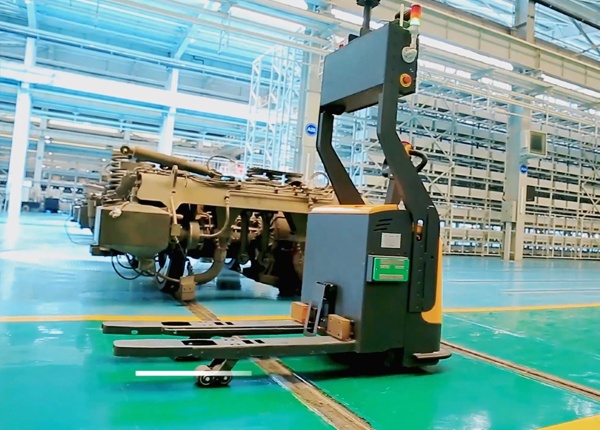
An AGV forklift can reach the correct storage area and still create an inventory problem if the pallet identity is missing, unreadable or inconsistent with the warehouse management system. Identification must therefore be planned alongside the vehicle workflow, not added as an isolated accessory.
Barcode labels and radio-frequency identification (RFID) can both support warehouse operations, but they work differently. Barcode systems generally require an optical reader to see the code. RFID uses radio communication between a reader and a compatible tag, subject to the tag, reader, environment and system configuration.
For warehouse decision-makers, the question is not which technology is universally better. It is which method provides reliable identification at the required points in the actual operating process.
Before comparing hardware, determine which objects and locations need identification. A warehouse may need to identify individual pallets, storage locations, transfer stations, inbound receipts or outbound orders. These are different requirements and may use different identification methods.
Pallet identity: connect the physical load to its inventory record.
Location identity: confirm the intended storage position or transfer point.
Task identity: associate a movement with the correct warehouse instruction.
Load status: distinguish available inventory from quality-hold or other restricted stock.
Transaction confirmation: record whether the physical movement has reached the required state.
A barcode or RFID tag does not automatically prove that a pallet has been placed in the correct position. The identification event must be connected to the relevant task, location and inventory rules.
Barcode identification is often practical when labels can be positioned consistently and readers can obtain a clear view. It is familiar to warehouse teams and can be integrated into established labeling processes.
Its limitations become important when labels are damaged, covered by wrapping, placed inconsistently or difficult to access from the reader's position. A code that is easy for a person to scan manually may not be readable from the vehicle's actual approach angle.
RFID can support identification without the same direct optical line of sight, but it is not automatically reliable in every environment. Performance depends on tag selection, mounting position, reader design, read-zone configuration and nearby materials. Metal surfaces and liquids can affect some RFID configurations, so testing is essential.
| Evaluation Factor | Barcode | RFID |
|---|---|---|
| Reading method | Optical code reading | Radio communication with a compatible tag |
| Label or tag placement | Requires a readable viewing position | Requires a suitable tag position and read zone |
| Common failure risks | Damage, dirt, obstruction and poor angle | Tag incompatibility, interference and unintended reads |
| Typical planning focus | Label consistency and optical access | Read-zone control and tag qualification |
Compare complete system costs rather than the unit price of labels or tags. Include readers, installation, integration, consumables, maintenance and the cost of failed identification events.
Identification performance depends on where and when a read occurs. A receiving station may provide a stable position for a barcode reader, while a different transfer point may have limited space or variable pallet orientation.
For each planned read point, document the expected vehicle position, pallet orientation, label or tag location, reading distance and required confirmation time. Include the full load, not just an empty pallet.
Test representative operating conditions such as wrapped loads, partially obscured labels, different pallet materials and normal variations in placement. For RFID, check whether neighboring tags can be read unintentionally. For barcode systems, verify that the reader can consistently obtain the intended code from the planned approach.
Record successful reads, failed reads, incorrect reads and recovery time. A high overall success rate can conceal repeated failures at one transfer station, so results should be reviewed by location and load type.
A failed read should trigger a defined process. The system needs to distinguish between an unreadable identifier, an unknown pallet, a mismatch with the task and a read that cannot be associated with a unique object.
Specify whether the vehicle should retry, request operator assistance, hold the task or move to an approved recovery location. The appropriate response depends on the warehouse's safety and inventory requirements.
Do not allow a failed identification event to be bypassed by assuming that the pallet is correct because it appears to be in the expected position. If manual confirmation is permitted, define who can perform it and how the resulting transaction is recorded.
Repeated failures should also be traceable. Useful records include the station, vehicle, task ID, time, identification result and recovery action. These records help determine whether the underlying cause is a label problem, reader configuration, data mismatch or physical process issue.
The identifier captured by the vehicle or station must map to a valid record in the warehouse system. Agree on the identifier format, uniqueness rules, data ownership and transaction sequence before implementation.
For example, if a pallet is relabeled during receiving, the warehouse system must ensure that the new identifier refers to the same inventory record. If an identifier is duplicated, the system needs a controlled way to resolve the conflict instead of assigning inventory based on an ambiguous match.
Clarify which system is responsible for creating identifiers, maintaining pallet records and confirming location changes. If the AGV fleet controller and warehouse management system use different identifiers for the same task, document the mapping and error-handling process.
Technology selection should consider both routine operating expenses and the cost of exceptions. Barcode labels may require replacement when damaged. RFID tags and readers may add hardware and configuration costs. Either approach can create additional labor if identification failures require manual intervention.
Estimate the expected number of identification events, the maintenance process, replacement rates and the operational impact of a failed read. Use test data where available rather than assuming that a technology will achieve perfect performance.
Define which pallets, locations and transactions require identification.
Confirm label or tag placement on actual loads.
Test reading performance at every relevant transfer point.
Measure failed reads and unintended reads under representative conditions.
Document retry, escalation and manual recovery procedures.
Confirm identifier formats and data ownership across systems.
Compare total operating costs, including exception handling.
Key checkpoint: Choose the identification method that works reliably at the actual point of operation. A technically capable reader cannot compensate for inconsistent labels, unclear data ownership or an undefined response to failed reads.
When requesting an AGV forklift proposal, provide examples of existing labels, pallet types, transfer stations and inventory identifiers. Explain which identification steps already exist and which must be automated.
Ask the supplier to identify required readers, tags, software interfaces and station modifications. Agree on test scenarios and measurable acceptance criteria before finalizing the design.
📖 AGV Forklift Guide — Essential manual for selection and safety.
⚙️ How AGV Systems Work — A deep dive into navigation and logic.
⚖️ AGV vs. AMR Comparison — Choosing the right technology for your facility.
💰 AGV Cost and ROI — Evaluating investment and payback periods.












 Chinese
 English





