

Scaling from 2 AGVs to 20 is not a linear process. Without a robust RCS (Robot Control System), your warehouse floor will suffer from "Digital Gridlock."
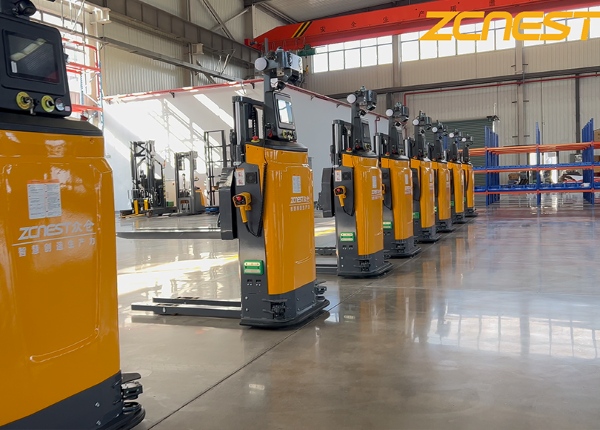
The Robot Control System is the "Air Traffic Controller" of your facility. It doesn't just tell a robot where to go; it tells it when to wait. ZCNEST’s proprietary RCS manages:
Collision Avoidance: Predicting path intersections 5 seconds before they occur and assigning "Right of Way."
Dynamic Task Re-allocation: If Robot A is low on battery, the RCS automatically shifts its task to the nearest idle Robot B.
Deadlock Resolution: Specialized logic for narrow corridors to ensure one robot backs into a "pocket" to let another pass.
The real power of fleet control comes from Bi-directional Data Flow. When an order arrives in your ERP, the ZCNEST RCS calculates the most efficient robot to deploy based on current location and battery status. This is the difference between a "motorized forklift" and a "smart warehouse."
ZCNEST provides scalable RCS licenses that can grow with your business—from a single cell to a multi-site global operation.
📖 AGV Forklift Guide — Essential manual for selection and safety.
⚙️ How AGV Systems Work — A deep dive into navigation and logic.
⚖️ AGV vs. AMR Comparison — Choosing the right technology for your facility.
💰 AGV Cost and ROI — Evaluating investment and payback periods.





 Chinese
 English