


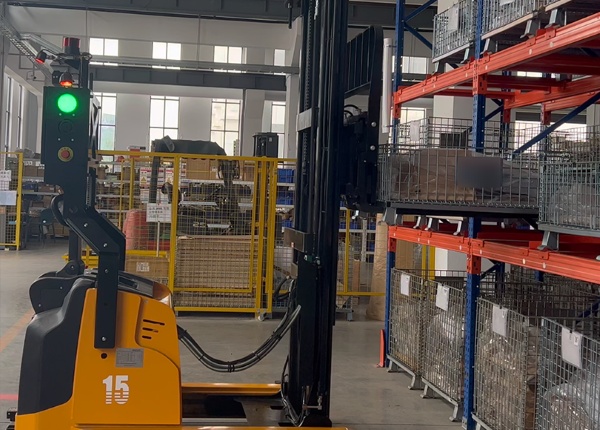
Why do two AGVs with the same top speed have different cycle times? The answer is Path Intelligence. At ZCNEST, we don't just follow lines; we solve spatial puzzles in real-time.
Standard AGVs stop at intersections to wait for "Right of Way." ZCNEST AGVs use Space-Time Lattice Planning:
1. Fluid Momentum: Instead of stopping, our robots adjust their speed profiles (coasting) to arrive at intersections exactly when the path is clear, maintaining kinetic energy and reducing battery drain.
2. Bezier Curve Turning: Rather than "Stop-Turn-Go," our robots execute smooth, high-speed curves that maximize stability while shaving seconds off every corner.
3. Deadlock Self-Resolution: In narrow VNA aisles, our fleet can "negotiate" movements, allowing one robot to yield into a pocket so others can pass, eliminating the need for human intervention when things get crowded.
The Efficiency Result: Optimized pathing algorithms can increase total facility missions-per-hour by 15-22% without increasing the physical speed of the robots. That is the ZCNEST software advantage.
📖 AGV Forklift Guide — Essential manual for selection and safety.
⚙️ How AGV Systems Work — A deep dive into navigation and logic.
⚖️ AGV vs. AMR Comparison — Choosing the right technology for your facility.
💰 AGV Cost and ROI — Evaluating investment and payback periods.





 Chinese
 English