


For most warehouse operators, the real question is not whether LiDAR SLAM works—it is whether the AGV will navigate reliably once the environment becomes **crowded, reflective, and constantly changing**. AGVs rarely fail in demo environments; they fail in chaotic, real-world aisles.
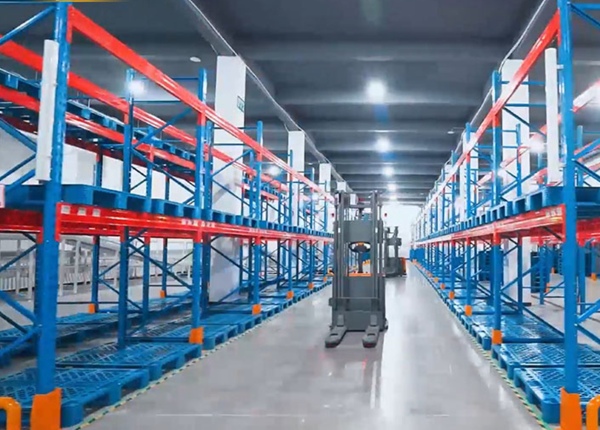
A mature LiDAR SLAM AGV does not treat every detected object as part of its permanent map. Instead, the navigation stack segmentates the environment into two distinct layers:
Static Features (The Core Map)
Walls, pillars, and fixed rack structures. These serve as the absolute localization references for calculation.
Dynamic Objects (Filtered Out)
Workers, moving forklifts, and temporary pallets. These are detected and dynamically filtered out as transient obstacles.
The Sensor Fusion Edge: Real-world "10mm precision" rarely relies on LiDAR alone. True stability is achieved by combining LiDAR data with **wheel encoders, IMU (Inertial Measurement Units), and cameras** to cross-verify positioning in real time.
Reflective surfaces remain one of the most common trouble areas for low-to-mid-range SLAM systems:
High-Gloss Epoxy Floors: Can create laser reflection noise, leading to false depth readings and sudden vehicle hesitation. Premium AGVs mitigate this using multi-echo filtering algorithms.
Glass Partitions: Laser beams pass through or reflect inconsistently, confusing the sensor. Industrial deployment teams solve this by adding frosted alignment strips or opaque safety tape near office glass boundaries.
While micro-corrections happen seamlessly during transit, a full re-localization failure (where the AGV "gets lost") typically points to major geometry blockages, severe plastic wrap reflection, or low-grade sensor hardware.
Fortunately, modern fleet management systems allow you to **remotely modify maps** without re-mapping the entire facility. You can update layout changes via software for:
Pallet staging zones & aisle routes.
Speed limits & temporary restricted zones.
Charging station relocations.
What Experienced Buyers Test Before Purchase:
Don't trust clean factory demos. Request a live proof-of-concept (PoC) testing the navigation stack under heavy pedestrian traffic, random pallet drops, and low-light transitions.
Share your aisle widths, floor materials, and forklift traffic density. Our engineering team will help analyze hidden layout risks before deployment.
Request a Free Layout Analysis →
📖 AGV Forklift Guide — Essential manual for selection and safety.
⚙️ How AGV Systems Work — A deep dive into navigation and logic.
⚖️ AGV vs. AMR Comparison — Choosing the right technology for your facility.
💰 AGV Cost and ROI — Evaluating investment and payback periods.





 Chinese
 English