

Standard pallets make automated forklift deployment relatively straightforward. The challenge begins when a warehouse uses plastic pallets, custom wooden pallets, steel skids or wire mesh containers with different bottom structures.
For a Chinese AMR forklift, the critical issue is not simply whether the forks can physically enter the pallet. The vehicle must also determine where the load is located, whether the fork entry is safe, whether the load is properly supported and whether the configured fork position matches the actual pallet design.
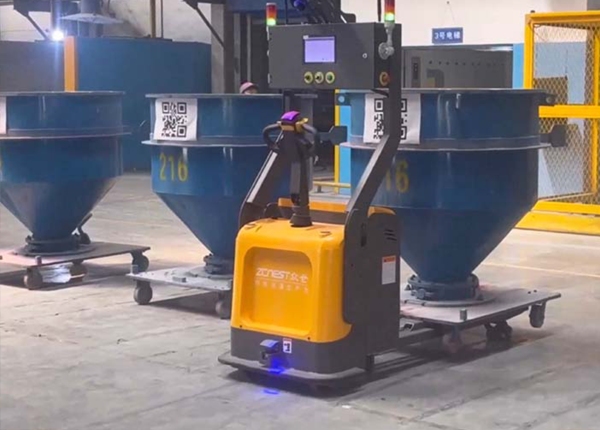
Before importing an AMR forklift for non-standard pallet handling, buyers should therefore evaluate the vehicle's mechanical dimensions, sensing technology, fork positioning accuracy and software configuration capabilities.
Potentially, but compatibility depends on the pallet's actual geometry.
Plastic pallets can have runner configurations that differ substantially from conventional wooden pallets. Some have three longitudinal runners, while others use multiple support feet or complex molded structures.
An automated forklift needs sufficient clearance for the forks to enter without contacting the pallet structure.
Important dimensions to verify include:
Overall pallet length and width
Fork entry height
Runner height
Runner spacing
Bottom clearance
Fork pocket dimensions
Maximum pallet deformation
Maximum load weight
Load center position
A pallet that can be handled by a manual forklift may still require additional validation for an autonomous forklift because the AMR must repeat the same insertion movement without an operator visually correcting the fork position.
Consider two pallets with identical external dimensions.
The first pallet may have large open fork pockets.
The second may have narrow openings created by closely spaced bottom runners.
Both pallets may be described as the same nominal size, but their automation compatibility can be completely different.
For this reason, a Chinese AMR supplier should evaluate the actual pallet drawing or physical sample rather than relying only on the pallet's nominal dimensions.
Steel transport skids create a different challenge because their surfaces, edges and reflectivity can differ considerably from conventional wooden pallets.
Depending on the AMR design, sensors may be used to determine:
Pallet or skid position
Fork-entry alignment
Load presence
Distance to the load
Fork position
Obstacle location
Whether the vehicle has reached the expected pickup position
However, sensor performance should not be judged simply by asking whether the vehicle has “vision.”
The important question is:
Which sensor performs which function?
A fleet may use a combination of laser scanners, cameras, fork-position sensors and other proximity or safety sensors.
For a custom steel skid, the supplier should demonstrate the complete pickup process under realistic warehouse conditions.
Ideally, provide the Chinese manufacturer with:
CAD drawing → dimensional specification → photographs → load information → physical sample
This gives the engineering team enough information to determine whether mechanical or software modifications are necessary.
This depends on the vehicle configuration.
A conventional autonomous forklift normally relies on correctly positioned forks to support a pallet or container. A wire mesh container may require a different attachment mechanism if the container cannot be safely supported by standard forks.
If a project requires hydraulic clamping, the engineering team should define the operating parameters rather than simply adding a hydraulic actuator.
Important parameters include:
Maximum container weight
Container dimensions
Center of gravity
Required clamping force
Minimum and maximum clamping stroke
Hydraulic pressure range
Clamp opening width
Required positioning accuracy
Emergency release behavior
The control system should also prevent excessive force from being applied to lightweight or deformable containers.
A wire mesh container can behave very differently from a rigid pallet.
Too little clamping force can allow the container to move.
Too much force can deform the container or damage its contents.
Therefore, the required pressure should be determined through engineering validation rather than using one universal setting for every load type.
This is one of the most useful capabilities to investigate when purchasing an autonomous forklift for mixed pallet environments.
Different pallet types may require different:
Approach speeds
Stopping positions
Fork heights
Fork spacing
Insertion depths
Acceleration profiles
Final positioning tolerances
A sophisticated fleet-management or vehicle-control system may allow these parameters to be associated with specific tasks, stations, pallet types or operating zones.
However, buyers should distinguish between user-configurable parameters and settings that require manufacturer engineering access.
If every modification requires the Chinese factory to remotely change the vehicle software, daily operational flexibility may be limited.
For non-standard pallets, the quality of the technical information provided during the RFQ can directly affect the accuracy of the proposed AGV configuration.
Prepare a pallet specification package containing:
Length
Width
Overall height
Bottom clearance
Runner dimensions
Runner spacing
Fork-entry dimensions
Minimum load
Maximum load
Typical load
Load center
Load distribution
Whether loads can overhang the pallet
Wood
Plastic
Steel
Wire mesh
Composite materials
Indoor or outdoor operation
Floor type
Floor flatness
Lighting conditions
Dust or moisture exposure
Rack or staging configuration
This information allows the Chinese engineering team to evaluate both the vehicle and the warehouse environment.
A manual forklift operator can visually correct the fork position while entering a pallet.
An autonomous forklift needs another mechanism.
Depending on the system design, the vehicle may use sensors and localization information to detect the pallet or target position and make controlled corrections.
If the alignment falls outside the configured tolerance, the vehicle may stop rather than force the forks into the pallet.
This is an important point when evaluating an AMR:
The goal is not simply to make the vehicle pick up a pallet. The goal is to make it recognize when a pallet cannot be safely picked up.
That distinction becomes particularly important with damaged pallets, irregular runners and partially obstructed fork pockets.
A factory acceptance test should include representative pallet types instead of testing only one standard pallet.
For example:
| Test Item | What to Verify |
|---|---|
| Standard wooden pallet | Normal fork entry |
| Plastic pallet | Runner clearance |
| Steel skid | Detection and alignment |
| Wire mesh container | Load stability |
| Damaged pallet | Exception handling |
| Off-center pallet | Alignment tolerance |
| Maximum payload | Lift and travel stability |
| Minimum payload | Detection reliability |
| Different fork-entry heights | Position control |
| Repeated pickup cycles | Long-term repeatability |
Testing should be performed with the actual pallet designs expected at the customer's warehouse.
A successful single pickup does not necessarily demonstrate reliable automation.
For B2B deployment, the more meaningful metric is the successful pickup rate over repeated cycles.
If your warehouse uses non-standard industrial pallets, add explicit technical requirements to the RFQ.
Ask the manufacturer to confirm:
Compatible pallet dimensions
Minimum fork-entry clearance
Maximum pallet weight
Maximum load center
Fork positioning accuracy
Fork spacing adjustment range
Available pallet-detection sensors
Supported pallet-recognition methods
Configurable insertion speed
Configurable fork height
Configurable insertion depth
Handling procedure for misaligned pallets
Handling procedure for damaged pallets
Whether parameters can be changed locally
Whether custom pallet profiles can be stored in the software
Whether the supplier will test customer pallets before production
For a customized AMR forklift, these requirements should be agreed upon before manufacturing begins, not after the vehicles arrive at the warehouse.
The biggest mistake when automating non-standard pallets is selecting an AMR based only on payload capacity and lifting height.
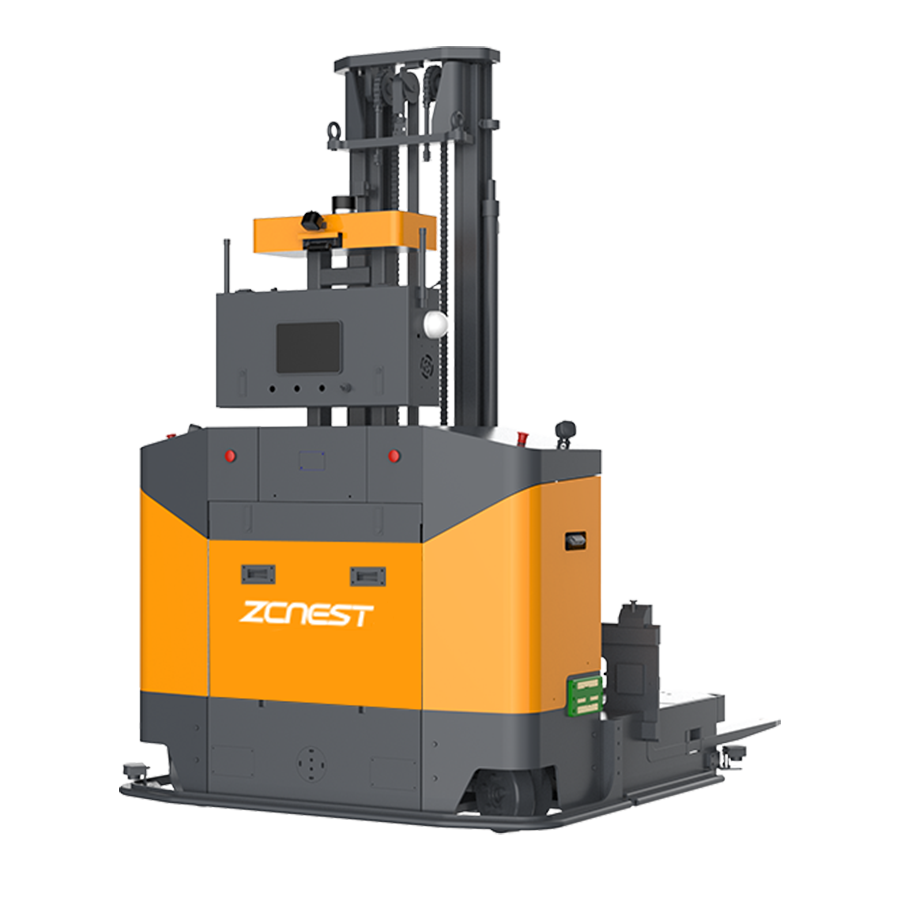
A 1.5-ton autonomous forklift may have more than enough lifting capacity but still be unsuitable if its fork dimensions, entry clearance or sensing configuration does not match the customer's pallets.
The better approach is to start with the actual pallet and load:
Pallet geometry → Load characteristics → Fork configuration → Sensor requirements → Software parameters → Repeated pickup testing
This gives the Chinese manufacturer a clear engineering target and gives the warehouse buyer measurable acceptance criteria before the fleet is shipped.
FREE ENGINEERING SUPPORT Stop Gambling on Generic Platforms. Get an AGV/AMR Tailored to Your Warehouse.Buying automated guided vehicles involves complex safety standards (CE/ANSI), navigation setups (Laser SLAM), and ERP system integration. Don't risk your factory safety with middle-men. ✓ 100% Direct Factory: Customized payload up to 5 Tons. ✓ Free CAD Simulation: Send us your layout, and our engineers will simulate the optimal AGV routes. ✓ Global Support: Overseas installation guidance & local maintenance partners. |
📖 AGV Forklift Guide — Essential manual for selection and safety.
⚙️ How AGV Systems Work — A deep dive into navigation and logic.
⚖️ AGV vs. AMR Comparison — Choosing the right technology for your facility.
💰 AGV Cost and ROI — Evaluating investment and payback periods.





 Chinese
 English