


Importing an AGV fleet from China does not end when the vehicles arrive at the warehouse.
A more practical question for the maintenance team is:
What parts should we keep locally so a worn component does not stop an entire automated fleet?
Mechanical wear components deserve particular attention because they are exposed to continuous movement, load cycles, floor conditions and daily warehouse traffic.
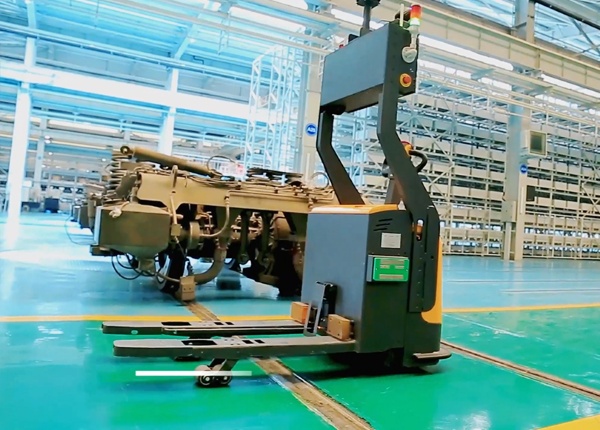
For a Chinese AGV fleet, the most important items to evaluate include drive tires, steering wheels, hydraulic hoses, seals, lubricants and other regularly serviced mechanical components.
The right spare-parts strategy is not necessarily to purchase large quantities of everything. Instead, the goal is to identify high-wear, low-cost components that can stop vehicle operation if they are unavailable.
There is no universal number because tire consumption depends heavily on:
Fleet size
Daily operating hours
Vehicle payload
Travel distance
Floor surface
Turning frequency
Acceleration and braking settings
Tire compound
Ambient temperature
Warehouse operating conditions
For an initial fleet purchase, the supplier should provide the expected replacement interval and recommended spare quantity based on the actual vehicle configuration.
A practical approach is to divide spare tires into three categories:
These should be available locally because a failure can immediately remove an AGV from operation.
Examples may include:
Drive tires
Steering wheels
Load wheels
Wheel bearings
Common seals
These can be stocked according to the manufacturer's maintenance schedule.
Examples include:
Hydraulic hoses
Hydraulic seals
Lubricants
Filters
Bushings
These may not need to be held in large quantities locally.
Instead, confirm:
Manufacturer availability
Part number
Lead time
Emergency shipping options
Local equivalent availability
The supplier should provide a recommended spare-parts list for the entire fleet, rather than leaving the warehouse to determine quantities independently.
Not necessarily.
If several vehicles use the same wheel and tire specification, a centralized spare inventory can be more efficient.
For example, if a warehouse operates multiple AGVs using the same drive-wheel assembly, the maintenance department can maintain a common pool of replacement units instead of assigning a separate spare set to every vehicle.
However, the spare-parts list should distinguish between:
Complete wheel assembly
and
Replaceable wear component.
A complete wheel assembly may include:
Tire
Wheel hub
Bearing
Fasteners
Drive interface
Keeping complete assemblies can significantly reduce repair time, but they occupy more inventory space and cost more.
For critical fleet vehicles, having at least some complete replacement assemblies available may be worthwhile.
Some hydraulic hoses and fittings may correspond to widely used industrial standards, but the exact specification must be verified for each AGV model.
Do not assume that a hose can be locally replaced simply because its diameter looks standard.
The maintenance team should record:
Hose internal diameter
Hose length
Working pressure
Burst pressure
Temperature rating
End fitting type
Thread standard
Fitting orientation
Hose material
Minimum bend radius
This information should be included in the supplier's spare-parts documentation.
An apparently compatible hose can still be unsuitable if its pressure rating, fitting thread or temperature specification is incorrect.
For autonomous forklifts, hydraulic components can also affect lift performance and load handling.
Therefore, replacement parts should meet the manufacturer's specified technical requirements rather than being selected solely according to physical dimensions.
Potentially, and this can be an important way to reduce long-term maintenance lead times.
Before importing the fleet, ask the Chinese manufacturer whether commonly replaceable hydraulic components can be sourced from international suppliers.
Request the original:
Manufacturer
Part number
Specification
Material
Pressure rating
Connection standard
Replacement interval
If the component is a standard industrial item, the US maintenance team may be able to maintain a local source.
If it is a proprietary component, it is better to include additional units in the initial spare-parts order.
Do not select gear oil solely by choosing a familiar industrial brand.
The correct lubricant depends on the gearbox and drive-system design.
The Chinese manufacturer should specify at least:
Lubricant type
Viscosity grade
Performance classification
Operating temperature range
Required quantity
Initial fill quantity
Replacement interval
Approved equivalent products
For example, the supplier may specify a particular viscosity grade or gearbox lubricant standard.
If the manufacturer permits equivalent products, the maintenance team can potentially purchase an approved local lubricant instead of importing small quantities from China.
However, the manufacturer's maintenance documentation should remain the primary reference.
This depends on the actual sensor design.
A laser-based navigation system does not necessarily have a separately replaceable “lens” that maintenance personnel can swap like a conventional camera lens.
The relevant spare may instead be:
Protective optical cover
Scanner window
Complete laser scanner
Camera module
Sensor assembly
This distinction is important.
If the navigation sensor itself is a critical proprietary component, keeping one complete replacement unit locally may provide much more value than storing several inexpensive optical covers.
The maintenance team should therefore obtain the exact sensor BOM from the Chinese manufacturer.
For a typical autonomous forklift fleet, the initial mechanical spare-parts review should cover:
| Component | Priority | Reason |
|---|---|---|
| Drive tires | High | Continuous wear |
| Load wheels | High | Frequent floor contact |
| Steering wheels | High | Mechanical wear |
| Wheel bearings | High | Can immobilize vehicle |
| Hydraulic hoses | High | Failure can stop lifting |
| Hydraulic seals | Medium | Planned maintenance |
| Gear oil | Medium | Routine maintenance |
| Bushings | Medium | Wear over operating cycles |
| Fasteners | Medium | Useful for field repairs |
| Optical covers | Medium | Environmental damage |
| Complete sensor assembly | High | Critical replacement lead time |
| Complete drive assembly | Fleet-dependent | Higher-cost critical spare |
The actual list should be customized against the vehicle's BOM.
Before shipment, request a complete spare-parts catalog containing:
Part number
Part name
Manufacturer
Specification
Material
Dimensions
Compatible vehicle model
Recommended replacement interval
Inspection interval
Lubrication requirements
Installation procedure
Required tools
Torque specifications where applicable
Unit price
Minimum order quantity
Estimated lead time
Recommended stock quantity
International shipping method
Whether the part can be sourced locally
This information allows the US maintenance department to determine which components should be purchased from China and which can be obtained domestically.
A useful way to calculate the initial stock level is to consider three variables:
Fleet size + expected consumption + supplier lead time
For example, a warehouse with a small fleet and very short Chinese replacement lead time may need less inventory than a 24/7 distribution center where one disabled AGV can create a significant operational bottleneck.
Critical components should receive a higher inventory priority when:
They can stop the entire vehicle
They have long international lead times
They are proprietary
They are difficult to substitute locally
They are relatively inexpensive compared with the cost of downtime
This means a $500 critical component can sometimes deserve more attention than a $5,000 component that is rarely needed and readily available.
For a new Chinese AGV deployment, this can be an efficient approach.
Adding an initial spare-parts package to the original purchase order avoids having to arrange a separate international shipment immediately after commissioning.
The initial package can focus on:
High-wear + critical + long-lead-time components.
The supplier can then provide a recommended quantity based on the fleet size and expected operating hours.
It is also worth negotiating whether the manufacturer can provide a discounted startup spare-parts package as part of the AGV contract.
A simple decision framework is:
Choose local inventory when the component is:
Frequently replaced
Easy to store
Relatively inexpensive
Available from multiple suppliers
Critical to vehicle uptime
Consider importing additional units when the component is:
Proprietary
Vehicle-specific
Difficult to identify locally
Long-lead-time
Critical to AGV operation
For expensive, low-failure components, consider keeping one strategic spare rather than maintaining large inventory.
This is particularly relevant to electronic and sensor assemblies.
The best time to build a spare-parts inventory is before the first vehicle arrives, not after the first breakdown.
Ask the Chinese manufacturer to provide the complete BOM, recommended spare list and maintenance schedule during the procurement stage.
Then classify each component according to:
Wear frequency → Failure impact → Replacement lead time → Local availability → Required stock level
For a Chinese AGV fleet, this approach can reduce emergency air freight, shorten maintenance downtime and give the local warehouse team greater independence from overseas technical support.
A well-planned spare-parts inventory is therefore not simply a maintenance expense. It is part of the uptime strategy for the entire automated warehouse.
FREE ENGINEERING SUPPORT Stop Gambling on Generic Platforms. Get an AGV/AMR Tailored to Your Warehouse.Buying automated guided vehicles involves complex safety standards (CE/ANSI), navigation setups (Laser SLAM), and ERP system integration. Don't risk your factory safety with middle-men. ✓ 100% Direct Factory: Customized payload up to 5 Tons. ✓ Free CAD Simulation: Send us your layout, and our engineers will simulate the optimal AGV routes. ✓ Global Support: Overseas installation guidance & local maintenance partners. |
📖 AGV Forklift Guide — Essential manual for selection and safety.
⚙️ How AGV Systems Work — A deep dive into navigation and logic.
⚖️ AGV vs. AMR Comparison — Choosing the right technology for your facility.
💰 AGV Cost and ROI — Evaluating investment and payback periods.











 Chinese
 English




