


Warehouse floors rarely remain perfectly uniform throughout their entire operating area.
Expansion joints, metal transition plates, concrete cracks, damaged sections and loading-area ramps can all create sudden changes in floor elevation. For an autonomous forklift, these conditions can affect not only ride quality but also localization, load stability, braking and navigation accuracy.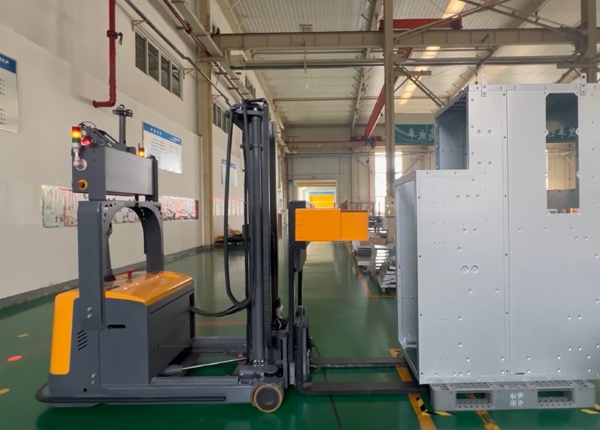
When importing an automated forklift from China, warehouse operators should therefore evaluate the vehicle's floor-clearance capability and the facility's actual floor conditions together.
A 10 mm threshold, for example, should not automatically be considered safe or unsafe. The answer depends on the threshold geometry, approach angle, wheel configuration, ground clearance, vehicle speed and manufacturer's validated operating limits.
Normally, a small floor-height transition does not directly “erase” a laser SLAM map.
Laser localization primarily relies on environmental features such as:
Rack columns
Walls
Structural posts
Fixed equipment
Other permanent reference features
A floor transition may instead affect the vehicle mechanically.
When a drive wheel crosses a raised metal plate, the vehicle can experience:
Vertical vibration
Wheel-speed variation
Chassis movement
Temporary pitch or roll
Changes in wheel-ground contact
These effects can influence odometry and sensor measurements, particularly if the vehicle travels over the transition at excessive speed.
The important distinction is:
A floor threshold is usually a vehicle-dynamics problem before it becomes a mapping problem.
A properly configured autonomous forklift should combine localization information with other positioning inputs rather than relying exclusively on wheel odometry.
Two 10 mm thresholds can behave very differently.
A gradual beveled transition distributes the vertical movement over a longer distance.
A sharp 10 mm vertical edge creates a much more abrupt impact.
Therefore, the RFQ should specify not only the height of the transition but also its geometry.
Ask the manufacturer to validate:
Maximum threshold height
Maximum vertical discontinuity
Maximum transition angle
Minimum wheel diameter
Minimum ground clearance
Maximum crossing speed
Maximum payload during crossing
These parameters should be confirmed for the actual AGV model.
An autonomous forklift contains sensitive electronic components, including:
Industrial computers
Motor controllers
Battery-management electronics
Communication modules
Navigation hardware
Safety controllers
The vehicle chassis and mounting system therefore need to withstand the vibration generated during normal operation.
Depending on the vehicle design, protection can involve:
Mechanical isolation
Shock-absorbing mounts
Flexible cable routing
Reinforced chassis structures
Sealed electrical enclosures
Vibration-resistant connectors
However, buyers should not assume that a vehicle is suitable for rough floors simply because it has a heavy steel chassis.
The more important question is whether the manufacturer has specified and validated the vehicle's operating limits.
For a serious industrial deployment, request the manufacturer's:
Operating vibration specifications
Shock specifications
Permitted floor conditions
Maximum obstacle/threshold height
Recommended travel speed over uneven areas
Payload limitations on uneven surfaces
This information is much more useful than a general statement such as “the AGV can operate on concrete floors.”
It depends on the size and geometry of the defect.
A small surface crack may have little effect on a warehouse AGV.
A deep or widened crack can create a much more significant problem if a wheel enters the opening or if the crack produces a vertical displacement between two sections of concrete.
The maintenance team should distinguish between:
Surface roughness
and
vertical floor displacement.
A rough but continuous surface may be acceptable for a vehicle designed for industrial floors.
A sudden vertical step can be much more demanding.
Before deployment, survey the actual AGV routes for:
Cracks
Potholes
Expansion joints
Floor transitions
Damaged concrete
Uneven repair patches
Drainage channels
Dock transitions
Metal plates
Record the width and depth of significant defects and, most importantly, any vertical displacement.
A floor survey is particularly important for high-speed routes because repeated impacts can increase mechanical wear over time.
The vehicle's response depends on its mechanical design and control strategy.
A properly engineered AGV should remain within its specified operating envelope.
If a surface defect exceeds the vehicle's allowable operating conditions, the correct solution is generally not to rely on the navigation software to compensate for it.
Instead, the warehouse may need to:
Repair the floor
Install a transition plate
Reduce vehicle speed
Restrict the route
Change the AGV path
Establish a dedicated crossing zone
This is especially important when the AGV is carrying a high or heavy load.
Uneven flooring can produce additional vehicle motion, which may affect load stability even when the navigation system remains functional.
There is no single maximum slope that applies to every Chinese automated forklift.
The allowable slope depends on factors such as:
Vehicle type
Payload
Load center
Wheel configuration
Drive motor torque
Brake system
Tire material
Surface friction
Ramp length
Direction of travel
Whether the vehicle is loaded or unloaded
For this reason, avoid specifying a generic value such as “5%” or “10%” unless it appears in the manufacturer's technical specification for the exact vehicle.
A slope percentage can be calculated from the change in elevation relative to horizontal travel.
For example, a 5% slope means approximately 5 units of elevation change for every 100 units of horizontal distance.
For an AGV project, however, the calculated slope is only one part of the evaluation.
The manufacturer should confirm the maximum allowable grade under the actual payload and operating conditions.
A heavily loaded automated forklift behaves differently from an empty vehicle.
When carrying a high pallet load, the system must account for:
Increased vehicle mass
Increased braking distance
Load-center effects
Mast dynamics
Traction requirements
Grade-climbing capability
Grade-descending capability
A warehouse should therefore avoid evaluating a ramp only with an empty AGV.
The acceptance test should include the intended maximum operating payload.
For a high-lift application, the evaluation should also consider whether the load is carried at different lift heights.
Yes.
Autonomous forklifts commonly use wheel motion information as one source of vehicle-position estimation.
If a drive wheel loses traction, the measured wheel rotation may no longer correspond exactly to the vehicle's actual movement.
Potential causes include:
Dust
Water
Oil
Polished concrete
Loose debris
Uneven surfaces
Excessive acceleration
Excessive slope
A robust autonomous navigation system should have additional localization information available to correct accumulated odometry errors.
However, no navigation algorithm should be treated as a substitute for adequate floor conditions.
Good localization + poor floor conditions is not a reliable automation strategy.
In many projects, yes.
Floor preparation can be significantly cheaper than trying to compensate for poor floor conditions through vehicle modifications.
Before placing the final AGV order, inspect:
Check:
Longitudinal slope
Cross slope
Cracks
Expansion joints
Thresholds
Potholes
Surface wear
Oil contamination
Water accumulation
Pay particular attention to:
Dock plates
Trailer transitions
Ramp interfaces
Door thresholds
Drainage channels
Concrete repairs
High-speed AGV routes deserve stricter attention because repeated impacts and traction changes can affect:
Wheel wear
Bearings
Chassis vibration
Load stability
Localization performance
Emergency stopping behavior
A useful RFQ package should include more than a CAD drawing.
Provide:
1. Floor plan
Show all intended AGV routes.
2. Floor construction
Specify concrete type and surface condition where available.
3. Floor flatness data
Provide measured flatness information rather than simply stating “level floor.”
4. Threshold locations
Mark every significant transition.
5. Slope information
Provide measured gradients for ramps and sloped areas.
6. Floor defects
Mark cracks, pits, expansion joints and repaired areas.
7. Environmental conditions
Identify areas exposed to:
Water
Oil
Dust
Temperature changes
Outdoor conditions
8. Operating conditions
Specify:
Maximum payload
Travel speed
Operating hours
Number of daily cycles
This allows the Chinese engineering team to determine whether the standard vehicle is suitable or whether additional mechanical or software configuration is required.
Do not rely only on a factory demonstration on a perfectly smooth floor.
Include representative floor conditions in the site acceptance test.
For example:
| Test Condition | What to Verify |
|---|---|
| Smooth concrete | Baseline performance |
| Expansion joint | Crossing stability |
| Metal transition | Wheel impact and tracking |
| Small floor crack | Continuous navigation |
| Repaired concrete | Ride quality |
| Ramp | Grade performance |
| Maximum payload | Stability and traction |
| Maximum route speed | Vehicle control |
| Wet transition area | Traction |
| Repeated crossings | Mechanical durability |
The test should measure more than whether the vehicle successfully crossed the area once.
Monitor:
Navigation deviation
Wheel slip
Vehicle vibration
Load stability
Travel speed
Fault alarms
Emergency stopping behavior
Repeated-cycle reliability
For warehouses with uneven floors, include these questions in the RFQ:
What is the maximum permitted floor slope?
What is the maximum vertical floor discontinuity?
What is the maximum recommended threshold height?
Can the AGV cross beveled metal transition plates?
What is the minimum ground clearance?
What is the minimum wheel diameter?
What floor flatness specification is required?
What surface coefficient of friction is required?
What happens if wheel slip occurs?
How does localization compensate for odometry error?
What payload is permitted when crossing a threshold?
What speed reduction is recommended on uneven surfaces?
What vibration/shock specifications apply to the vehicle?
Can the manufacturer conduct an on-site floor survey?
Can the actual warehouse floor be included in the FAT/SAT?
Getting these answers before manufacturing begins is much safer than discovering floor incompatibility after the AGVs have arrived.
An autonomous forklift does not operate independently from its environment.
The vehicle, tires, floor, navigation system, payload and operating speed all interact.
For a Chinese AGV import project, the correct evaluation sequence is:
Floor survey → AGV technical limits → Route design → Payload validation → Speed configuration → On-site testing
A 10 mm threshold, a concrete crack or a warehouse ramp should therefore never be judged using a generic AGV specification alone.
The final acceptance criteria should be based on the actual vehicle model, actual payload, actual floor condition and actual operating route.
FREE ENGINEERING SUPPORT Stop Gambling on Generic Platforms. Get an AGV/AMR Tailored to Your Warehouse.Buying automated guided vehicles involves complex safety standards (CE/ANSI), navigation setups (Laser SLAM), and ERP system integration. Don't risk your factory safety with middle-men. ✓ 100% Direct Factory: Customized payload up to 5 Tons. ✓ Free CAD Simulation: Send us your layout, and our engineers will simulate the optimal AGV routes. ✓ Global Support: Overseas installation guidance & local maintenance partners. |
📖 AGV Forklift Guide — Essential manual for selection and safety.
⚙️ How AGV Systems Work — A deep dive into navigation and logic.
⚖️ AGV vs. AMR Comparison — Choosing the right technology for your facility.
💰 AGV Cost and ROI — Evaluating investment and payback periods.





 Chinese
 English